Anhalt Castle
Anhalt Castle stands as a significant medieval fortress near Harzgerode in Germany, deeply intertwined with the history of the House of Ascania. Founded in the early 12th century by Count Otto of Ballenstedt, this hill castle served as the ancestral home of a dynasty that played a pivotal role in shaping the political landscape of central Germany.
The castle's origins trace back to a period of intense regional conflict. The first recorded mention of Anhalt Castle dates to 1140, amid the struggles of Otto’s son, Albert the Bear, against the rival Welf dynasty. During these hostilities, forces allied with the Archbishop of Magdeburg and Margrave Conrad of Meissen attacked and destroyed the original fortress. This early structure was strategically positioned on the Großer Hausberg, a hill nearly 400 meters above sea level, overlooking the Selke valley. Its location provided commanding views and defensive advantages typical of hill castles.
Architectural evolution and medieval expansion
Following Albert the Bear’s rise to power post-1147, Anhalt Castle was comprehensively rebuilt and expanded. The reconstruction transformed it from a modest fortress into a considerable complex rivaling other prominent castles such as Wartburg Castle in Thuringia. The castle became one of the three main residences of the Ascanian family, alongside Ballenstedt and Aschersleben, underscoring its importance as a political and military center.
The castle’s architecture is notable for its predominant use of brick construction, an uncommon choice in the region during the 12th century when stone and timber were more typical. The initial structure featured a large round residential tower approximately 18 meters in diameter, serving as a central living and defensive space.
Later expansions included extensive defensive earthworks such as a dry moat and an outer rampart known as a Vorwall, stretching over 543 meters. These fortifications enhanced the castle’s defensibility and reflected evolving military architecture trends of the High Medieval period.
Historical significance and political legacy
In 1215, the title Prince of Anhalt was officially associated with the castle, marking its elevated status within the Holy Roman Empire. The name "Anhalt" gradually extended from the fortress to the ruling family and the surrounding territory, cementing the castle’s role in regional identity formation.
Following the division of the Principality of Anhalt in 1252, the castle became the main seat of the older Aschersleben line of the Ascanian family. However, this line ended in 1315, leading to the castle’s decline. Over subsequent centuries, Anhalt Castle was gradually abandoned, paralleling the desertion of the nearby village of Anhalt, first mentioned in 1311 and deserted by the mid-15th century.
Archaeological rediscovery and preservation efforts
Interest in Anhalt Castle revived in the 19th century, notably through the efforts of Duke Alexius of Anhalt-Bernburg, who initiated archaeological excavations starting in 1822. These early efforts cleared much of the ruins and included the construction of a distinctive neo-Gothic well house over the castle’s original well, a structure that remains a visible landmark today.
Further archaeological investigations between 1901 and 1909, led by surveyor Brinckmann and architect Starke, provided detailed studies of the castle’s layout and remnants. In 2012, restoration work preserved significant portions of the ruins, coinciding with the 800th anniversary of the Anhalt principality, enhancing public access and historical interpretation.
Architectural remains and site features
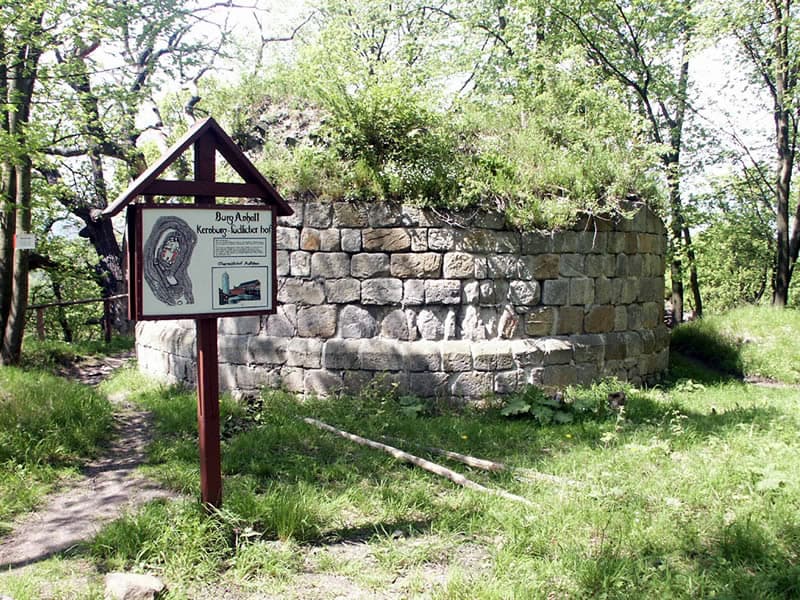
Today, visitors to Anhalt Castle can explore surviving sections of the castle walls, including parts of the chapel and remains of residential buildings. The base of the bergfried or main tower rises about three meters and is covered in vegetation, hinting at its former role as a fortified lookout and last refuge.
Excavations around the castle have uncovered traces of the deserted village of Anhalt, including farmstead remains, well depressions, and a rubble mound marking the location of the village church. Among the notable archaeological finds is a smelting furnace dating to the 12th or 13th century, indicating local iron ore processing activities that contributed to the regional economy.
The castle’s location on the Großer Hausberg offers panoramic views of the Selke valley, emphasizing its strategic importance. The site is accessible via hiking trails, with a checkpoint near the former neck ditch, a defensive trench that once protected the castle’s entrance.
Neo-Gothic well house
The neo-Gothic well house constructed by Duke Alexius in the 19th century stands as a unique architectural feature on the site. This small structure symbolizes the early modern rediscovery and preservation efforts, blending historical reverence with the Romantic architectural revival popular at the time.
Cultural heritage and visitor experience
Anhalt Castle remains a poignant symbol of the House of Ascania’s legacy and the medieval history of the Harz region. Its ruins provide valuable insights into medieval fortification techniques, regional politics, and the evolution of castle architecture in central Germany.
Visitors today can explore the ruins along marked hiking routes, experiencing the castle’s historical atmosphere and scenic surroundings. The site’s partial restoration and archaeological interpretation make it an important destination for those interested in medieval history, architecture, and German heritage.
Frequently asked questions (FAQ)
- How do I get to Anhalt Castle?
- Anhalt Castle is located near Harzgerode in Saxony-Anhalt, Germany. It is accessible by car and via hiking trails from the town, with parking available nearby.
- What is the best time to visit Anhalt Castle?
- The best time to visit Anhalt Castle is during the spring through early autumn months when hiking trails are open and the weather is favorable for exploring the ruins and surrounding landscape.
- Is Anhalt Castle suitable for families and children?
- Yes, the castle ruins are accessible via well-marked hiking paths suitable for families. Children can enjoy exploring the remains and learning about medieval history in an engaging outdoor setting.
- Can I enter the castle ruins freely?
- Yes, Anhalt Castle ruins are open to the public free of charge. Visitors can explore the site independently during opening hours without guided tours, although some informational signage is available.
- What architectural features are notable at Anhalt Castle?
- Notable features include the remains of the round residential tower, the bergfried base, the chapel ruins, and the neo-Gothic well house from the 19th century, illustrating different historical phases of the site.
Photo gallery

Information
Opening hours
9:00-17:00, daily
Ticket prices
Free
Current owner
State museum
Loading map...
Visitor reviews
No reviews yet. Been here? Write the first review and help other travelers!
Write the first reviewVisited this castle? Share your experience
Your review helps other travelers and adds first-hand knowledge to our encyclopedia.