Old Castle
The Old Castle (Alte Burg) in Koblenz stands as a remarkable testament to the city's rich historical tapestry, blending Roman foundations with medieval fortifications and Baroque architectural enhancements. Situated on the banks of the Moselle River near the Baldwin Bridge, this hill castle exemplifies centuries of architectural evolution and strategic military significance. Today, it houses the city archives and remains a prominent cultural landmark within the Rhineland-Palatinate region.
Roman origins and early medieval foundations
The site of the Old Castle is steeped in history that dates back to the 4th century when a Late Roman city wall and a round tower were constructed here as part of the city's defenses. These Roman remnants form the foundation upon which later medieval structures were built, illustrating a continuous occupation and strategic importance of the location. The castle's tall foundations incorporate Roman masonry, showcasing the reuse of ancient materials in medieval construction.
Medieval transformation and fortification
In the 12th century, the von der Arken family established a Romanesque residence on the site, marking the castle's first medieval phase. This residence was a significant local stronghold, utilizing the robust Roman foundations to assert control over the surrounding area. By 1277, Archbishop Henry II of Finstingen transformed the residence into a coercion castle to suppress rising demands for independence by the citizens of Koblenz. This conversion was completed by 1307, integrating the castle into the city's defensive network with a broad, water-filled moat and an enceinte (ring wall).
Role in archiepiscopal power struggles
Throughout the 14th century, the Old Castle was central to the archbishops' efforts to maintain control over Koblenz. Archbishop Diether of Nassau used the castle as a military base to subdue the city in 1304. Later, Archbishop Baldwin of Luxemburg initiated the construction of the Baldwin Bridge in 1342, enhancing the castle's connectivity and strategic importance. Under Archbishop Otto von Ziegenhain, additional fortifications such as a western round tower and a bridge gate were added, further strengthening the castle's defensive capabilities.
Architectural evolution and Baroque renovations
The castle underwent numerous expansions and reconstructions over the centuries, notably under Archbishops Baldwin of Luxembourg, Otto von Ziegenhain, and Richard von Greiffenklau zu Vollrads. By the early 18th century, the castle ceased to function as a residence and was rented out. Starting in 1779, its fortifications were gradually dismantled, reflecting shifts in military technology and urban development.
Baroque architectural features
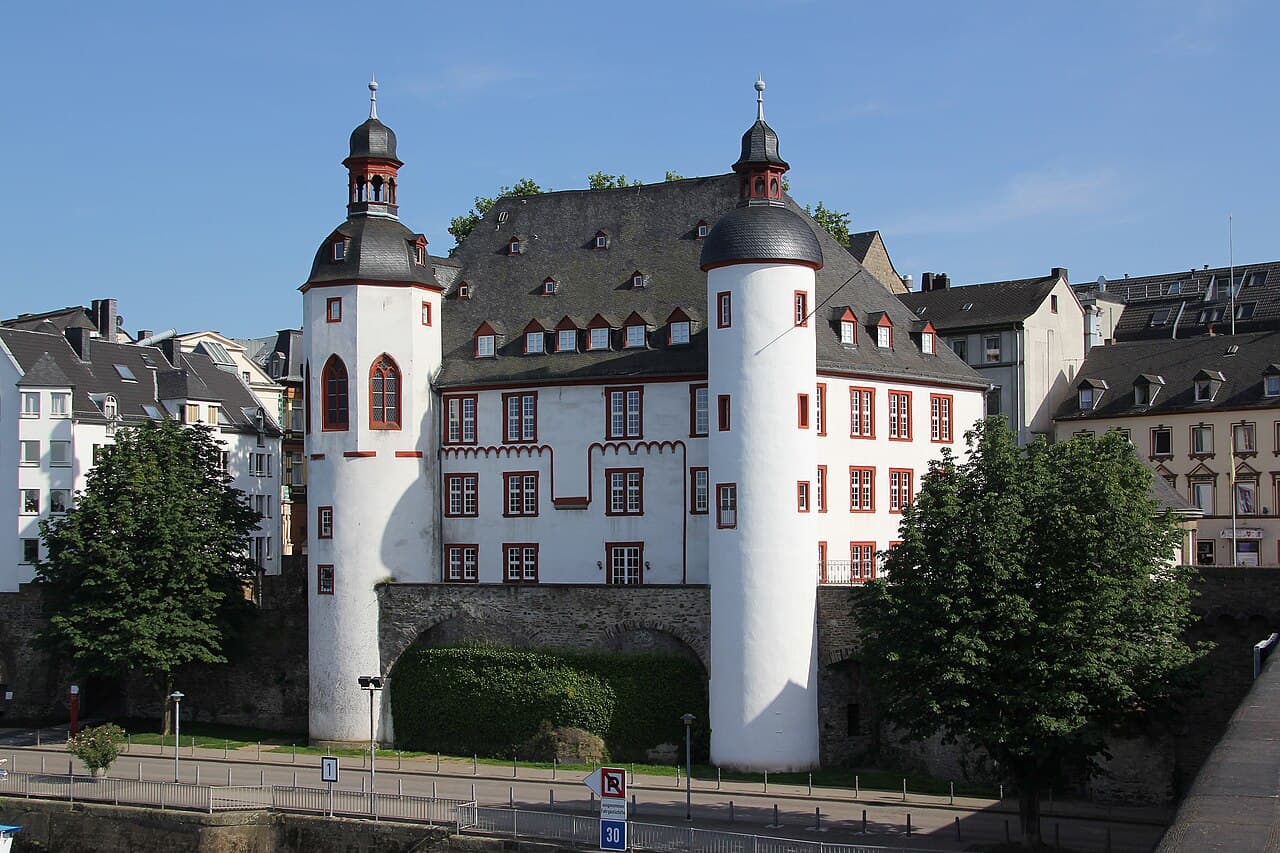
The surviving castle house is a large, three-story building characterized by a steep hipped roof covered with black slate. Two tall towers on the Moselle side are crowned with baroque-style cupolas, reconstructed in the late 19th century. The western half of the city-facing façade and the Moselle front display Baroque elements from multiple remodeling phases, including a major reconstruction between 1680 and 1682 led by court architect Johann Christoph Sebastiani, who designed the roof and cupolas.
Renaissance influences
A hexagonal stair tower on the city side exhibits Renaissance architectural elements, such as paired rectangular windows, shell-decorated gable crowns, and a stair turret with a tracery frieze. Inside, a richly designed spiral staircase combines late Gothic and Renaissance styles, while a simpler Baroque staircase also exists. Vaulted ceilings of a former chapel remain in the western corner tower, although many older interior features were lost during 20th-century renovations.
Later uses and preservation
Following the castle's military and residential use, it entered a period of industrial and civic functions. During French rule in the early 19th century, the castle became state property and was sold to private owners. In 1806, it housed a sheet metal factory that operated until 1897, during which an extension was added on the city side.
The city of Koblenz acquired the castle in 1897 and undertook extensive renovations from 1898 to 1900 under architect Friedrich Wilhelm Ludwin Mäckler. The factory annex was removed, and historic features such as the tower lanterns were restored. From 1899 to 1923, the building served as the Stadtsparkasse Koblenz (municipal savings bank), later housing the municipal welfare office and, from 1938, the Hitler Youth area management headquarters.
The castle sustained only minor damage during World War II. Between 1960 and 1962, it underwent full renovation, although some historic interior elements like baroque stucco ceilings were removed. Subsequently, it housed the city library and, from 1980, the city archive. Since the library's relocation in 2013, the archive remains the sole occupant.
Architectural remains and cultural significance
The Old Castle is the only medieval building in Koblenz to have survived all historical military conflicts largely intact. Its main castle house stands on a steep slope rising from the Moselle riverbank, elevated by layers of cultural debris accumulated since Roman times. The castle's cellar level preserves Romanesque architectural features, while the main building evolved from the medieval palas, extensively rebuilt in the late 17th and 18th centuries.
Originally a water castle, it was surrounded on three sides by a 15 to 20 meter wide water-filled moat and a ring wall, defensive features removed in the 19th century. The castle's location and iconic silhouette form a prominent visual endpoint of Koblenz's eastern old town along the Moselle riverfront, contributing significantly to the city's historic townscape.
Recognized as a protected cultural monument, the Old Castle has been part of the UNESCO World Heritage Upper Middle Rhine Valley since 2002 and is listed in the Rhineland-Palatinate monument register. Its layered history, architectural diversity, and preservation make it a key site for understanding the region's medieval and early modern heritage.
Frequently asked questions (FAQ)
- How do I visit the Old Castle in Koblenz?
- The Old Castle is located in Koblenz's old town near the Moselle riverbank and Baldwin Bridge. It currently serves as the city archive and is accessible during archive opening hours. Visitors should check local tourism websites or contact the city archive for visiting information and any guided tours.
- What is the historical significance of the Old Castle?
- The Old Castle is historically significant as a medieval hill castle built on Roman foundations, playing a key role in Koblenz's defense and archiepiscopal power struggles during the High Middle Ages. Its survival through centuries of conflict and architectural evolution highlights its importance in regional history.
- What architectural styles are represented in the Old Castle?
- The Old Castle exhibits a blend of architectural styles including Romanesque foundations, Romanesque and Gothic elements in the medieval palas, Renaissance features in the stair tower, and Baroque renovations evident in the roof, cupolas, and façade. This mix reflects its long construction and renovation history.
- Is the Old Castle accessible for people with disabilities?
- Due to its historic structure and preservation status, accessibility may be limited in some areas of the Old Castle. Visitors with mobility concerns should contact the city archive or local tourism offices in advance to inquire about accommodations and access options.
- When was the Old Castle built and who were its primary builders?
- The Old Castle's origins date to the 4th century Roman round tower foundations, with the first medieval construction by the von der Arken family around 1185. Significant expansions and fortifications were made in the 13th and 14th centuries under archbishops such as Henry II of Finstingen and Baldwin of Luxemburg.
Photo gallery

Information
Sources & official resources
Verify the information above using these authoritative references.
Loading map...
Visitor reviews
No reviews yet. Been here? Write the first review and help other travelers!
Write the first reviewVisited this castle? Share your experience
Your review helps other travelers and adds first-hand knowledge to our encyclopedia.