Koblenz Fortress
Koblenz Fortress was a significant component of the extensive Prussian fortress system designed to protect the strategic city of Koblenz in Germany. This fortress complex included the city fortifications of Koblenz itself, the imposing Ehrenbreitstein Fortress across the Rhine, and a network of exterior defensive works such as entrenchments and smaller forts. The system was conceived to secure the confluence of the Rhine and Moselle rivers, a crucial military and economic junction.
Construction phases and design
The construction of Koblenz Fortress occurred in three distinct phases spanning much of the 19th century: the initial phase from 1815 to 1830, a second major building period between 1859 and 1868, and a final stage from 1871 to 1886. These phases reflect evolving military engineering principles and the adaptation to advances in artillery technology. The fortress was designed as a bastioned fortress, a style characterized by angular bastions projecting from curtain walls to provide overlapping fields of fire and eliminate blind spots.
The fortress's design was overseen by prominent military engineers Ernst von Aster and Gustav von Rauch. Von Aster was instrumental in the initial phases, bringing expertise in fortification design following the Napoleonic Wars, while von Rauch contributed during the later expansions, adapting the fortress to the changing demands of modern warfare.
Architectural features and layout
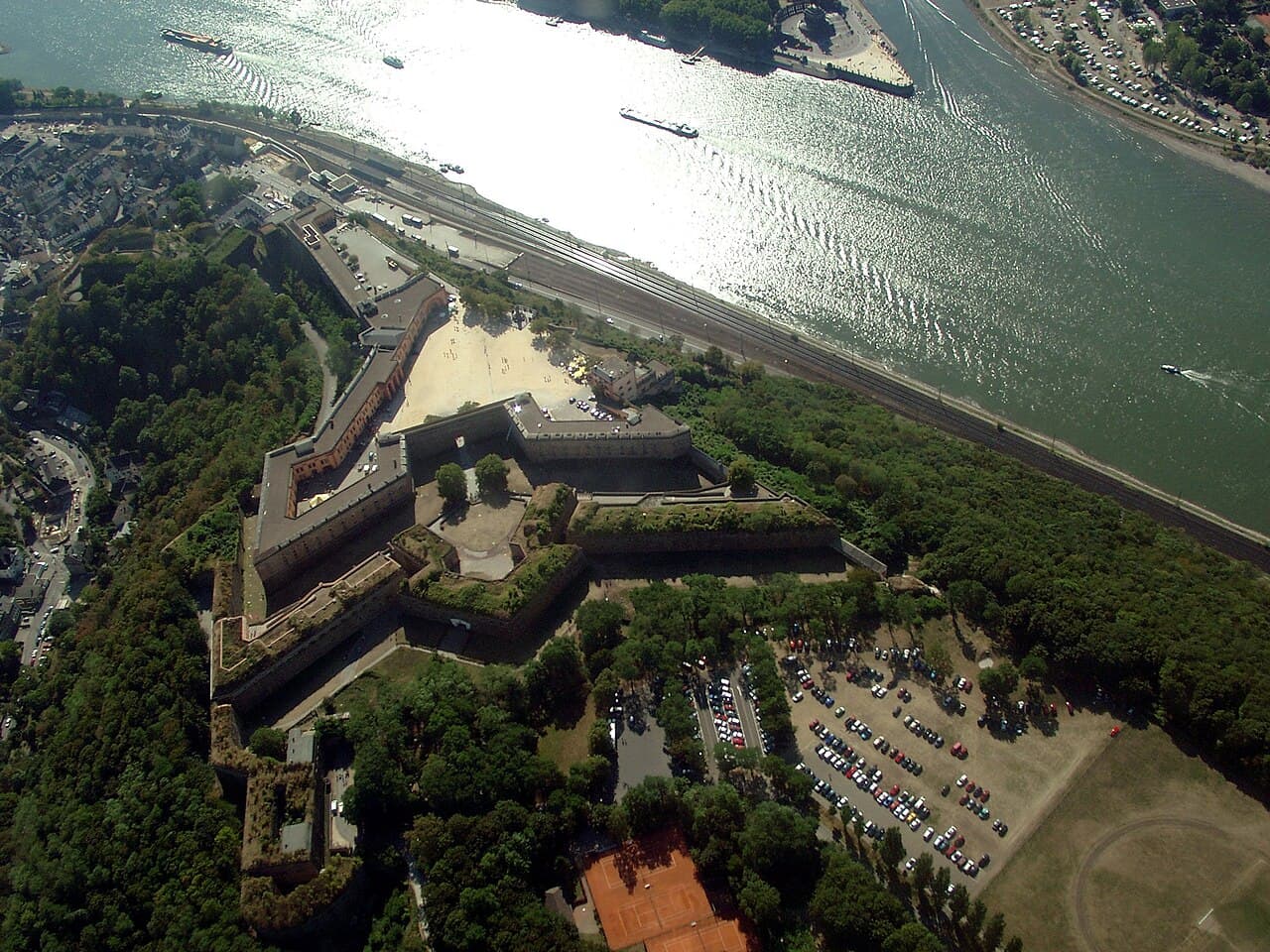
Koblenz Fortress comprised multiple layers of defenses, including massive bastions, curtain walls, ravelins, and moats. The fortress's layout was designed to maximize defensive coverage of the approaches to Koblenz. Key components included fortified gates controlling access, artillery platforms positioned to dominate the surrounding terrain, and barracks and storage facilities integrated within the fortifications.
The fortress was part of a larger defensive network with Ehrenbreitstein Fortress serving as a central stronghold. This interconnected system allowed for mutual support between fortifications, enhancing the overall defensive capability of the region.
Historical context and military significance
Constructed in the aftermath of the Napoleonic Wars, Koblenz Fortress was part of Prussia's strategic effort to secure its western borders and assert control over the Rhineland. Throughout the 19th century, it played a role in regional defense planning, although it never saw significant combat action. Its presence, however, was a deterrent to potential aggressors and a symbol of Prussian military strength.
The fortress's relevance declined towards the end of the 19th century with changes in military technology and political circumstances. In 1890, parts of the fortress were declassified, reflecting a shift in defense priorities. The demolition of gates between 1896 and 1899 and further dismantling between 1920 and 1927 marked the gradual reduction of the fortress's military role.
Preservation and current condition
Today, some sections of Koblenz Fortress remain preserved, offering insight into 19th-century military architecture. While significant portions were demolished, surviving bastions, walls, and other fortifications provide valuable historical and architectural interest. The fortress stands as a testament to the era's defensive strategies and engineering prowess.
Visitors to the Koblenz area can explore remnants of this bastioned fortress system, which complements the more prominent Ehrenbreitstein Fortress. The site contributes to the cultural heritage of the Rhineland and serves as an educational resource on Prussian military history.
Frequently asked questions (FAQ)
- What is Koblenz Fortress and where is it located?
- Koblenz Fortress is a 19th-century Prussian bastioned fortress located near the city of Koblenz in Rhineland-Palatinate, Germany. It was part of a larger defensive system including Ehrenbreitstein Fortress.
- When was Koblenz Fortress built and who designed it?
- The fortress was constructed in three phases between 1815 and 1886. The main designers were military engineers Ernst von Aster and Gustav von Rauch, who adapted the fortress to evolving military needs.
- What architectural style characterizes Koblenz Fortress?
- Koblenz Fortress is designed as a bastioned fortress, featuring angular bastions, curtain walls, ravelins, and moats typical of 19th-century military fortifications.
- Is Koblenz Fortress open to visitors?
- Some parts of Koblenz Fortress are preserved and accessible to the public. Visitors can explore the remaining fortifications and learn about the fortress's historical role in Prussian defense.
- Why were parts of Koblenz Fortress demolished?
- Parts of the fortress were declassified and demolished between 1890 and 1927 due to changes in military technology and strategic priorities, reducing the fortress's defensive importance.
Photo gallery

Information
Current owner
Municipality
Loading map...
Visitor reviews
No reviews yet. Been here? Write the first review and help other travelers!
Write the first reviewVisited this castle? Share your experience
Your review helps other travelers and adds first-hand knowledge to our encyclopedia.