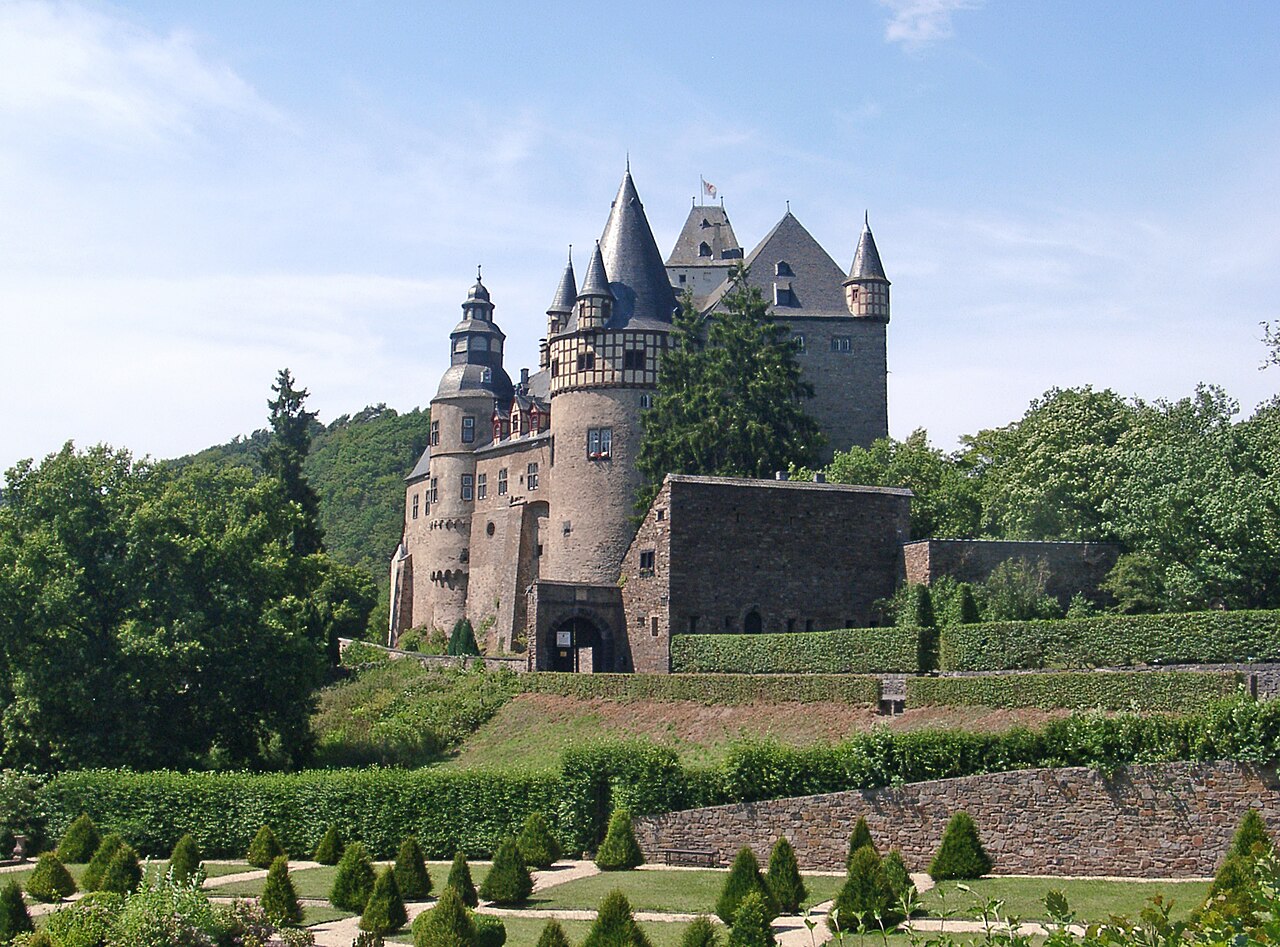
Olbrück Castle
Olbrück Castle is a striking hilltop fortress located near the village of Niederdürenbach in Germany. Perched atop a phonolite volcanic cone rising approximately 460 meters above sea level, the castle commands expansive views over the Brohltal valley and surrounding landscapes. Its strategic position and robust construction exemplify the defensive priorities of Late Medieval hill castles in the Rhineland region. The castle's distinctive diamond-shaped floor plan and imposing structures reflect centuries of architectural evolution and historical significance.
The centerpiece of the castle is its 34-meter high bergfried (main tower), dating from the mid-14th century, which remains the oldest and most intact part of the complex. The tower's massive plastered masonry walls, up to five meters thick, and its rounded corners convey a formidable presence. Internally, the tower contains five vaulted floors connected by a spiral staircase, originally accessed via a high entrance on the second floor for defensive purposes. Today, the tower serves as a museum space, educating visitors about medieval castle construction, defensive mechanisms, and the site's layered history. From the tower's roof terrace, visitors enjoy sweeping panoramic views including the Rhine River to the east, the Ahr Mountains to the north, and the volcanic landscapes to the south, with the Cologne Cathedral visible on clear days.
Medieval origins and feudal significance
Olbrück Castle's origins trace back to around the year 1100, making it an early medieval fortress initially established by a noble family connected to the influential House of Wied. The earliest documented figure associated with the castle is Burghardus de Oreburch, recorded in 1112. The castle originally served as the administrative center for a lordship encompassing ten villages, with early records referring to the estate under names such as Oleburg and Holebriche. Ownership remained with the founding noble family until 1244.
Over subsequent centuries, the castle's ownership became fragmented among more than fifteen noble houses through inheritance, marriage, and sales. Prominent families involved included the Wied, Isenburg, Eppstein, Virneburg, Schöneck, Orsbeck, Drachenfels, and the Waldbott von Bassenheim lineage, which consolidated sole ownership in 1555. This complex feudal history reflects the castle's importance in regional power dynamics and aristocratic networks.
Conflicts and transformations in the early modern period
The castle endured significant military action during the Thirty Years' War. In 1632, Swedish forces captured and devastated Olbrück Castle, only for it to be recaptured in January 1633 by Spanish and Electorate of Cologne troops under the command of Graf Ernst von Isenburg-Grenzau. Despite this recovery, the castle suffered partial collapse in 1660 but was restored under the supervision of Capuchin friar Bonitius from Linz, who oversaw reconstruction efforts that included structural stabilization and repairs.
Later military conflicts continued to impact the castle. During the Palatinate War of Succession, French troops garrisoned the fortress until 1689. Despite payments intended to preserve the castle, French General François d’Escoubleau ordered its destruction that year. Reconstruction began in 1690, introducing a Baroque chapel and a refined residential building, marking a shift from purely military functions to more comfortable noble habitation.
Decline and partial revival in the modern era
By 1797, Olbrück Castle ceased to serve as a noble residence after the French Revolutionary armies occupied the Rhineland. The castle was declared national property, confiscated, and sold for demolition in 1804. It subsequently became a quarry for building materials, leading to significant deterioration and loss of original fabric.
Renewed interest in the castle emerged in the late 19th century when Baron Oskar Otto von Ekesparre acquired the site. Between 1874 and 1875, he restored the main tower, reconstructing battlements and installing a wooden staircase, transforming the tower into a habitable structure with four rooms. However, further restoration efforts in the 20th century were limited by financial and legal obstacles under the ownership of architect Rainer Maria Schlitter.
In 1998, the local municipality leased Olbrück Castle and incorporated it into the Vulkanpark Brohltal/Laacher See heritage area as a protected monument and museum. Archaeological excavations and restoration between 1999 and 2001 stabilized the ruins and prepared the site for public visitation. In 2012, ownership transferred to Slovak financial advisor Pavol Pavlovic, whose development proposals sparked debate about conservation and public access, underscoring ongoing challenges in heritage management.
Architectural features and surviving structures
The main tower (bergfried)
The castle's most prominent surviving structure is its main tower, also known as the bergfried, a hallmark of medieval defensive architecture. Rising to 34.10 meters, the tower is built on a footprint approximately eight by twelve and a half meters. Its walls, up to five meters thick, are constructed from plastered masonry with rounded corners, enhancing its defensive strength and durability.
Inside, the tower contains five vaulted floors connected by a spiral staircase situated in the northeast corner. The original entrance was located at the second floor, accessible only by a drawbridge from an adjacent residential building, a common defensive feature designed to limit access during sieges. Today, visitors enter through a ground-level doorway, while a narrow round-arched doorway on the north side marks the location of the historic high entrance.
In 2001, a timber-framed oriel window was added to the third floor as a free reconstruction, providing architectural interest and additional viewing space. The tower's summit features a battlemented platform serving as a viewing terrace. The crenellations reflect a 19th-century reconstruction rather than the original medieval design, yet they contribute to the tower's iconic silhouette.
Residential buildings and chapel
South of the bergfried lie the remains of a rectangular residential building dating from the late 17th century. This structure includes seven window openings along its longer side and is anchored by massive round towers on the southern corners, built upon medieval foundations. These elements demonstrate the castle's adaptation to Baroque architectural styles during its post-war reconstruction phase.
Northeast of the main tower, archaeological remains reveal portions of a medieval residential building and a vaulted chamber believed to be the castle chapel. These features highlight the dual residential and spiritual functions of the castle complex throughout its history.
Defensive walls and outer baileys
Encircling the core structures are remnants of the original ring wall, which provided a fortified perimeter defense. Historical evidence indicates the presence of outer baileys or zwingers on the eastern, western, and northern sides. These narrow enclosed spaces between walls were designed to expose attackers to defensive fire, reflecting sophisticated layered defensive strategies typical of hill castles in the Rhineland.
Castle entrance and later additions
Access to the castle was historically controlled via an entrance on the southern side. Today, visitors pass through a neo-Gothic gate located lower than the main structures. This gate is flanked by a thick round tower, whose upper floor was added in 1875 atop the remains of an older tower stump, illustrating phases of 19th-century restoration and adaptation.
The castle ruins today present a compelling blend of medieval masonry, 17th-century residential foundations, and 19th- and 20th-century restoration efforts. These layers of construction and reconstruction narrate the castle's long and turbulent history, making it a significant cultural heritage site. As a museum, Olbrück Castle offers visitors a tangible connection to medieval fortification architecture, regional noble history, and the evolving functions of castles across centuries.
Visitor experience and cultural significance
Today, Olbrück Castle is an important heritage site within the Vulkanpark Brohltal/Laacher See, attracting visitors interested in medieval history, architecture, and geology. The castle's museum rooms housed within the main tower provide educational exhibits on castle construction techniques and historical context. The panoramic views from the tower's roof terrace are a highlight, offering visitors a unique perspective on the Rhineland's diverse landscapes.
The castle's layered history, from its medieval origins through early modern conflicts and modern preservation challenges, illustrates broader themes of feudal power, military strategy, and cultural transformation. Its preservation as a museum and monument ensures that Olbrück Castle remains a valuable resource for understanding Germany's medieval heritage and architectural evolution.
Frequently asked questions (FAQ)
- When was Olbrück Castle originally built?
- Olbrück Castle was originally built around the year 1100, with the oldest preserved structures dating to the mid-14th century.
- What is the architectural style of Olbrück Castle's main tower?
- The main tower features medieval defensive architecture with thick plastered masonry walls and rounded corners typical of 14th-century hill castles.
- Can visitors access the top of the main tower?
- Yes, visitors can climb to the roof terrace of the main tower, which offers panoramic views of the Rhine River, Ahr Mountains, and surrounding volcanic landscapes.
- What historical events affected Olbrück Castle?
- The castle was captured and damaged during the Thirty Years' War and later destroyed by French forces in 1689 during the Palatinate War of Succession, followed by reconstruction efforts.
- Is Olbrück Castle open to the public?
- Olbrück Castle is accessible to visitors as a museum and heritage site, with exhibitions inside the main tower presenting its history and architecture.
Information
Website
Visit websiteSources & official resources
Verify the information above using these authoritative references.
Loading map...
Visitor reviews
No reviews yet. Been here? Write the first review and help other travelers!
Write the first reviewVisited this castle? Share your experience
Your review helps other travelers and adds first-hand knowledge to our encyclopedia.