Olavinlinna Castle
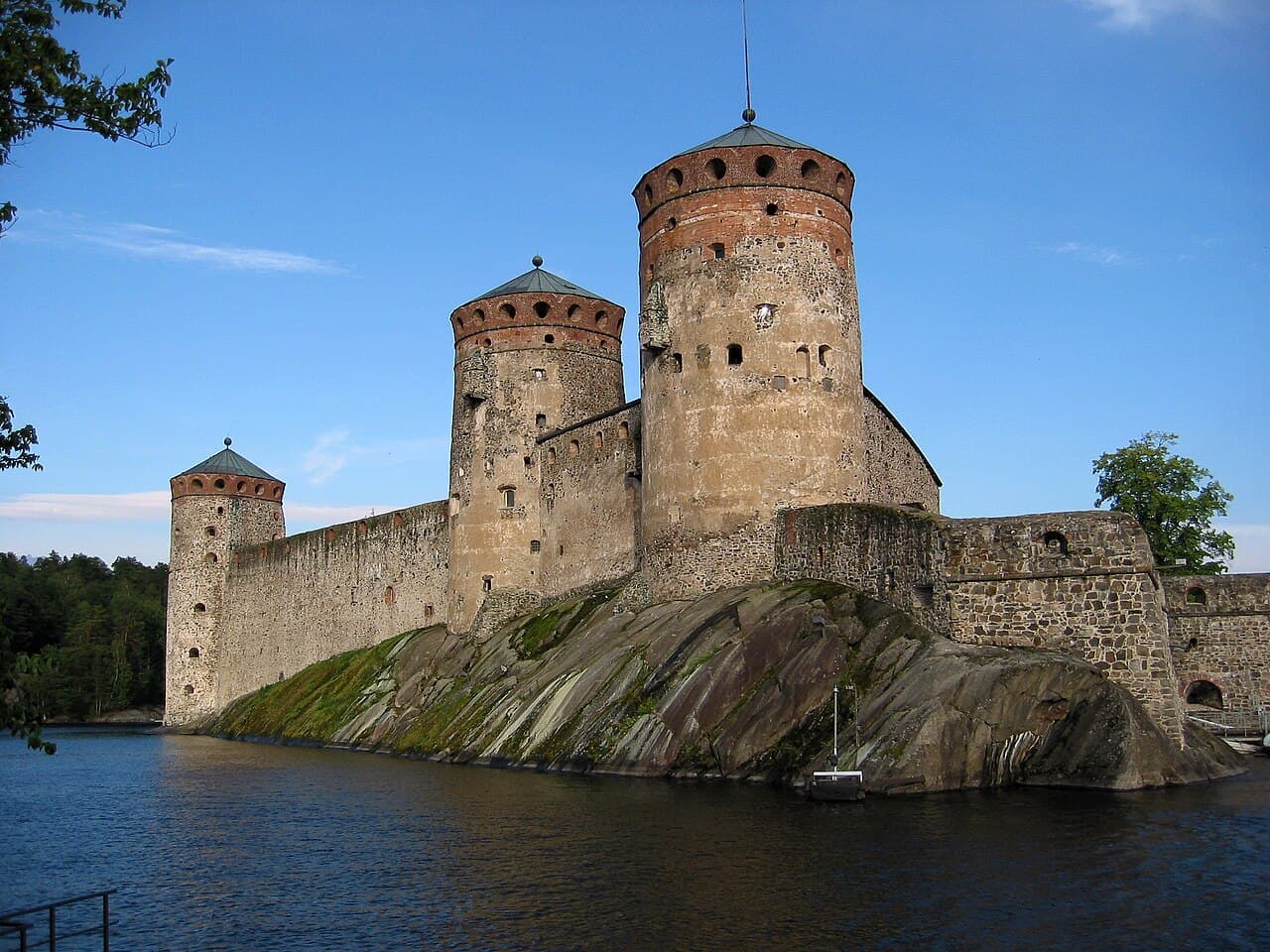
Olavinlinna Castle, also known as St. Olaf’s Castle, is a late medieval bastioned fortress located on a rocky island in the Kyrönsalmi strait in Savonlinna, Finland. Founded in 1475 by the Swedish nobleman Erik Axelsson Tott, the castle was strategically positioned to defend the eastern borders of the Swedish realm against the Novgorod Republic and later the expanding Grand Duchy of Moscow. Its unique location between two large lakes, Haukivesi and Pihlajavesi, provided natural defenses, including strong currents that prevented ice formation during winter, which was a significant military advantage in the northern climate.
The castle is a pioneering example of late medieval military architecture in Northern Europe, notable for its early adoption of bastioned fortifications designed to withstand artillery attacks. It was the first Swedish fortress to feature three thickset round towers, a design innovation that marked a shift in fortress construction adapting to gunpowder warfare. Over the centuries, Olavinlinna expanded from a simple stronghold into a complex defensive system, comprising the main castle (päälinna) with its three circular towers and a fortified outer bailey (esilinna) with additional towers and bastions.
Historical significance and military role
Constructed during the volatile period of the Kalmar Union, Olavinlinna served as a critical military outpost on Sweden’s eastern frontier. Its main purpose was to secure control over the Savo region and to protect against incursions from the east, particularly from the Novgorod Republic and later Russian forces. The castle’s position on an island and its robust fortifications made it a formidable barrier against invasions.
Throughout its history, Olavinlinna endured multiple sieges, notably during the war of 1495–1497, when it was besieged three times by Russian troops but never captured by direct assault. Commanders such as Peter Kylliäinen led determined defenses with small garrisons, often composed of local peasants. The fortress’s thick stone walls and strategic location made it costly and difficult to conquer.
Despite its strong defenses, the castle changed hands primarily through surrender rather than by force. It fell to Russian forces during the Great Northern War in 1714 and again in the Hats’ War of 1743. After the latter, it became part of the Russian Empire, reflecting the shifting political landscape of Northern Europe.
Swedish and russian fortification phases
Under Swedish rule, the castle underwent important enhancements, especially during the reign of King Gustav I Vasa in the 16th century. The height of the towers was increased, and a large artillery tower was added in 1565 to bolster resistance against cannon fire, illustrating the adaptation of medieval fortresses to early modern warfare technologies.
Following the Russian acquisition in the 18th century, further fortifications were constructed, including bastions and a protected water channel built in 1788. This channel allowed water carriers safe access to fresh water during sieges, demonstrating practical defensive considerations for prolonged military engagements.
Architectural features and layout
The main castle of Olavinlinna is triangular in plan and features three massive circular towers: the northwestern tower, southern tower, and eastern tower. These towers have exceptionally thick walls made from locally quarried stone, designed to withstand artillery bombardment. The slightly curved curtain walls connecting the towers enhance defensive coverage and create overlapping fields of fire, a sophisticated feature for its time.
Within the main castle stands a three-story palace building that served various functions. The ground floor was used for storage, the middle floor housed the great hall (linnantupa) where official gatherings and feasts took place, and the upper floor contains the King’s Hall (kuninkaansali), likely reserved for formal and ceremonial occasions. This layout reflects the castle’s combined military and residential purposes.
Outer bailey and auxiliary structures
East of the main castle lies the outer bailey (esilinna), a rectangular courtyard surrounded by additional defensive towers and wooden buildings. Historically, the castle complex included five main towers beyond the main castle: the Church Tower (Kirkkotorni) or Virgin Mary’s Tower, the Bell Tower (Kellotorni) also known as Saint Olaf’s Tower, the Kijli Tower named after commander Nils Pederinpoika Kijli, the Saint Erik’s Tower now in ruins, and the Thick Tower (Paksu torni), which exploded in 1791 and was replaced by the Thick Bastion.
The Church Tower is notable for containing a small chapel that served the spiritual needs of the castle’s inhabitants. The chapel featured three altars and a rare architectural element called a hagioscope, which allowed individuals unable to attend services openly—such as prisoners or the sick—to observe mass discreetly. Originally Catholic, the chapel later adapted to Lutheran and Orthodox practices, reflecting the castle’s changing rulers.
Later history and preservation
After Finland became part of the Russian Empire as an autonomous Grand Duchy in 1809, Olavinlinna’s military role diminished. It remained a garrison until 1847 before being repurposed as a prison and storage facility. Two major fires in 1868 and 1869 destroyed many of the wooden structures associated with the castle.
Restoration efforts began in the late 19th century and continued throughout the 20th century. A significant restoration project between 1961 and 1975 returned much of the castle to its original medieval appearance. Conservation work included removing non-original vegetation that threatened the masonry and installing a modern rotating pontoon bridge in 1974 to improve visitor access while preserving the historic environment.
Today, Olavinlinna Castle is one of Finland’s best-preserved medieval fortresses and a major tourist attraction. It hosts the renowned Savonlinna Opera Festival and contains a restaurant and festival halls within its walls. The castle’s well-maintained stone walls, towers, and bastions provide valuable insight into the military architecture and historical conflicts of the Swedish-Russian borderlands.
Architectural legacy and cultural importance
Olavinlinna is unique in the Nordic region for its blend of medieval and early modern defensive features, including its pioneering use of bastioned fortifications adapted to resist artillery fire. Its survival through centuries of warfare and political shifts makes it a significant monument in Finnish and Baltic history.
The castle’s integration of military, residential, and religious functions within a compact island fortress exemplifies the complexity of medieval fortress design. The chapel with its hagioscope is a rare architectural feature in northern European castles, underscoring the fortress’s role as both a military stronghold and a community center.
As a restored historic site, Olavinlinna attracts scholars, history enthusiasts, and tourists, offering a comprehensive view of fortress evolution and the geopolitical struggles that shaped Northern Europe. Its ongoing use for cultural events ensures it remains a vibrant part of Finland’s heritage.
Olavinlinna (Finnish: [ˈolɑʋinˌlinːɑ]; Swedish: Olofsborg) is the northernmost medieval stone fortress still standing and the best preserved in the former Swedish realm. It is built on an island connecting the lakes Haukivesi and Pihlajavesi and serves as a spectacular stage for the Savonlinna Opera Festival, first held in 1912.
Frequently asked questions (FAQ)
- When was Olavinlinna Castle built and by whom?
- Olavinlinna Castle was built in 1475 by the Swedish nobleman Erik Axelsson Tott to defend Sweden's eastern borders.
- What architectural style characterizes Olavinlinna Castle?
- Olavinlinna Castle is a late medieval bastioned fortress featuring three thickset round towers designed to resist artillery.
- Can visitors attend cultural events at Olavinlinna Castle?
- Yes, the castle hosts the annual Savonlinna Opera Festival, attracting visitors for performances in a historic setting.
- Is Olavinlinna Castle accessible year-round for visitors?
- Visiting hours vary seasonally, and it is recommended to check local information for current opening times and access conditions.
- What makes Olavinlinna Castle unique among Nordic fortresses?
- Its combination of medieval and early modern bastioned fortifications, strategic island location, and rare chapel hagioscope make it unique.
Photo gallery

Information
Website
Visit websiteSources & official resources
Verify the information above using these authoritative references.
Loading map...
Visitor reviews
No reviews yet. Been here? Write the first review and help other travelers!
Write the first reviewVisited this castle? Share your experience
Your review helps other travelers and adds first-hand knowledge to our encyclopedia.