
Oka Castle
Oka Castle is a significant historic fortress located in Taketa, Japan, renowned for its strategic hilltop position and long-standing history dating back to the late 12th century. Established in 1185 for the famed warrior Minamoto no Yoshitsune, the castle played a pivotal role in the military and political landscape of medieval Japan. Its original construction exemplified typical hill castle (yamajiro) architecture, designed to take advantage of the natural topography for defense.
The castle's early history is marked by its association with the Minamoto clan, one of the most powerful samurai families of the period. In 1332, Shiga Sadatomo took control of the castle and undertook extensive repairs and enhancements, reflecting the evolving military needs and architectural styles of the High Medieval period. The Shiga family maintained dominion over Oka Castle for more than two centuries, until 1586.
Architectural evolution and expansions
Following the Shiga era, the castle came under the control of Nakagawa Hideshige in 1594, who initiated a significant phase of expansion and modernization. This included the construction of a prominent main keep (tenshu) and a palace complex, which elevated the castle's status and fortification capabilities. The architectural style during this period reflected the transition from purely military fortresses to more elaborate residences that combined defense with administrative functions.
The castle's layout featured multiple baileys (kuruwa), stone walls (ishigaki), and gates designed for layered defense. The use of stone base walls was a hallmark of Japanese castle architecture in the late Sengoku and early Edo periods, offering enhanced durability and resistance to siege weaponry.
Destruction and present condition
Despite its robust construction, the main keep of Oka Castle was destroyed by an earthquake during the Edo period, significantly altering the castle's silhouette and defensive capacity. The Nakagawa family continued to rule the castle until the Meiji Restoration in the late 19th century, a period that led to the dismantling of many feudal structures across Japan.
Following the restoration, most of the castle's buildings were dismantled as part of the government's efforts to modernize and reduce the power of the samurai class. Today, Oka Castle remains as ruins, with only some of its impressive stone walls and foundations surviving. These ruins provide valuable insight into the castle's original grandeur and the architectural techniques used during its active centuries.
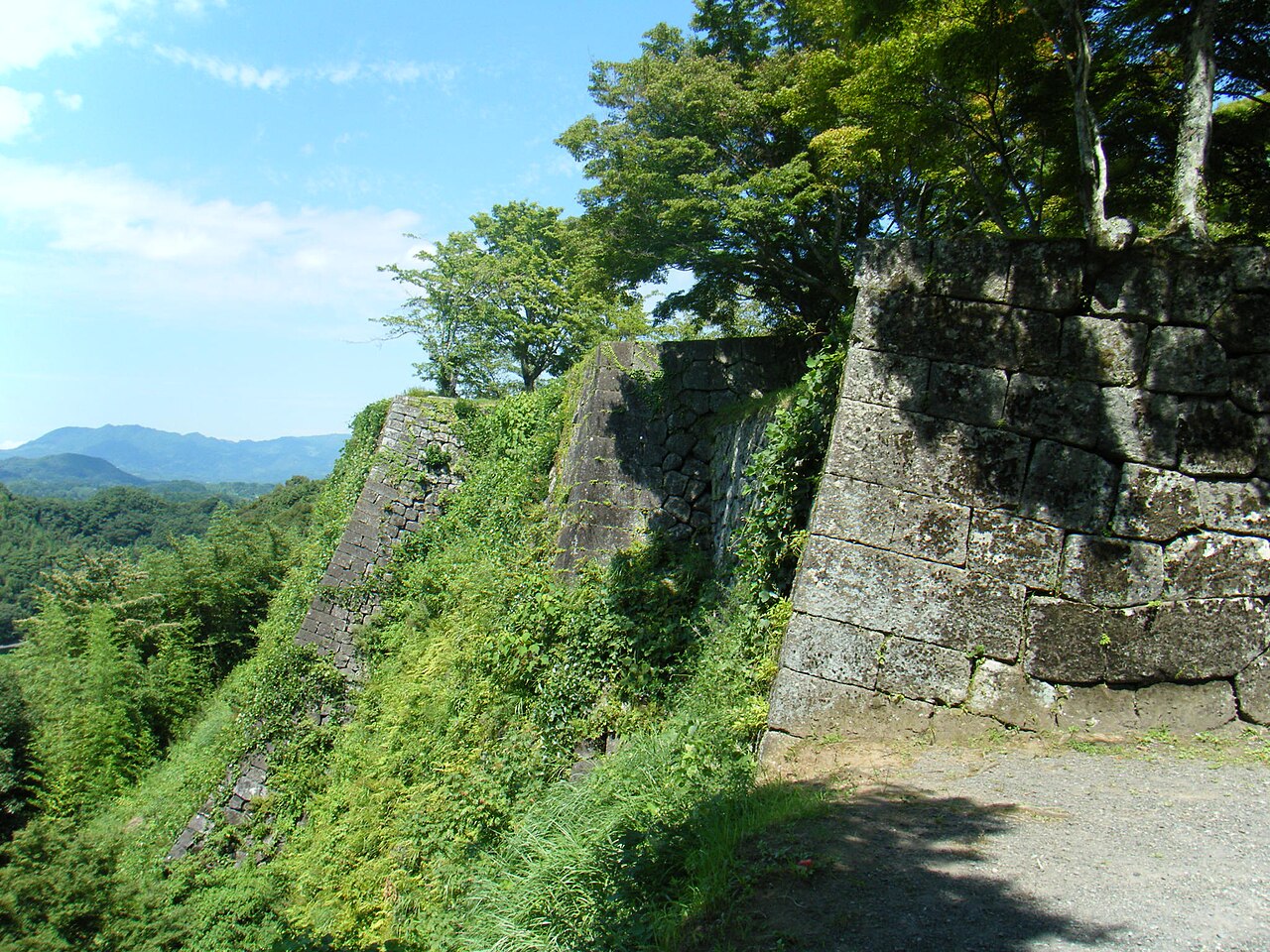
Photo by As6673 • Public domain
Historical significance and cultural heritage
Oka Castle stands as a testament to Japan's rich feudal history and the evolution of castle architecture from the High Medieval through the Edo period. Its association with prominent historical figures like Minamoto no Yoshitsune and the Nakagawa clan underscores its importance in regional power struggles and governance.
The castle's ruins are a popular destination for historians and tourists interested in Japanese military architecture and samurai culture. The site offers panoramic views of the surrounding landscape, emphasizing the strategic importance of its hilltop location.
Visiting Oka Castle today
While the castle structures no longer stand intact, visitors to Oka Castle can explore the extensive stone walls and remnants of the castle grounds. The site is accessible and provides interpretive signage to help visitors understand the castle's historical context and architectural features.
Oka Castle's enduring legacy is preserved through ongoing conservation efforts aimed at protecting its ruins and promoting awareness of Japan's feudal heritage. It remains one of the most evocative examples of a hill castle whose history spans several centuries of Japanese history.
Frequently asked questions (FAQ)
- When was Oka Castle originally built and by whom?
- Oka Castle was originally built in 1185 for Minamoto no Yoshitsune, a prominent samurai of the late Heian period.
- What architectural features are notable at Oka Castle?
- Oka Castle is known for its hilltop location, stone walls, multiple baileys, and the remains of its main keep and palace complex built during the late 16th century.
- What happened to the main keep of Oka Castle?
- The main keep was destroyed during an earthquake in the Edo period, after which the castle gradually fell into ruin.
- Can visitors explore Oka Castle today?
- Yes, visitors can explore the castle ruins, including the stone walls and foundations, with interpretive signage explaining the site's history.
- Who ruled Oka Castle after the Shiga family?
- After the Shiga family, Nakagawa Hideshige took control in 1594 and expanded the castle significantly.
Photo gallery

Photo by As6673•Public domain
Information
Website
Visit websiteSources & official resources
Verify the information above using these authoritative references.
Loading map...
Visitor reviews
No reviews yet. Been here? Write the first review and help other travelers!
Write the first reviewVisited this castle? Share your experience
Your review helps other travelers and adds first-hand knowledge to our encyclopedia.