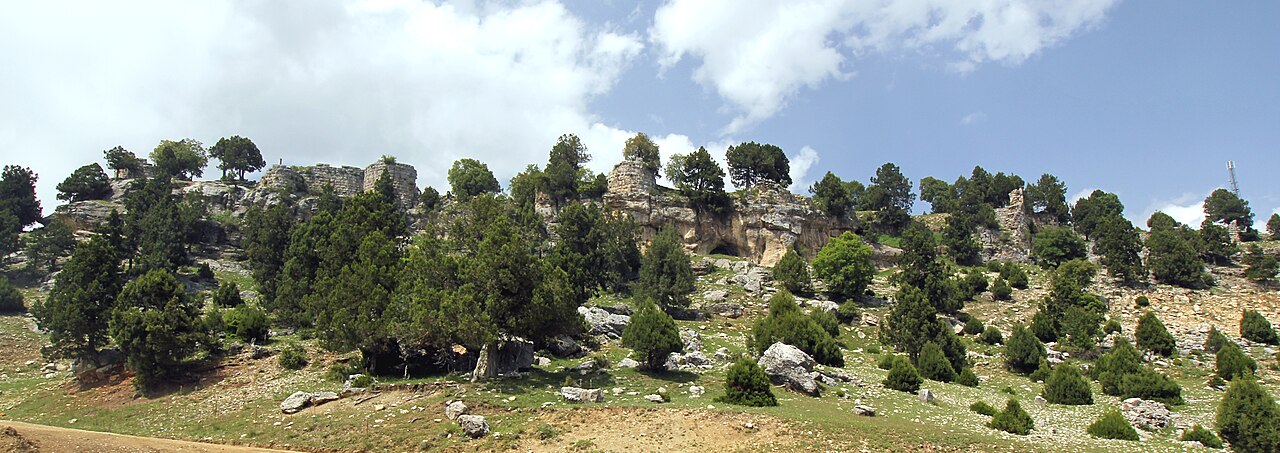
Oğlan Castle
Oğlan Castle, locally known as Oğlan Kalesi, is a medieval fortress located on a small rocky outcrop east of the village of Çokak in the Mersin province of Turkey. This castle stands in the historic region of Cilicia, an area notable for its strategic importance and complex history during the High Medieval period. Cilicia was the seat of the Armenian Kingdom of Cilicia from the late 11th century until the late 14th century, a time when numerous fortifications were constructed to defend the region against various incursions.
The exact medieval name and detailed history of Oğlan Castle remain unknown, a common issue with many fortifications in this part of Cilicia. However, architectural and historical analysis suggests that the castle was likely built in the early 13th century, placing it firmly within the High Medieval era. The castle's construction exhibits a blend of Armenian masonry techniques and architectural features reminiscent of Crusader fortifications found in the Holy Land, indicating a collaboration or influence between Armenian builders and Crusader occupants, most likely the Knights Hospitaller. The Hospitallers were granted lands in this region around 1214, which aligns well with the castle's estimated construction date.
Architectural features and design
Oğlan Castle is believed to have functioned primarily as a defensible hall or tower house, a common type of fortification designed to serve both residential and military purposes. The castle's plan is rectangular and it originally likely had two stories. Today, what remains most prominently is a barrel vault, a significant architectural feature that demonstrates the skill of the Armenian masons who constructed it. The barrel vault is well-preserved and provides insight into the castle's original internal structure.
The south face of the castle, where the main entrance probably was located, has been lost over time, which limits full understanding of the original layout. The castle's position on a rocky outcrop allowed for a strong defensive advantage, overseeing the surrounding fields and controlling local routes. There is also clear intervisibility with Kızlar Castle to the south, suggesting a network of fortifications that could communicate or provide mutual defense across the landscape.
Historical context and significance
The region of Cilicia was a cultural crossroads during the High Medieval period, inhabited by Armenians and influenced by Crusader states. Oğlan Castle's mixed architectural characteristics reflect this intersection of cultures. The castle likely served not only as a military outpost but also as the center of an agricultural estate, supporting local economic activity and providing security for the surrounding lands.
The presence of the Knights Hospitaller in the area after 1214 indicates that Oğlan Castle may have had strategic importance in controlling trade routes and defending against incursions from neighboring powers. The Hospitallers were known for their fortification expertise and their castles often combined residential comfort with military strength, traits that can be inferred at Oğlan.
Current condition and visitor information
Today, Oğlan Castle is in a partially preserved state, with the barrel vault being the most notable surviving feature. The castle is freely accessible to visitors, though the site offers limited remains beyond the vault. Its proximity to Kızlar Castle makes it a worthwhile quick stop for those interested in the medieval fortifications of Cilicia.
Visitors should be prepared for a modest site with no extensive facilities but can appreciate the craftsmanship of the Armenian masons and the historical significance of the location. The castle's setting on a rocky outcrop provides a glimpse into the strategic considerations of medieval fortification builders in this region.
Architectural comparison and influences
Oğlan Castle's architectural plan is unusual for Armenian military architecture, which typically favored different layouts. The rectangular plan and barrel vault construction show influence from Crusader fortress designs in the Levant, highlighting the cultural and military exchanges between Armenian builders and Crusader knights. This fusion of styles is a testament to the dynamic political and cultural environment of Cilicia during the High Medieval period.
The castle's construction techniques, especially the masonry, display hallmark features of Armenian craftsmanship, such as finely cut stone blocks and precise fitting, which have contributed to the vault's survival over centuries. The combination of these elements makes Oğlan Castle an important example of cross-cultural medieval military architecture.
Frequently asked questions (FAQ)
- How do I get to Oğlan Castle from the village of Çokak?
- Oğlan Castle is located on a small rocky outcrop east of Çokak village. Visitors can reach the site by walking or driving on local rural roads leading east from the village center.
- What is the best time of year to visit Oğlan Castle?
- The best time to visit Oğlan Castle is during the spring and autumn months when the weather is mild. Summers can be hot, and winters may be cold and wet, which can make access more difficult.
- Is there an entrance fee to visit Oğlan Castle?
- There is no entrance fee to visit Oğlan Castle. The site is freely accessible to the public.
- Can I visit Oğlan Castle and Kızlar Castle in the same trip?
- Yes, Oğlan Castle and Kızlar Castle are located close to each other, making it convenient to visit both sites in a single trip. The castles have intervisibility and share historical connections.
- What architectural features distinguish Oğlan Castle?
- Oğlan Castle is distinguished by its well-preserved barrel vault and rectangular plan. The masonry shows Armenian craftsmanship with influences from Crusader fortifications, reflecting a unique blend of styles.
Information
Loading map...
Visitor reviews
No reviews yet. Been here? Write the first review and help other travelers!
Write the first reviewVisited this castle? Share your experience
Your review helps other travelers and adds first-hand knowledge to our encyclopedia.