O’Dea Castle
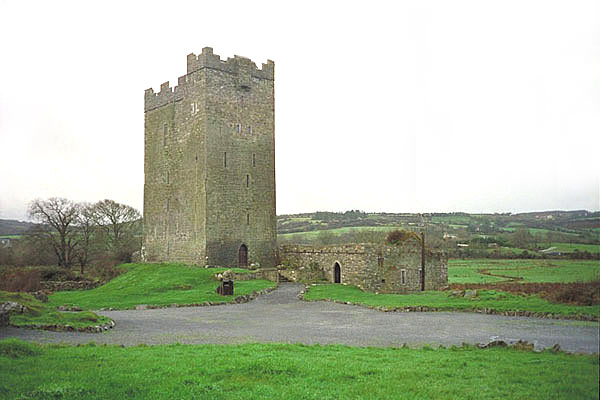
O’Dea Castle is a quintessential example of a late medieval Irish tower house, located in Mollaneen near Corofin in County Clare, Ireland. Constructed between 1470 and 1490 by Diarmaid O’Dea, the castle served as the fortified residence of the native Gaelic O’Dea clan, who controlled the surrounding lands during a period marked by frequent conflict and political upheaval. The castle's strategic position atop a limestone outcrop provided a natural defensive advantage, typical of hill castles designed to oversee and protect their territories.
The site of O’Dea Castle holds significance that predates the structure itself. Notably, in 1318, the area was the scene of the Battle of Dysert O’Dea, where a coalition of Irish clans decisively defeated Anglo-Norman forces, ending their dominance in the region for over two centuries. This victory is a defining moment in the local history of County Clare and reflects the resilience of Gaelic Ireland during the late medieval period.
Architectural features and construction
The castle is a classic example of a fortified tower house, a common type of residence for Gaelic lords during the 15th century. Rising approximately 15 meters high, the structure is built on a naturally elevated limestone platform measuring about 6 by 12 meters. Constructed primarily from local stone, the tower house was designed to be both a defensible stronghold and a noble residence.
Key architectural elements include battlements that originally crowned the walls, providing a protected parapet for defenders. The interior contained multiple floors connected by a now partially destroyed staircase, which allowed access to living quarters and defensive positions. The castle also featured a wall walk along the roofline, enabling sentries to patrol and defend the structure effectively.
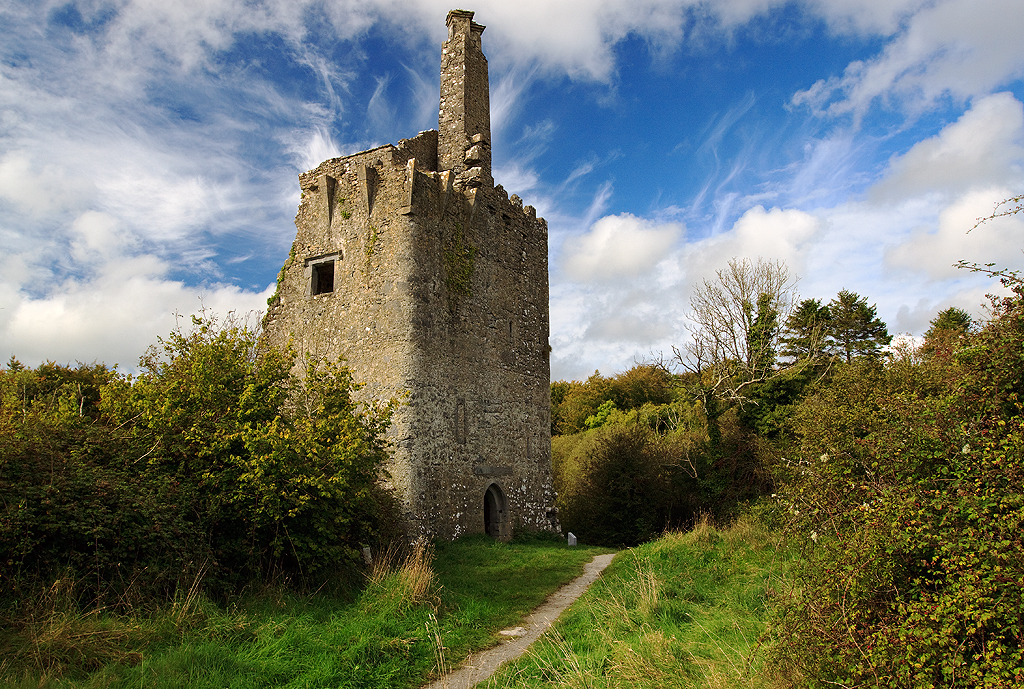
During the Cromwellian conquest of Ireland in the mid-17th century, the castle suffered deliberate damage inflicted by occupying soldiers. The battlements, upper storeys, and main staircase were partially demolished, significantly reducing the castle's defensive capabilities and residential function. Despite this, the core tower house remains largely intact, offering valuable insight into medieval Irish military architecture.
Historical significance and ownership
The castle's history is closely intertwined with the fortunes of the O’Dea clan, who were prominent Gaelic lords in County Clare. After its construction by Diarmaid O’Dea, the castle witnessed numerous conflicts reflecting the turbulent political landscape of Ireland from the late 15th century through the 17th century.
In 1570, the castle was briefly seized by the Earl of Ormond, an influential Anglo-Irish noble, but was reclaimed by the O’Dea family by 1584 under Domhnall Maol O’Dea. The Nine Years’ War (1594–1603) brought further changes in control, with the castle passing to Daniel Neylon, a Protestant bishop, before returning to the O’Deas.
In the early 1640s, Conor Cron O’Dea, a notable leader, supported the Irish Confederates during the Irish Confederate Wars, participating in the siege of Ballyalla Castle in 1642. The castle later endured occupation by Cromwellian forces in 1651, who garrisoned it and inflicted structural damage.
Following the Cromwellian period, ownership shifted between the Neylon family and the O’Deas. However, after supporting King James II during the Jacobite–Williamite conflicts, the O’Dea family lost the castle, which passed to the Synge family. The castle subsequently fell into decline until the 20th century.
Restoration and archaeological significance
In 1970, the castle was purchased by John O’Day, an American who initiated restoration efforts to preserve this important heritage site. The restoration focused on stabilizing the tower house and reconstructing elements such as the partial wall walk, allowing visitors to experience the castle's medieval defensive features.
Adjacent to the castle are the remains of the Dysert O’Dea Monastery, an ecclesiastical site that enriches the historical landscape. The combined archaeological complex offers a comprehensive view of the region's medieval social and religious life.
Within the castle, the Dysert O’Dea Castle Archaeology Centre houses an extensive collection of artifacts spanning from the Stone Age (1700–1000 BCE) through to the early 20th century. These exhibits provide invaluable insight into the long history of human settlement in the area, linking prehistoric occupation with the medieval Gaelic heritage and beyond.
Cultural heritage and visitor experience
Today, O’Dea Castle stands as a well-preserved example of Irish medieval architecture and Gaelic clan history. Its restoration and museum facilities offer visitors an immersive experience into Ireland’s turbulent past, from ancient times through the medieval era to modern history.
The castle's location in County Clare places it within a region rich in cultural heritage, with nearby historical sites and natural landscapes enhancing its appeal. Visitors can explore the castle’s defensive structures, the archaeological trails around the monastery, and the museum’s extensive collections, making it a significant destination for those interested in Irish history and architecture.
Frequently asked questions (FAQ)
- When was O’Dea Castle built and by whom?
- O’Dea Castle was built between 1470 and 1490 by Diarmaid O’Dea, the head of the O’Dea clan, as a fortified residence in County Clare, Ireland.
- What architectural features characterize O’Dea Castle?
- O’Dea Castle is a traditional Irish tower house featuring battlements, a wall walk, multiple floors, and defensive stone construction typical of late medieval Gaelic fortifications.
- What is the historical significance of the Battle of Dysert O’Dea near the castle?
- The Battle of Dysert O’Dea in 1318 was a decisive Gaelic victory that expelled Anglo-Norman forces from the region for over 200 years, marking a key moment in local history.
- Can visitors explore archaeological exhibits at O’Dea Castle?
- Yes, the Dysert O’Dea Castle Archaeology Centre inside the castle displays artifacts from the Stone Age through the early 20th century, illustrating the area's long human history.
- How was the castle affected during the Cromwellian conquest?
- In 1651, Cromwellian soldiers garrisoned the castle and deliberately damaged its battlements, upper floors, and staircase, reducing its defensive capabilities.
Information
Website
Visit websiteSources & official resources
Verify the information above using these authoritative references.
Loading map...
Visitor reviews
No reviews yet. Been here? Write the first review and help other travelers!
Write the first reviewVisited this castle? Share your experience
Your review helps other travelers and adds first-hand knowledge to our encyclopedia.