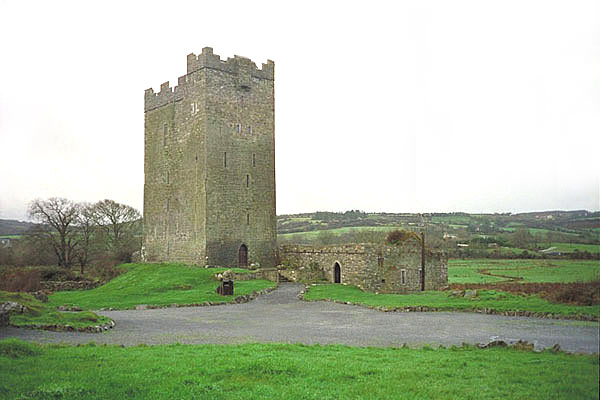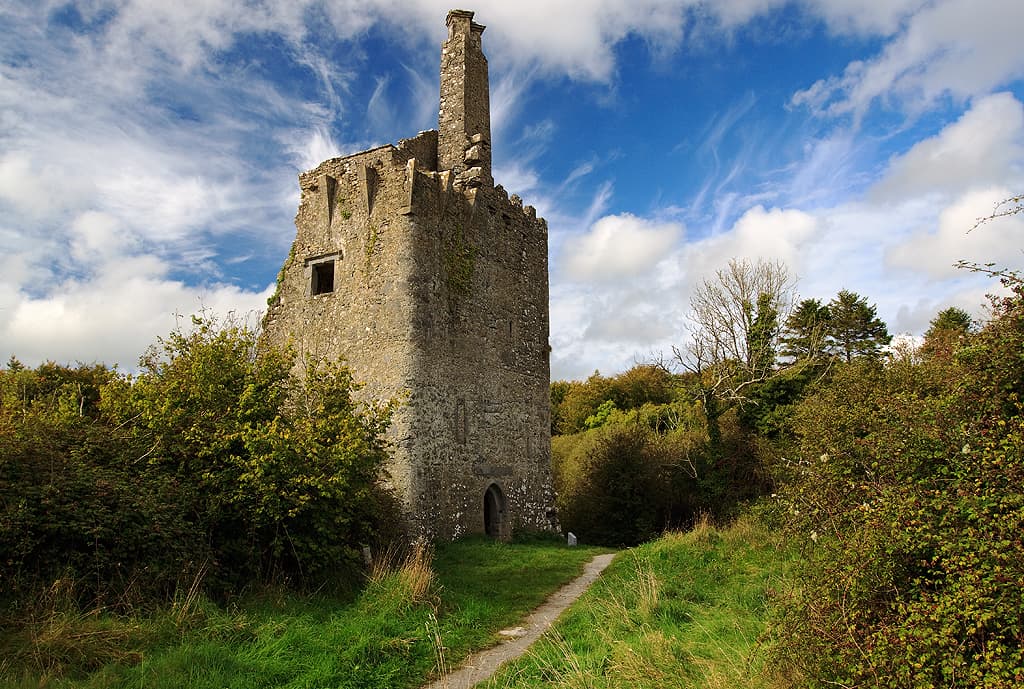
Dromore Castle is a notable example of a 16th-century tower house situated in County Clare, Ireland. This historic structure stands between the towns of Crusheen and Corofin, embedded within the scenic landscape of the Dromore Wood Nature Reserve. Managed by the National Parks and Wildlife Service, the castle is a protected National Monument that offers insight into Ireland's Renaissance period architecture and defensive residential designs.
Historical background and location
Dromore Castle was constructed in the 16th century, a time when tower houses were commonly built across Ireland as fortified residences for local lords and gentry. The castle's placement on a slight elevation classifies it as a hill castle, providing strategic views over the surrounding countryside and natural defenses against potential attackers.
The castle's proximity to the towns of Crusheen and Corofin situates it within a historically rich region of County Clare, known for its rural heritage and numerous archaeological sites. The integration of the castle into the Dromore Wood Nature Reserve enhances its cultural and environmental significance, combining natural beauty with heritage preservation.
Architectural features and design
Dromore Castle is a classic example of an Irish tower house, a type of fortified residence characterized by a tall, narrow structure designed primarily for defense and habitation. The castle's vertical emphasis is typical of such buildings, with multiple floors connected by a spiral staircase often located within a corner turret.
The castle's walls are constructed of locally sourced stone, providing both strength and insulation. Defensive features likely include narrow slit windows for archers, battlements or crenellations at the roofline, and a fortified entrance designed to resist forced entry. While specific details about internal chambers and layout are limited, typical tower houses from this period include a great hall, private chambers, storage areas, and sometimes a dungeon or cellar.
Defensive elements
The castle's elevated position on a hill enhances its natural defenses, allowing occupants to observe approaching threats from a distance. The thick stone walls and limited access points would have made it difficult for attackers to penetrate the stronghold. Additionally, features such as machicolations or murder holes may have been present to defend the entrance, although specific evidence for these at Dromore Castle is not well documented.
Role within the Renaissance period in Ireland
During the Renaissance in Ireland, the construction of tower houses like Dromore Castle reflected the socio-political climate of the time. These structures served as both homes and fortifications for the Irish gentry, balancing domestic comfort with military readiness amid frequent local conflicts and shifting allegiances.
Dromore Castle exemplifies this dual purpose, embodying Renaissance architectural influences adapted to the practical needs of rural Ireland. The castle's design prioritizes defense while also providing living space that would have been suitable for the status and lifestyle of its inhabitants.
Current condition and conservation
Today, Dromore Castle is preserved as a National Monument and is in a well-preserved state, maintained by the National Parks and Wildlife Service. Its location within the Dromore Wood Nature Reserve ensures both environmental protection and public accessibility.
Visitors to the site can explore the castle grounds and surrounding woodlands, gaining an appreciation for the castle's historical context and its integration into the natural landscape. Conservation efforts focus on stabilizing the structure and preventing deterioration while allowing safe public access.
Visiting information and cultural significance
Dromore Castle is accessible to visitors interested in Ireland's medieval and Renaissance heritage. The surrounding nature reserve offers walking trails and opportunities for wildlife observation, making the site a destination for both history enthusiasts and nature lovers.
Interpretive signage and guided tours may be available seasonally, providing educational insights into the castle's architecture, history, and its role within the broader context of Irish heritage.
Photo gallery

Information
Loading map...
Visitor reviews
No reviews yet. Been here? Write the first review and help other travelers!
Write the first reviewVisited this castle? Share your experience
Your review helps other travelers and adds first-hand knowledge to our encyclopedia.