O'Dea Castle — Ireland castle

O'Dea Castle

O'Dea Castle: late medieval tower house in County Clare, Ireland
Late Medieval (14th–15th c.)

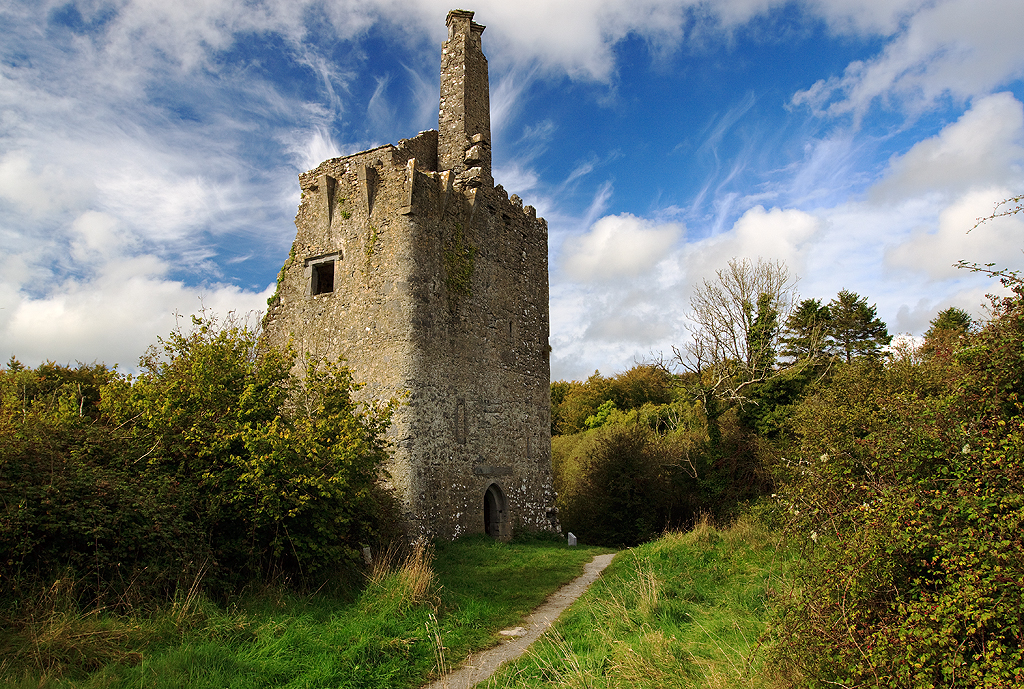
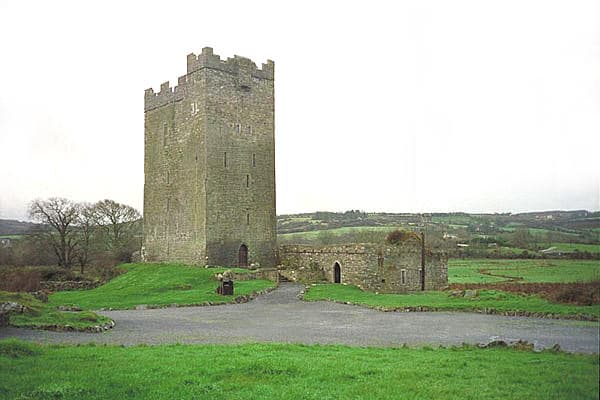
O'Dea Castle, also known as Dysert O'Dea Castle, is a prominent example of a late medieval fortified tower house located near Corofin in County Clare, Ireland. Constructed between 1470 and 1490 by Diarmaid O'Dea, the Lord of Cineal Fearmaic, this castle served as the stronghold of the O'Dea clan, an influential Gaelic family in the region. The castle's name derives from the nearby Dysert O'Dea Monastery, with "Dysert" meaning "hermitage" in Irish, indicating the area's religious significance alongside its military function.

Architectural features and structure

O'Dea Castle is a tower house standing approximately 50 feet (15 meters) high, built on a natural limestone outcrop that measures about 20 by 40 feet (6 by 12 meters). This elevated position provided both a defensive advantage and a commanding view of the surrounding landscape. The castle's design is typical of Irish tower houses of the period, featuring thick stone walls, narrow slit windows for archers, and a fortified entrance to deter attackers.

The castle's vertical layout is composed of multiple floors connected by a spiral staircase embedded within the walls. The ground floor was typically used for storage and included a vaulted ceiling for added strength. Above, the main hall and living quarters were located, designed for both habitation and defense. The battlements at the top allowed defenders to survey the area and repel invaders.

Defensive elements

The castle incorporates several defensive features common to late medieval Irish fortifications. These include a murder hole above the entrance, enabling defenders to attack assailants attempting to breach the door. The narrow windows served as arrow slits, providing protection while allowing archers to fire upon enemies. The thick walls, sometimes exceeding several feet in thickness, offered substantial resistance to siege weapons.

While the castle lacks extensive curtain walls or outer baileys typical of larger castles, its strategic location on a rocky outcrop and compact, vertical design compensated for these absences, making it difficult to assault.

Historical context and ownership

The O'Dea family were a powerful Gaelic clan in County Clare, with their influence extending over the surrounding territories. Diarmaid O'Dea, who commissioned the castle, was a notable figure in the region during the 15th century. The castle was built during a period of frequent clan conflicts and English incursions, necessitating strong defensive residences for Gaelic lords.

Throughout its history, O'Dea Castle witnessed various conflicts, including skirmishes related to the Desmond Rebellions and later English attempts to consolidate control over Ireland. The castle remained in the hands of the O'Dea family for several centuries, serving as both a residence and a symbol of their authority.

Connection to Dysert O'Dea Monastery

The castle's proximity to the Dysert O'Dea Monastery highlights the intertwined religious and secular power structures of medieval Ireland. The monastery, founded in the early medieval period, was an important religious center, and the castle's presence nearby underscored the O'Dea clan's role as both protectors and patrons of the church.

Preservation and current status

O'Dea Castle is well preserved compared to many other tower houses in Ireland. Its stone structure remains largely intact, allowing visitors to appreciate the architectural details and defensive features. The castle has undergone conservation efforts to maintain its condition and ensure safety for public access.

Today, the castle is a popular tourist attraction, offering guided tours that explore its history, architecture, and the broader cultural heritage of the O'Dea clan and County Clare. The site also includes a museum showcasing artifacts from the castle and surrounding area, providing insight into the medieval lifestyle and conflicts of the region.

Visitor information

O'Dea Castle is located approximately 5 kilometres from Corofin, accessible via the R476 road. Visitors can explore the castle grounds and interiors during opening hours, which vary seasonally. The castle's elevated position and sturdy construction offer a tangible connection to Ireland's medieval past.

Architectural significance and influence

The castle exemplifies the tower house typology that proliferated across Ireland during the late medieval period. These structures combined residential and defensive functions in a compact vertical form, reflecting the turbulent political landscape of the time. O'Dea Castle's preservation provides valuable insight into construction techniques, defensive strategies, and the social status of Gaelic lords.

The use of local limestone and the castle's adaptation to the natural rock outcrop illustrate the integration of architecture with the landscape. Its design influenced subsequent fortifications in the region and remains a key example studied by historians and architects interested in medieval Irish castles.

Frequently asked questions (FAQ)

How do I get to O'Dea Castle?
O'Dea Castle is located in County Clare, Ireland, easily accessible by car or public transport. The nearest major city is Ennis, which is about 15 minutes away by car. There are parking facilities available at the castle for visitors.
What is the historical significance of O'Dea Castle?
O'Dea Castle, built in the 15th century, is a significant example of medieval architecture in Ireland. It served as the stronghold of the O'Dea clan, who played a vital role in the region's history. The castle is a testament to the turbulent past of Irish clans and their enduring legacies.
When was O'Dea Castle constructed?
O'Dea Castle was constructed in the early 15th century, around 1450. It has been remarkably well-preserved, allowing visitors to step back in time and experience a piece of Ireland's rich history. The castle underwent various renovations over the centuries, reflecting changes in architectural styles.
Can I take a guided tour of O'Dea Castle?
Yes, guided tours of O'Dea Castle are available, providing visitors with in-depth insights into its history and architecture. The tours are conducted by knowledgeable guides who share fascinating stories about the castle and its former inhabitants. It's a great way to enhance your visit and learn more about this historical site.
Why is O'Dea Castle a popular tourist attraction?
O'Dea Castle is popular due to its well-preserved structure and rich history, drawing visitors interested in medieval architecture and Irish heritage. The castle's picturesque setting and educational tours make it an appealing destination for families, history enthusiasts, and tourists alike. Additionally, its proximity to other attractions in County Clare adds to its appeal.
Is it possible to visit O'Dea Castle year-round?
Yes, O'Dea Castle is open to visitors year-round, though hours may vary seasonally. It's advisable to check the official website or contact the castle for the latest opening hours before planning your visit. This flexibility allows visitors to explore the castle during their travels in Ireland.
What are the ticket prices for O'Dea Castle?
Ticket prices for O'Dea Castle are generally affordable, with discounts available for children, students, and seniors. Admission fees help maintain the castle and support its preservation efforts. For the most accurate pricing, it's best to visit the official website or inquire at the entrance.
What is the best time to visit O'Dea Castle?
The best time to visit O'Dea Castle is during the late spring and summer months, from May to September, when the weather is typically mild and pleasant. This season also sees a variety of events and activities at the castle, enhancing the visitor experience. However, autumn can also be beautiful, with fewer crowds and stunning fall foliage.
Are there any nearby attractions to O'Dea Castle?
Yes, O'Dea Castle is conveniently located near several attractions, including the Cliffs of Moher and the Burren National Park. Visitors can explore the unique landscapes and historical sites in the surrounding area. This makes O'Dea Castle an excellent starting point for a broader exploration of County Clare.

Photo gallery

O'Dea Castle
Click to view

Photo by Odea at English Wikipedia•Public domain

1 photo • Click any image to view in full screen

Information

Hill Castle

Loading map...

Visitor reviews

No reviews yet. Been here? Write the first review and help other travelers!

Write the first review

Visited this castle? Share your experience

Your review helps other travelers and adds first-hand knowledge to our encyclopedia.

Write a review

(5/5)

0/2000 characters

Your review will be visible after admin approval

Nearby castles

0 km

O’Dea Castle

, United Kingdom

O’Dea Castle is a quintessential example of a late medieval Irish tower house, located in Mollaneen near Corofin in County Clare, Ireland. Constructed between 1470 and 1490 by Diarmaid O’Dea, the castle served as the fortified residence of the native Gaelic O’Dea clan, who controlled the surrounding lands during a period marked by frequent conflict and political upheaval. The castle's strategic position atop a limestone outcrop provided a natural defensive advantage, typical of hill castles designed to oversee and protect their territories. The site of O’Dea Castle holds significance that predates the structure itself. Notably, in 1318, the area was the scene of the Battle of Dysert O’Dea, where a coalition of Irish clans decisively defeated Anglo-Norman forces, ending their dominance in the region for over two centuries. This victory is a defining moment in the local history of County Clare and reflects the resilience of Gaelic Ireland during the late medieval period. Architectural features and construction The castle is a classic example of a fortified tower house, a common type of residence for Gaelic lords during the 15th century. Rising approximately 15 meters high, the structure is built on a naturally elevated limestone platform measuring about 6 by 12 meters. Constructed primarily from local stone, the tower house was designed to be both a defensible stronghold and a noble residence. Key architectural elements include battlements that originally crowned the walls, providing a protected parapet for defenders. The interior contained multiple floors connected by a now partially destroyed staircase, which allowed access to living quarters and defensive positions. The castle also featured a wall walk along the roofline, enabling sentries to patrol and defend the structure effectively. During the Cromwellian conquest of Ireland in the mid-17th century, the castle suffered deliberate damage inflicted by occupying soldiers. The battlements, upper storeys, and main staircase were partially demolished, significantly reducing the castle's defensive capabilities and residential function. Despite this, the core tower house remains largely intact, offering valuable insight into medieval Irish military architecture. Historical significance and ownership The castle's history is closely intertwined with the fortunes of the O’Dea clan, who were prominent Gaelic lords in County Clare. After its construction by Diarmaid O’Dea, the castle witnessed numerous conflicts reflecting the turbulent political landscape of Ireland from the late 15th century through the 17th century. In 1570, the castle was briefly seized by the Earl of Ormond, an influential Anglo-Irish noble, but was reclaimed by the O’Dea family by 1584 under Domhnall Maol O’Dea. The Nine Years’ War (1594–1603) brought further changes in control, with the castle passing to Daniel Neylon, a Protestant bishop, before returning to the O’Deas. In the early 1640s, Conor Cron O’Dea, a notable leader, supported the Irish Confederates during the Irish Confederate Wars, participating in the siege of Ballyalla Castle in 1642. The castle later endured occupation by Cromwellian forces in 1651, who garrisoned it and inflicted structural damage. Following the Cromwellian period, ownership shifted between the Neylon family and the O’Deas. However, after supporting King James II during the Jacobite–Williamite conflicts, the O’Dea family lost the castle, which passed to the Synge family. The castle subsequently fell into decline until the 20th century. Restoration and archaeological significance In 1970, the castle was purchased by John O’Day, an American who initiated restoration efforts to preserve this important heritage site. The restoration focused on stabilizing the tower house and reconstructing elements such as the partial wall walk, allowing visitors to experience the castle's medieval defensive features. Adjacent to the castle are the remains of the Dysert O’Dea Monastery, an ecclesiastical site that enriches the historical landscape. The combined archaeological complex offers a comprehensive view of the region's medieval social and religious life. Within the castle, the Dysert O’Dea Castle Archaeology Centre houses an extensive collection of artifacts spanning from the Stone Age (1700–1000 BCE) through to the early 20th century. These exhibits provide invaluable insight into the long history of human settlement in the area, linking prehistoric occupation with the medieval Gaelic heritage and beyond. Cultural heritage and visitor experience Today, O’Dea Castle stands as a well-preserved example of Irish medieval architecture and Gaelic clan history. Its restoration and museum facilities offer visitors an immersive experience into Ireland’s turbulent past, from ancient times through the medieval era to modern history. The castle's location in County Clare places it within a region rich in cultural heritage, with nearby historical sites and natural landscapes enhancing its appeal. Visitors can explore the castle’s defensive structures, the archaeological trails around the monastery, and the museum’s extensive collections, making it a significant destination for those interested in Irish history and architecture.

Late Medieval (14th–15th c.)
Details
5.4 km

Ballyportry Castle

Munster, United Kingdom

Ballyportry Castle stands as a significant relic of medieval Gaelic Ireland, located in the historic province of Munster. Constructed in the 15th century by the powerful O'Brien family, who were the dominant Gaelic aristocrats in County Clare, this castle was part of a network of fortifications and ecclesiastical buildings that symbolized the O'Briens' territorial control and influence during the late medieval period. The castle's architecture reflects the typical medieval Gaelic defensive style, characterized by robust stone walls, narrow windows for archers, and strategic positioning to oversee and protect their lands. Although specific architectural details of Ballyportry Castle have not been extensively documented, it likely featured a tower house structure, which was common among Gaelic lords for both residence and defense. The castle's location in Clare, a region rich in Gaelic heritage, made it a focal point of local power and culture. Historical significance of Ballyportry Castle The castle was a key stronghold for the O'Brien dynasty, who held sway over much of Clare during the 15th century. The O'Briens were descendants of the High King Brian Boru and maintained their status as Gaelic nobility well into the early modern period. Ballyportry Castle was not merely a military fortification but also a symbol of Gaelic resilience and governance in a period marked by increasing Anglo-Norman influence in Ireland. For just over a century, Ballyportry Castle served as a residence and defensive bastion for the O'Briens. However, the fortunes of Gaelic Ireland began to wane following the Battle of Kinsale in 1603, a decisive conflict that led to the collapse of Gaelic power in Ireland. The defeat at Kinsale marked the beginning of the end for many Gaelic lords, including the O'Briens, as English control expanded and Gaelic landholdings were confiscated or diminished. The decline of Gaelic Ireland and Ballyportry's fate Following the Battle of Kinsale, the 17th century was a period of decline for Gaelic aristocracy. The O'Brien family and other Gaelic leaders faced increasing pressure from English colonial policies, land seizures, and military campaigns. The Treaty of Limerick in 1691 symbolized the final collapse of Gaelic Ireland's political and military autonomy. While Ballyportry Castle did not play a direct role in these later conflicts, its decline mirrored the broader fate of Gaelic fortifications across Ireland. Many such castles fell into disrepair or were abandoned as the Gaelic aristocracy lost their lands and influence. Today, Ballyportry Castle remains an important historical site, representing the legacy of Gaelic Ireland's medieval aristocracy and their architectural heritage. Architectural features and cultural heritage Though detailed records of Ballyportry Castle's architectural elements are scarce, it is likely that the castle included typical features of a Gaelic tower house, such as thick stone walls, a fortified entrance, battlements, and narrow slit windows designed for defense. These features were practical adaptations to the turbulent political landscape of medieval Ireland, where castles served as both homes and military strongholds. The castle's cultural significance extends beyond its military function. As a seat of the O'Brien family, Ballyportry was a center of Gaelic governance, law, and culture. It likely hosted gatherings, legal proceedings, and served as a symbol of the O'Briens' authority in Clare. Preservation and current status Today, Ballyportry Castle is recognized as a site of historical importance in Munster. Its remains, though not fully intact, offer valuable insights into Gaelic castle construction and the socio-political history of medieval Ireland. Preservation efforts focus on maintaining the site for educational and cultural purposes, allowing visitors to connect with Ireland's rich Gaelic past. Visitors to the region interested in medieval Irish history and architecture will find Ballyportry Castle a compelling destination. Its story encapsulates the rise and fall of Gaelic power and the architectural legacy left behind by one of Ireland's most storied families.

Late Medieval (14th–15th c.)
Details
7.1 km
Dromore Castle — Ireland castle

Dromore Castle

, Ireland

Dromore Castle is a notable example of a 16th-century tower house situated in County Clare, Ireland. This historic structure stands between the towns of Crusheen and Corofin, embedded within the scenic landscape of the Dromore Wood Nature Reserve. Managed by the National Parks and Wildlife Service, the castle is a protected National Monument that offers insight into Ireland's Renaissance period architecture and defensive residential designs. Historical background and location Dromore Castle was constructed in the 16th century, a time when tower houses were commonly built across Ireland as fortified residences for local lords and gentry. The castle's placement on a slight elevation classifies it as a hill castle, providing strategic views over the surrounding countryside and natural defenses against potential attackers. The castle's proximity to the towns of Crusheen and Corofin situates it within a historically rich region of County Clare, known for its rural heritage and numerous archaeological sites. The integration of the castle into the Dromore Wood Nature Reserve enhances its cultural and environmental significance, combining natural beauty with heritage preservation. Architectural features and design Dromore Castle is a classic example of an Irish tower house, a type of fortified residence characterized by a tall, narrow structure designed primarily for defense and habitation. The castle's vertical emphasis is typical of such buildings, with multiple floors connected by a spiral staircase often located within a corner turret. The castle's walls are constructed of locally sourced stone, providing both strength and insulation. Defensive features likely include narrow slit windows for archers, battlements or crenellations at the roofline, and a fortified entrance designed to resist forced entry. While specific details about internal chambers and layout are limited, typical tower houses from this period include a great hall, private chambers, storage areas, and sometimes a dungeon or cellar. Defensive elements The castle's elevated position on a hill enhances its natural defenses, allowing occupants to observe approaching threats from a distance. The thick stone walls and limited access points would have made it difficult for attackers to penetrate the stronghold. Additionally, features such as machicolations or murder holes may have been present to defend the entrance, although specific evidence for these at Dromore Castle is not well documented. Role within the Renaissance period in Ireland During the Renaissance in Ireland, the construction of tower houses like Dromore Castle reflected the socio-political climate of the time. These structures served as both homes and fortifications for the Irish gentry, balancing domestic comfort with military readiness amid frequent local conflicts and shifting allegiances. Dromore Castle exemplifies this dual purpose, embodying Renaissance architectural influences adapted to the practical needs of rural Ireland. The castle's design prioritizes defense while also providing living space that would have been suitable for the status and lifestyle of its inhabitants. Current condition and conservation Today, Dromore Castle is preserved as a National Monument and is in a well-preserved state, maintained by the National Parks and Wildlife Service. Its location within the Dromore Wood Nature Reserve ensures both environmental protection and public accessibility. Visitors to the site can explore the castle grounds and surrounding woodlands, gaining an appreciation for the castle's historical context and its integration into the natural landscape. Conservation efforts focus on stabilizing the structure and preventing deterioration while allowing safe public access. Visiting information and cultural significance Dromore Castle is accessible to visitors interested in Ireland's medieval and Renaissance heritage. The surrounding nature reserve offers walking trails and opportunities for wildlife observation, making the site a destination for both history enthusiasts and nature lovers. Interpretive signage and guided tours may be available seasonally, providing educational insights into the castle's architecture, history, and its role within the broader context of Irish heritage.

Renaissance (15th–17th c.)
Details