Ockenfels Castle
Ockenfels Castle is a prominent hill castle perched on a gentle spur about 60 meters above the Rhine River in the municipality of Ockenfels, Germany. This historic fortress, originally established in the early 13th century, exemplifies the enduring strategic and architectural significance of medieval castles along the Rhine valley. Its commanding position provided both defensive advantage and control over the surrounding landscape, a common characteristic of hill castles constructed during the High Medieval period.
The castle’s origins trace back to the noble Herren zur Leyen family, vassals to the Electorate of Cologne, who first built the fortress to secure their territorial holdings. Early documentation from 1239 references their fief at Oberwillscheid, while by 1341 Johann von der Leyen is recorded as the castle’s owner. The castle’s ownership history reflects the complex feudal relationships and inheritance practices of medieval Germany, passing through several noble families over the centuries.
Medieval origins and ownership lineage
The Herren zur Leyen family maintained control until their male line ended in 1420, after which Rolman von Dattenberg acquired the castle. Through the marriage of his daughter Anna von Dattenberg in 1439, the castle passed to Dittrich von Monreal and his descendants, who held it for nearly two centuries. This period saw the castle functioning as a feudal seat and defensive stronghold amid the political turbulence of the region.
In 1475, Ockenfels Castle suffered significant damage during the Kölner Stiftsfehde (Cologne ecclesiastical conflict), when forces under Charles the Bold attacked and destroyed parts of the fortress. Despite this, records from the early 17th century describe the castle as strong and well-maintained under Johann Adam von Hoheneck. By 1615, the castle was officially recognized by Elector Ferdinand of Cologne, confirming Eberhard Heinrich von Hoheneck as the estate’s legitimate holder.
Ownership changes and early modern period
The castle changed hands again in 1623 when it was sold to Georg von Gerolt, a councilor and financial controller of the Electorate of Cologne. Von Gerolt resided in nearby Linz am Rhein and was formally enfeoffed with the estate in 1624. The Gerolt family retained ownership until the male line ended in 1887 with the death of Friedrich von Gerolt. Subsequently, the property was acquired by the Rheinisches Heim housing cooperative.
In 1912, the area containing the castle was incorporated into the town of Linz, which purchased the site in 1918. The castle had fallen into ruin by this time, reflecting centuries of neglect and the impact of earlier conflicts.
20th-century restoration and adaptive reuse
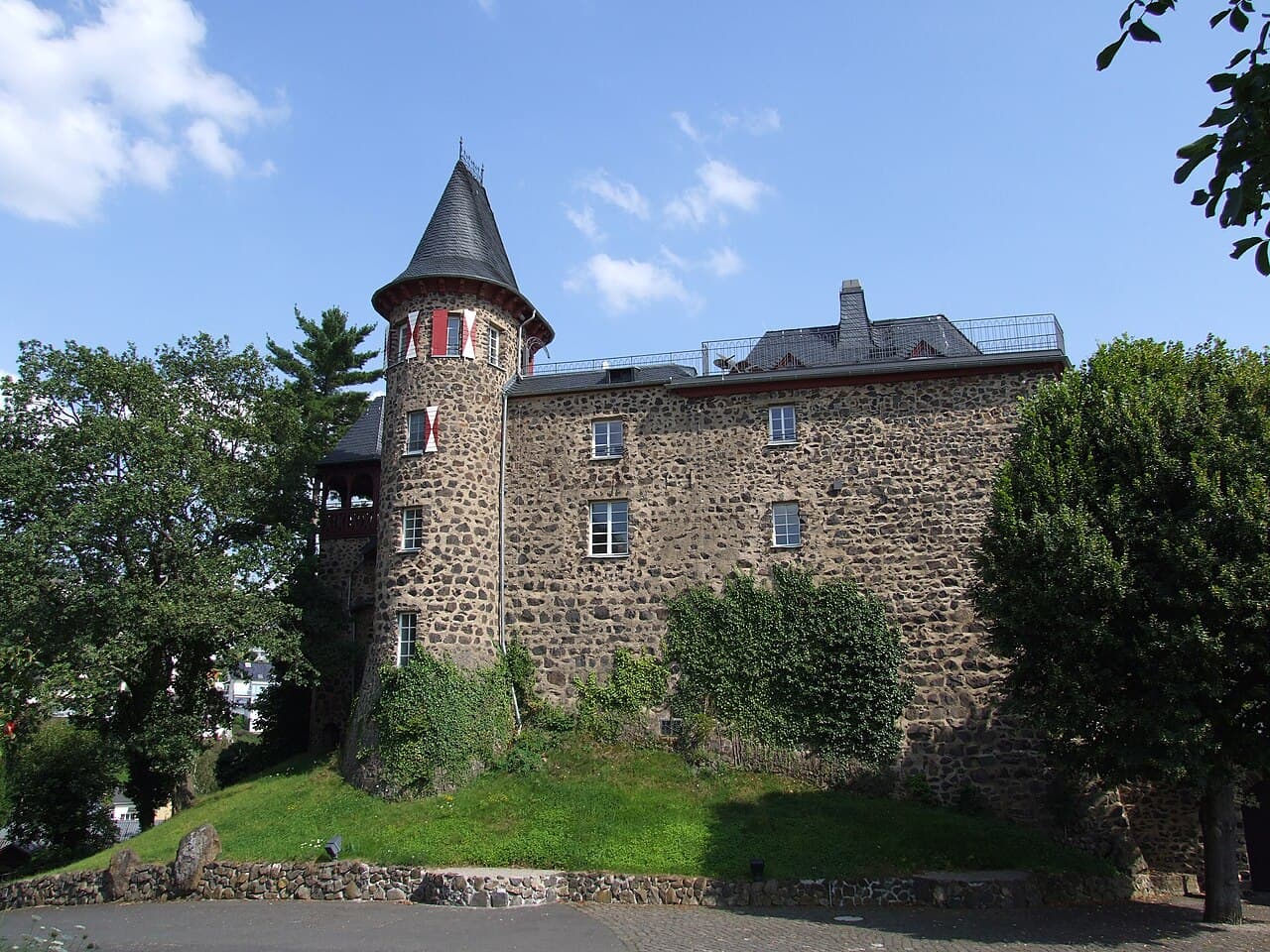
In 1924, Vice-Consul Franz Delden acquired the ruined castle and commissioned architect Heinrich Reinhardt to undertake a comprehensive restoration. Between 1924 and 1927, the reconstruction incorporated surviving medieval walls and fragments of the defensive ring wall, utilizing basalt rubble stones to replicate the original masonry. Reinhardt’s work embraced a romantic medieval aesthetic, blending historical authenticity with early 20th-century architectural sensibilities.
Following restoration, the castle served various functions: from 1936, it operated as a nursing home run by the Cellitinnen sisters of Cologne. By 1960, it was converted into a hotel specializing in rest and wellness, reflecting changing social and economic uses of historic buildings. After several ownership changes and a period of disuse, the castle was acquired in 1998 by Kundenzentrum Burg Ockenfels GmbH. It now functions as office space for the Betula shoe brand and Birko Orthopädie under the Birkenstock company.
Architectural features and castle layout
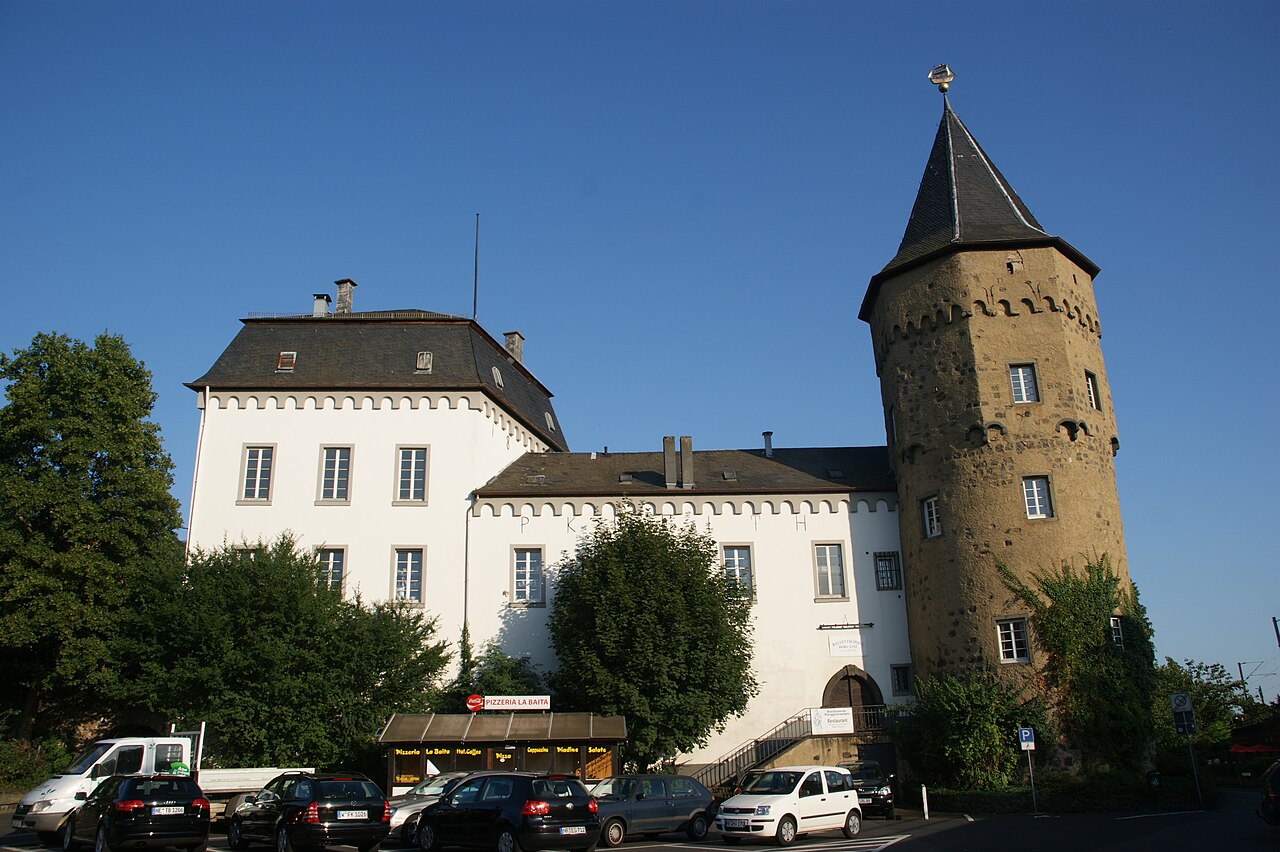
Ockenfels Castle is characterized by its three-winged building complex centered around a prominent Burgfried (main tower). This tower is flanked by two semi-circular towers, which together form a defensive enclosure around a central courtyard open toward the Rhine valley below. The castle’s elevated position on the hilltop provided natural defense augmented by its architectural features.
The current structure reflects a combination of surviving medieval fabric and 20th-century additions. Key medieval elements include foundation walls, a fragment of the defensive ring wall, and one original tower segment. These remnants served as a foundation for the romantic restoration, which carefully matched the historic masonry with basalt rubble stone construction.
The integration of authentic ruins with new construction creates a distinctive layout that honors the castle’s historical origins while ensuring structural stability. The use of basalt not only echoes the local geology but also reinforces the fortress’s imposing presence. The castle’s design conveys its original defensive purpose and its enduring role as a landmark in the Rhine valley landscape.
Cultural significance and visitor experience
Today, Ockenfels Castle stands as a testament to the layered history of medieval fortifications in Germany. Its location near the Rheinsteig hiking trail makes it accessible to visitors interested in exploring the scenic and historic Rhine valley. The castle’s blend of medieval ruins and romantic restoration offers insight into both medieval architecture and early 20th-century preservation approaches.
While the castle is currently used for commercial offices, its exterior and surroundings remain a point of interest for historians, architects, and tourists. The castle’s story reflects broader themes of feudal power, conflict, architectural evolution, and adaptive reuse, making it a valuable cultural heritage site.
Frequently asked questions (FAQ)
- How do I get to Ockenfels Castle?
- Ockenfels Castle is located near the town of Ockenfels in Rhineland-Palatinate, Germany. It is accessible by local roads and is close to the Rheinsteig hiking trail, which passes nearby. Visitors can reach the castle by car or on foot from Linz am Rhein.
- What is the historical significance of Ockenfels Castle?
- Ockenfels Castle is a historic hilltop fortress originally built in the early 13th century by the Herren zur Leyen family. It played a strategic role in regional conflicts, including damage during the Kölner Stiftsfehde, and reflects the feudal history of the Electorate of Cologne.
- Can I visit the interior of Ockenfels Castle?
- Currently, Ockenfels Castle is privately owned and used as office space, so public access to the interior is limited. However, visitors can view the castle exterior and its architectural features from the surrounding grounds and nearby hiking trails.
- When was the castle restored?
- The castle underwent significant restoration between 1924 and 1927 under architect Heinrich Reinhardt, who incorporated surviving medieval structures and used basalt rubble stones to match the original masonry.
- Why is basalt stone used in the castle's construction?
- Basalt is a volcanic rock common in the Rhineland region. Its use in Ockenfels Castle's restoration reflects local geology and provides durable, visually consistent masonry that echoes the medieval building materials.
Photo gallery

Information
Architect
Heinrich Reinhardt
Current owner
Kundenzentrum Burg Ockenfels GmbH
Loading map...
Visitor reviews
No reviews yet. Been here? Write the first review and help other travelers!
Write the first reviewVisited this castle? Share your experience
Your review helps other travelers and adds first-hand knowledge to our encyclopedia.