Ochiltree Castle
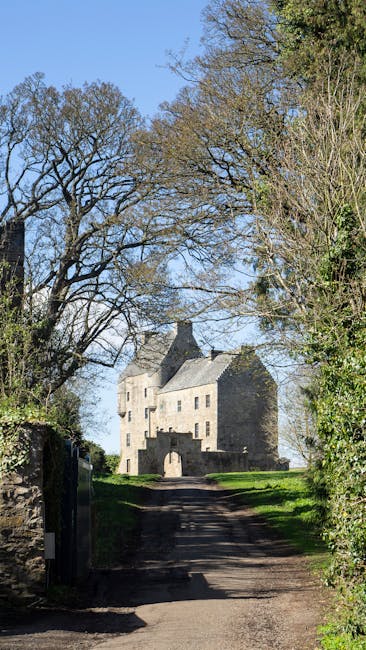
Ochiltree Castle, located near Linlithgow in Scotland, is a notable example of a 16th-century Renaissance tower house. Its architecture and history reflect the turbulent and dynamic nature of Scottish noble estates during the Renaissance period. The castle stands as a three-storey L-plan building with an attic, featuring distinctive circular bartizans at the south east and north west angles on the second storey, which were typical defensive and decorative elements of the era.
Historical ownership and significance
The estate was originally owned by Sir James Hamilton of Finnart from 1526, following the forfeiture of the Stirling family of Keir. Hamilton's tenure ended with his execution for treason in 1540, after which the castle's ownership is less clearly documented. It is believed that in the late 16th century, Captain James Stewart of Ochiltree from East Ayrshire may have owned or even constructed the castle, although this is not definitively confirmed. By 1610, the property had reverted to the Stirling family, significant Scottish landowners with a long regional presence.
During the early 17th century, the castle underwent substantial remodeling under Sir Archibald Stirling of Keir and his wife Dame Grizel Stirling (née Ross), whose monograms are still visible on the finialed pediments above the western doorway. This renovation included the addition of a new entrance porch, a straight staircase along the western wall connecting the ground and first floors, and an extension of the northern wing to include a new kitchen on the ground floor. The old kitchen was partitioned, and a new two-storey range of offices was added to the west. This west range was later replaced in the late 19th century by a long single-storey wing, which possibly incorporated parts of the earlier structure in its southern wall.
Architectural features and layout
The castle's L-plan design was a common layout for Scottish tower houses, providing both defensive advantages and practical living arrangements. The circular bartizans, positioned on the second-storey corners, served as lookout points and added to the castle's imposing silhouette. The original entrance was located in the interior angle of the north wall, adjacent to a circular stair turret, which was a typical feature for access and defense.
The extensive remodeling around 1610 modernized the castle's appearance and functionality, reflecting Renaissance influences in Scottish architecture. The new western doorway and porch enhanced the castle's approach, while the addition of a straight staircase improved internal circulation. The extension of the northern wing and the addition of service buildings demonstrated the evolving domestic needs of the estate's owners.
The estate and its surroundings
By the early 19th century, the Ochiltree estate was owned by Archibald Primrose, 4th Earl of Rosebery. The estate spanned across two parishes: Linlithgow and Ecclesmachan, indicating its considerable size and importance in the region. The castle itself, while primarily a residence, was part of a larger landed estate that included agricultural lands and possibly other ancillary buildings.
Later alterations and current state
The late 19th-century replacement of the west range with a single-storey wing suggests ongoing adaptation of the castle to changing needs and styles. This wing projects to the south east and likely incorporates remnants of the earlier structures, blending historical fabric with newer construction.
Today, Ochiltree Castle remains a well-preserved example of a Renaissance Scottish tower house, showcasing architectural features from both its original 16th-century construction and its 17th- and 19th-century modifications. Its layered history and distinctive design elements make it a subject of interest for those studying Scottish noble residences and Renaissance architecture in Scotland.
Architectural and cultural importance
Ochiltree Castle exemplifies the transition in Scottish castle architecture from purely defensive medieval fortresses to more comfortable and stylistically refined Renaissance homes. The incorporation of bartizans, finialed pediments, and remodeled interiors reflects broader European influences reaching Scotland during this period. The castle's association with notable historical figures such as Sir James Hamilton of Finnart and the Stirling family further enhances its cultural significance.
Its location near Linlithgow, a town with rich royal and architectural heritage, situates Ochiltree Castle within a landscape dense with historical landmarks, contributing to understanding the social and political networks of Scottish nobility in the Renaissance and post-Renaissance periods.
Information
Loading map...
Visitor reviews
No reviews yet. Been here? Write the first review and help other travelers!
Write the first reviewVisited this castle? Share your experience
Your review helps other travelers and adds first-hand knowledge to our encyclopedia.