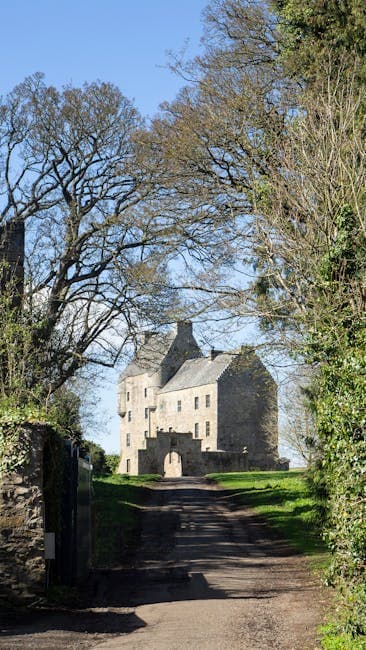
Midhope Castle
Midhope Castle stands as a remarkable example of a 16th-century Scottish tower house located near Abercorn in West Lothian, Scotland. Famously known as "Lallybroch" in the popular American television series Outlander, this historic castle has drawn increasing attention from visitors and fans alike. The castle is situated within a private estate owned by the Hopetoun family, who permit public access to the castle's exterior under regulated conditions, reflecting its location in an active agricultural area.
Architectural evolution and features
The castle's core structure is a five-storey oblong tower house, characteristic of Scottish noble residences from the Renaissance period. The original tower likely dates back to the 15th century, with significant modifications occurring in the late 16th and 17th centuries. In 1678, the castle underwent a notable transformation when the original entrance tower was removed, and the eastern wing was heightened and extended. This alteration included the addition of a new doorway and the construction of a small courtyard measuring approximately 114 by 61 feet (35 by 19 meters) on the southern side.
The castle's stonework includes a commemorative inscribed stone dated 1582 bearing the initials "AD MB," marking the ownership of Alexander Drummond and his wife Marjory Bruce. This stone is a key historical artifact linking the castle to prominent figures of the time. The painted ceiling originally from the tower is now preserved by Historic Scotland and features intricate cinquefoil motifs and gold stars on a blue background. These decorations celebrate the marriage of Sir Robert Drummond, laird of Midhope in 1619, to a Hamilton heiress, symbolizing the union of two influential Scottish families. The family motto, "ad astra per ardua," meaning "to the stars through difficulties," is reflected in the ceiling's star motifs and the Drummond coat of arms.
Historical context and ownership
The earliest records of the Midhope estate trace back to the 14th century, initially associated with Henry Graham of Mannerstoun. After his death without a male heir, the estate passed through his daughters, one of whom married John Martin of Midhope. It is believed that John Martin constructed the original tower house around 1438. The Martins maintained control of the estate through the 15th century, with Lady Christian Martin retaining occupancy rights after her husband's death.
In the 16th century, ownership shifted among various noble families. Elizabeth Martin, Lady of Falscastell, transferred half of the Midhope lands to Sir James Hamilton of Finnart in 1537. The estate was held under feudal overlordship by the Livingstones of Drumry and later by John Lindsay, 5th Lord Lindsay of the Byres. Alexander Drummond acquired the castle later in the century and was closely connected to the Crown, serving the Earl of Huntly and acting in official capacities such as returning jewels of Mary, Queen of Scots, to Regent Morton in 1573.
The Drummond family's influence continued into the 17th century, with Sir Robert Drummond's marriage to a Hamilton heiress marking a significant alliance. The Drummonds' stewardship saw the castle adapt architecturally and socially, reflecting their status and the evolving needs of a noble household.
Photo by Fernando Sánchez Aranguren
Estate features and ancillary structures
Beyond the main tower house, the estate includes a notable late 17th-century dovecot located approximately 140 meters southeast of the castle. This large, two-chambered oblong structure was designed to house pigeons or doves, which were valuable resources for food and fertilizer during the period. The dovecot exemplifies the practical aspects of estate management in the post-medieval Scottish countryside.
Cultural significance and modern interest
The castle's role as "Lallybroch" in Outlander has significantly increased public interest, bringing attention to its rich history and architectural heritage. While the castle itself remains a ruin, its evocative presence and connection to Scottish history and popular culture make it a compelling destination for visitors. Public access is carefully managed by the Hopetoun estate to balance preservation with visitor experience, requiring vehicle passes and adherence to guidelines due to the castle's location in an active farming area.
Preservation efforts have focused on safeguarding key historical elements such as the painted ceiling, which is housed at the Palace of Holyroodhouse for public display, ensuring that Midhope Castle's artistic and cultural legacies endure.
Visiting midhope castle
Visitors to Midhope Castle can explore the exterior of this evocative tower house, appreciating its imposing ruins and imagining its storied past. Due to its private estate location, access requires prior arrangement and compliance with estate rules, including obtaining a vehicle pass. The surrounding landscape offers a glimpse into the agricultural heritage of West Lothian, complementing the castle's historic ambiance.
Midhope Castle remains a poignant symbol of Scottish Renaissance architecture and noble life, enriched by its layered history and ongoing cultural relevance.
Frequently asked questions (FAQ)
- How do I visit Midhope Castle?
- Midhope Castle is located on private land owned by the Hopetoun estate. Visitors can view the exterior but must obtain a vehicle pass and follow estate guidelines. Access may be restricted on certain days due to agricultural activities.
- What is the historical significance of Midhope Castle?
- Midhope Castle is a notable 16th-century Scottish tower house with origins in the 15th century. It was home to the Martin and Drummond families and features Renaissance architectural modifications and a painted ceiling symbolizing noble alliances.
- Why is Midhope Castle known as Lallybroch?
- Midhope Castle is famously known as Lallybroch from the TV series Outlander, where it serves as the ancestral home of the protagonist Jamie Fraser, boosting its cultural and tourist appeal.
- What architectural features are notable at Midhope Castle?
- Key features include the five-storey oblong tower, a 1582 inscribed stone commemorating Alexander Drummond and Marjory Bruce, a painted ceiling with cinquefoil and star motifs, and a late 17th-century dovecot nearby.
- Is Midhope Castle accessible to the public?
- While the castle is on private estate land, the Hopetoun estate allows public access to the exterior with prior permission and a vehicle pass. Visitors should check for any access restrictions before planning their visit.
Photo gallery

Photo by Miquel Rosselló Calafell

Information
Sources & official resources
Verify the information above using these authoritative references.
Loading map...
Visitor reviews
No reviews yet. Been here? Write the first review and help other travelers!
Write the first reviewVisited this castle? Share your experience
Your review helps other travelers and adds first-hand knowledge to our encyclopedia.