Blackness Castle
Blackness Castle is a remarkable 15th-century fortress located on a rocky spit projecting into the Firth of Forth in Scotland. Constructed in the 1440s by Sir George Crichton, the castle likely replaced an earlier fortification and served as the main port for the Royal Burgh of Linlithgow, a principal residence of the Scottish monarch. Its strategic position on the southern shore of the Firth allowed it to control maritime access and defend the royal interests in the region.
The castle passed into crown ownership in 1453 when it was seized by James II of Scotland following a brief rebellion by the Crichton family. Since then, Blackness Castle has remained a royal property, serving variously as a fortress, state prison, and military installation. Notable prisoners held within its walls include Cardinal David Beaton and Archibald Douglas, 6th Earl of Angus.
Architectural design and fortifications
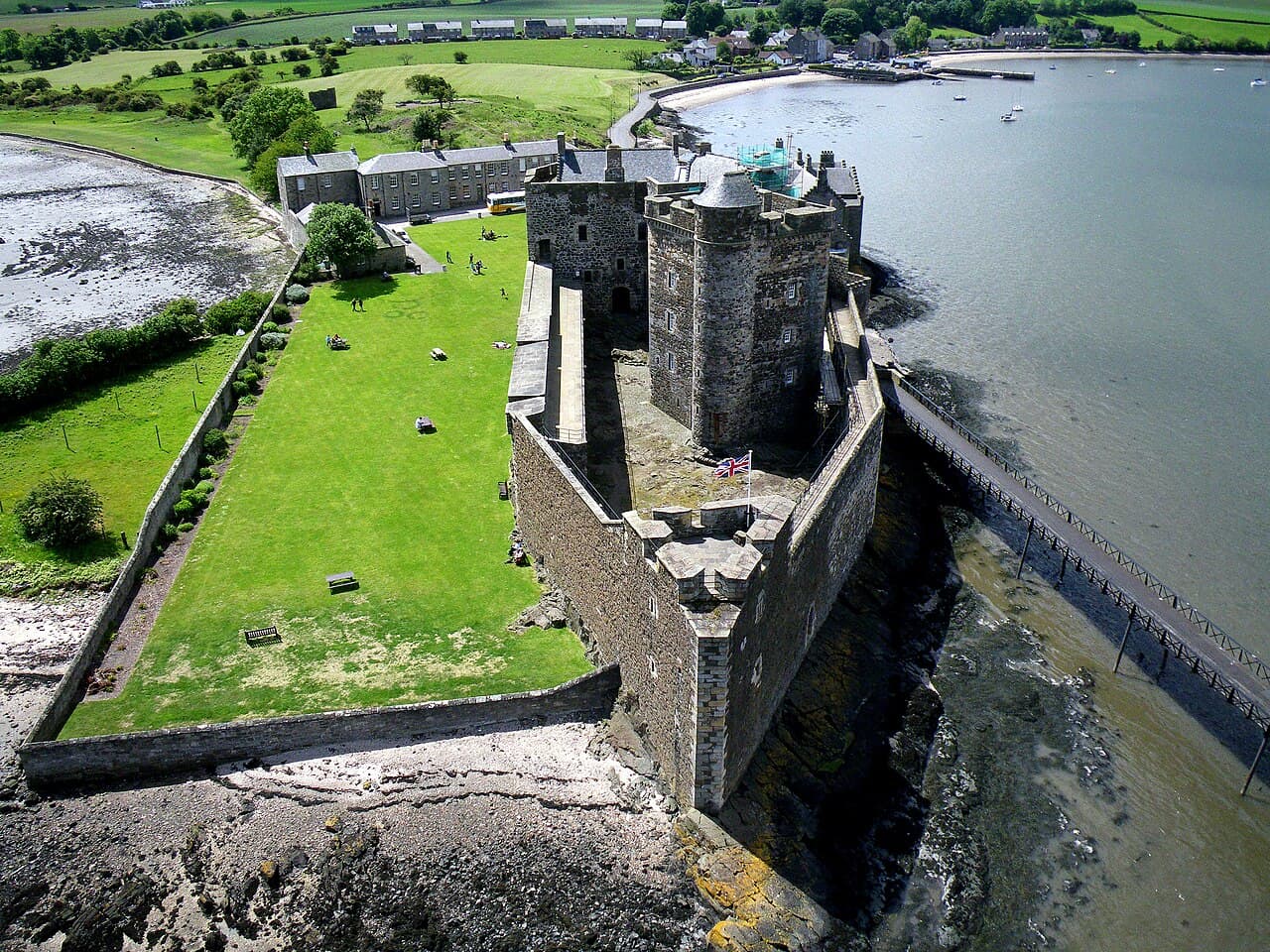
Blackness Castle is famously described as "the ship that never sailed" due to its long, narrow layout oriented along a north-south axis, jutting into the Firth of Forth. The castle's distinctive shape is emphasized by its towers, with the north tower known as the "stem", the south tower as the "stern", and the central tower called the "main mast".
The castle comprises a curtain wall enclosing a courtyard, flanked by the integrated north and south towers and a separate central tower. The curtain walls were significantly thickened in the mid-16th century, reaching over 5 meters in thickness to withstand artillery bombardment. Gun ports were incorporated into these walls, reflecting the castle's adaptation to the evolving military technology of the period.
A notable defensive feature is the 16th-century spur protecting the main gate. This spur includes a rare Scottish caponier, a covered passage allowing defenders to fire along the entrance corridor, exposing attackers to crossfire. The entrance itself is dog-legged, enhancing its defensibility by forcing assailants to navigate a winding path under fire. The spur was further fortified in the late 17th century with additional gun batteries and a latticed iron gate (yett) dating from 1693.
The north tower or Stem Tower originally had three storeys but was reduced to two in the late 17th century to serve as a platform for artillery. It features a fireplace in the upper chamber and a pit prison below, accessible only through a trapdoor, with a drain opening to the sea that floods at high tide.
The south tower or Stern Tower mainly dates from the mid-16th century and includes thick-walled artillery positions in its basement, with gunloops up to 1.5 meters wide. This tower housed the main living quarters, including chambers and a large hall, which was subdivided during the castle's use as an ammunition depot but later restored. A large south-facing window was adapted as a gun emplacement in the 17th century.
The central Main Mast Tower stands five storeys tall with walls 2.3 meters thick at the base. Each floor contains a large room with a fireplace, garderobe, and wall chambers. Originally connected by a narrow spiral staircase, a larger stair tower was added in the 17th century. The basement is vaulted, and the roof is stone-vaulted, with a parapet rebuilt in the 20th century retaining original corbels. A well lies just outside this tower.
Historical significance and military use
In the mid-16th century, Sir James Hamilton of Finnart, the King's Master of Works, extensively strengthened Blackness Castle's defenses to accommodate the increasing use of artillery in warfare. These improvements made it one of the most advanced artillery fortifications in Scotland at the time.
During the Scottish Reformation in 1560, the castle was surrendered peacefully but later became a stronghold for supporters of Mary, Queen of Scots during the Marian civil war, holding out until 1573. In 1650, it fell to Oliver Cromwell's New Model Army after bombardment from both land and sea.
Following the 17th century, Blackness Castle was repaired and continued to serve as a prison, notably housing Covenanters—Scottish Presbyterian dissenters—in the late 1600s. After the 1707 union of Scotland and England, it ceased functioning as a prison but remained a minor British Army garrison.
Between 1759 and 1815, the castle was used to imprison French prisoners of war during the Seven Years' War and the Napoleonic Wars. In the 1870s, it was converted into Scotland's central ammunition depot, which involved roofing over the courtyard and constructing barracks and officers' quarters on the surrounding land. The depot closed in 1912, though the castle was briefly reused by the army during World War I.
Later restoration and current status
From 1926 to 1935, a restoration program removed most 19th-century military additions and sought to restore the castle's medieval appearance. Some reconstructed features may not fully reflect the original medieval architecture but contribute to the castle's historic ambiance.
Today, Blackness Castle is a Scheduled Ancient Monument managed by Historic Environment Scotland. It remains largely intact and well-preserved, attracting visitors interested in Scotland's medieval and military heritage.
The castle's unique ship-like design, advanced artillery defenses, and rich history as a royal fortress, prison, and military site make it a significant cultural landmark on the Firth of Forth. Its dramatic location and architectural features continue to captivate historians, architects, and tourists alike.
Architectural features in detail
The caponier and defensive spur
The caponier within the defensive spur is a rare feature in Scottish castles, allowing defenders to fire along the length of the entrance passage. This design maximizes defensive firepower and complicates any assault on the main gate. The spur's dog-legged entrance and rock-cut ditch further enhance its defensive capabilities.
The towers and living quarters
The Stem Tower served both defensive and prison functions, with its flooded pit prison being a grim feature. The Stern Tower combined artillery positions with residential chambers, including a large hall used for gatherings. The central Main Mast Tower provided robust accommodation with thick walls, fireplaces, and garderobes, reflecting the castle's dual military and domestic roles.
Water gate and pier
To the north-west, a water gate provides access to a 19th-century cast-iron pier, one of the last drawbridges built in Britain. This feature connected the castle to maritime transport and was integral during its time as an ammunition depot.
19th-century military buildings
Outside the curtain walls, barracks and officers' quarters were constructed in the 19th century on a filled-in defensive ditch. These buildings supported the castle's role as an ammunition depot and garrison but were mostly removed during the 20th-century restoration to highlight medieval features.
Legends and cultural impact
Popular legend speaks of a ley tunnel linking Blackness Castle to the nearby House of the Binns, approximately 3.1 km to the south. While no archaeological evidence supports this, it adds to the castle's mystique and cultural allure.
Blackness Castle has appeared in various films and television productions, further cementing its place in Scotland's cultural heritage and attracting visitors worldwide.
Frequently asked questions (FAQ)
- What is the historical significance of Blackness Castle?
- Blackness Castle, built in the 15th century, served as a fortress and royal residence. Its strategic position on the Firth of Forth made it a key naval stronghold during the Wars of Scottish Independence and later conflicts. Today, it stands as a testament to Scotland's tumultuous history and military architecture.
- When was Blackness Castle built?
- Construction of Blackness Castle began in the late 15th century, specifically around 1440, commissioned by Sir George Crichton. The castle underwent several modifications over the years, reflecting the changing needs of its occupants and the evolving military technology of the time.
- Can I visit Blackness Castle?
- Yes, visitors are welcome to explore Blackness Castle. It is managed by Historic Environment Scotland, and you can enjoy guided tours and exhibitions that delve into its rich history. Be sure to check the official website for any visitor restrictions or special events.
- What are the opening hours for Blackness Castle?
- Blackness Castle is typically open to visitors from 9:30 AM to 5:30 PM, though hours may vary seasonally. It's advisable to check the official Historic Environment Scotland website before your visit to confirm current hours and any potential changes.
- Is Blackness Castle accessible for visitors with disabilities?
- Yes, Blackness Castle has made efforts to improve accessibility for all visitors. While some areas may be challenging due to the castle’s historical structure, there are pathways and facilities designed to accommodate those with mobility issues. Contact the venue in advance to inquire about specific accessibility options.
- When is the best time to visit Blackness Castle?
- The best time to visit Blackness Castle is during the spring and summer months when the weather is generally milder and conducive to outdoor exploration. Additionally, visiting during these seasons allows you to enjoy the beautiful surroundings and local events that may be taking place.
- What are the ticket prices for Blackness Castle?
- Ticket prices for Blackness Castle vary, with discounted rates available for children, seniors, and families. Admission fees typically range from £6 for adults to £3 for children, but it's best to check the Historic Environment Scotland website for the latest pricing and any special offers.
- Are there any nearby attractions to visit when at Blackness Castle?
- Yes, there are several nearby attractions worth exploring, including the picturesque village of Blackness and the historic town of Linlithgow, home to Linlithgow Palace. The scenic walk along the Firth of Forth offers stunning views and opportunities for photography, making it a great complement to your castle visit.
Photo gallery

Information
Website
Visit websiteSources & official resources
Verify the information above using these authoritative references.
Loading map...
Visitor reviews
No reviews yet. Been here? Write the first review and help other travelers!
Write the first reviewVisited this castle? Share your experience
Your review helps other travelers and adds first-hand knowledge to our encyclopedia.