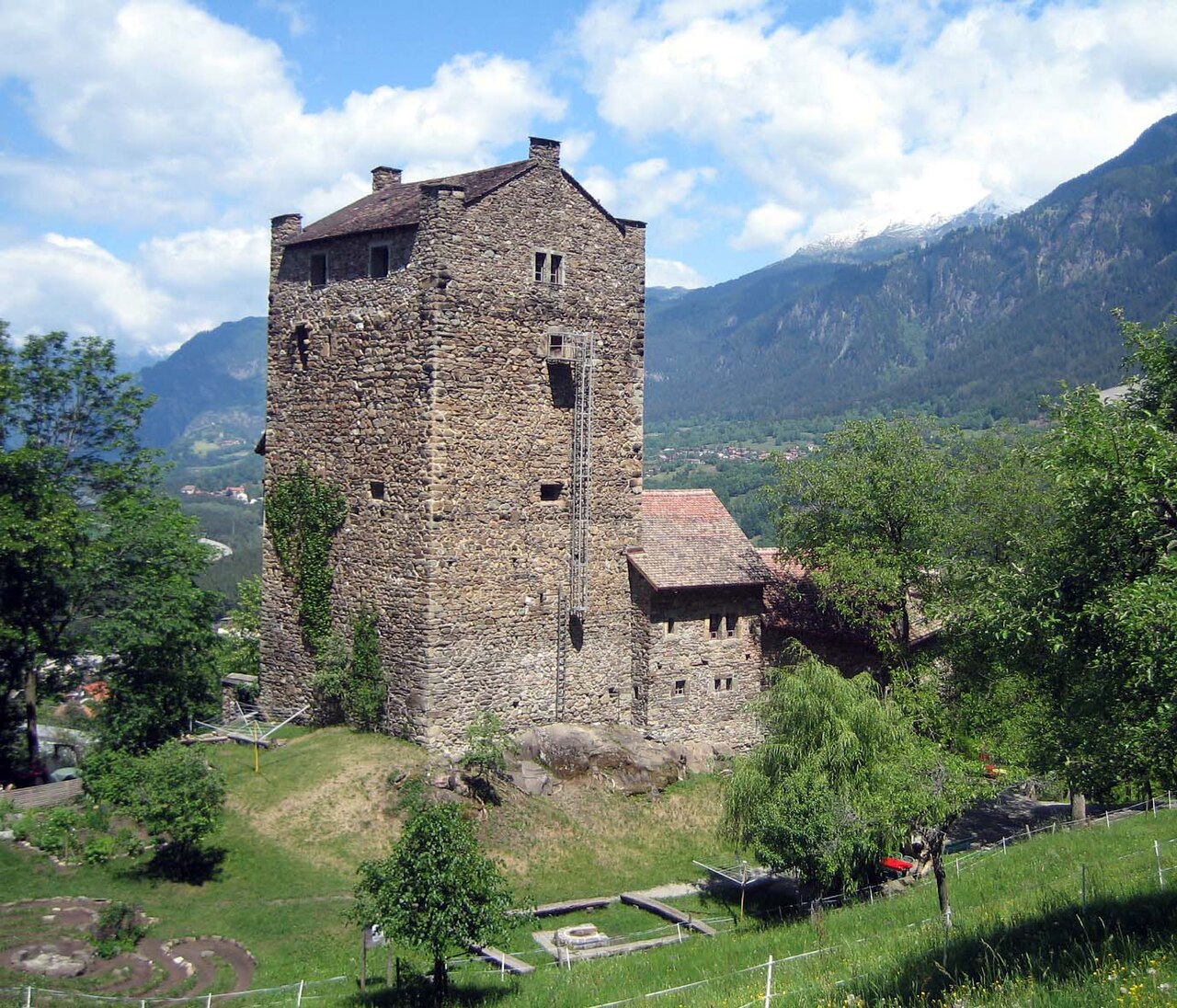
Obertagstein Castle
Obertagstein Castle is a medieval hill castle located near the town of Thusis in the Swiss canton of Graubünden. Constructed in the 13th century, it was likely built by the noble Masein/Rialt family as a strategic stronghold near the neighboring Untertagstein Castle. The castle occupies the entire summit of a small rock outcropping, measuring approximately 15 by 15 meters, which provided a naturally defensible position overlooking the surrounding landscape.
The earliest documentary evidence relating to the castle dates back to the early 14th century. In 1316, Margareta von Rialt bequeathed her properties in the Tagstein area to her nieces, marking the first known transfer of ownership. The first explicit mention of a castle in the vicinity appears in 1322, though this likely refers to Untertagstein rather than Obertagstein. That same year, the male line of the Rialt family became extinct, and the castle passed to the Bärenburg family. This family served as ministerialis knights—unfree vassals—under the powerful Vaz family. Following the extinction of the Vaz lineage in 1337, the Bärenburgs became vassals of the Counts of Toggenburg, and the castle was granted to the Tumb family, who adopted the name von Tagstein, probably in reference to Untertagstein.
Architectural layout and defensive features
The castle's design reflects typical high medieval fortification principles, adapted to its rocky hilltop setting. The defensive complex originally included an outer gate on the south-west corner, which led to a narrow path wrapping around the southern side of the rock. This path passed through a middle gate before reaching an inner gate on the eastern side, controlling access to the heart of the castle.
One of the castle's notable features was its main cistern, essential for water storage during sieges. However, at some point, the western wall adjacent to the cistern collapsed, rendering the cistern unusable. This breach was repurposed as a new entrance, resulting in the original outer gate being sealed off. The new western gate was accessed via a wooden bridge spanning a defensive ditch, which separated the castle's core from ancillary buildings.
Surrounding the castle was a ring wall that remains largely intact today. Interestingly, during construction, builders left two tree trunks standing and incorporated them into the wall structure, a rare example of integrating natural elements into medieval masonry. Beyond the ditch, the space likely housed storage buildings and workshops, essential for the castle's self-sufficiency.
The palas and internal structures
The palas, or main residential building, occupied the eastern end of the castle complex, overlooking the courtyard. The original entrance to the palas was located on its eastern side, providing controlled access to the living quarters. The compact layout reflects the limited space on the rocky outcrop and the need for efficient use of available area.
Historical events and decline
In the 15th century, Obertagstein Castle suffered a devastating fire that gutted much of its interior, leading to its abandonment. By 1512, the ruins were recorded as property of the Cazis Priory, indicating its transition from a noble residence to ecclesiastical ownership. Despite its ruined state, the castle became a destination for visitors as early as the 16th century, with hikers leaving their marks by carving initials and dates into the plaster walls, a testament to its enduring local significance.
Location and significance
Situated just south of Thusis, Obertagstein Castle's hilltop position provided commanding views of the surrounding valleys and routes, underscoring its strategic importance during the high medieval period. Its proximity to Untertagstein Castle suggests a network of fortifications controlling movement and asserting noble authority in the region.
Today, the castle remains a partially preserved ruin, offering insight into medieval defensive architecture and feudal history in the Swiss Alps. Visitors can explore the surviving walls, gates, and courtyard, experiencing the rugged terrain and imagining the castle's role in regional power dynamics.
Frequently asked questions (FAQ)
- How do I get to Obertagstein Castle?
- Obertagstein Castle is located in Thusis, Switzerland, easily accessible by car or public transport. If you are traveling by train, you can take a train to Thusis and then a short bus ride or walk to the castle.
- What is the historical significance of Obertagstein Castle?
- Obertagstein Castle dates back to the 13th century and played a crucial role in the defense of the region. It served as a strategic stronghold during various conflicts and is an important example of medieval Swiss architecture.
- When was Obertagstein Castle built?
- Construction of Obertagstein Castle began in the early 1200s, making it one of the oldest surviving castles in the area. It has undergone several renovations over the centuries but retains much of its original medieval charm.
- Can I visit Obertagstein Castle year-round?
- Yes, Obertagstein Castle is open to visitors throughout the year, although the best time to visit is during the warmer months from April to October. This allows you to enjoy the beautiful surroundings and participate in guided tours.
- Why is Obertagstein Castle a popular tourist attraction?
- Obertagstein Castle attracts visitors due to its rich history, stunning architecture, and breathtaking views of the surrounding landscape. The castle also offers guided tours that provide insight into its historical significance and architectural features.
- Is it possible to enter the castle grounds without a ticket?
- While the castle grounds can be enjoyed freely, entering the main structures typically requires a ticket. Ticket prices are reasonable, and the fees support the preservation of this historic site.
- What are the opening hours for Obertagstein Castle?
- Obertagstein Castle is generally open from 9 AM to 5 PM during the peak season. However, it is advisable to check the official website for the most current opening hours and any seasonal changes.
- Are there any nearby attractions to visit while at Obertagstein Castle?
- Yes, visitors can explore nearby attractions such as the picturesque village of Thusis, the Landwasser Viaduct, and the stunning Viamala Gorge. These sites complement your visit to the castle and provide a full day of sightseeing.
- What are the ticket prices for visiting Obertagstein Castle?
- Ticket prices for Obertagstein Castle are quite affordable, with discounts available for children, students, and seniors. Family packages are also offered, making it a great option for visitors of all ages.
Information
Loading map...
Visitor reviews
No reviews yet. Been here? Write the first review and help other travelers!
Write the first reviewVisited this castle? Share your experience
Your review helps other travelers and adds first-hand knowledge to our encyclopedia.