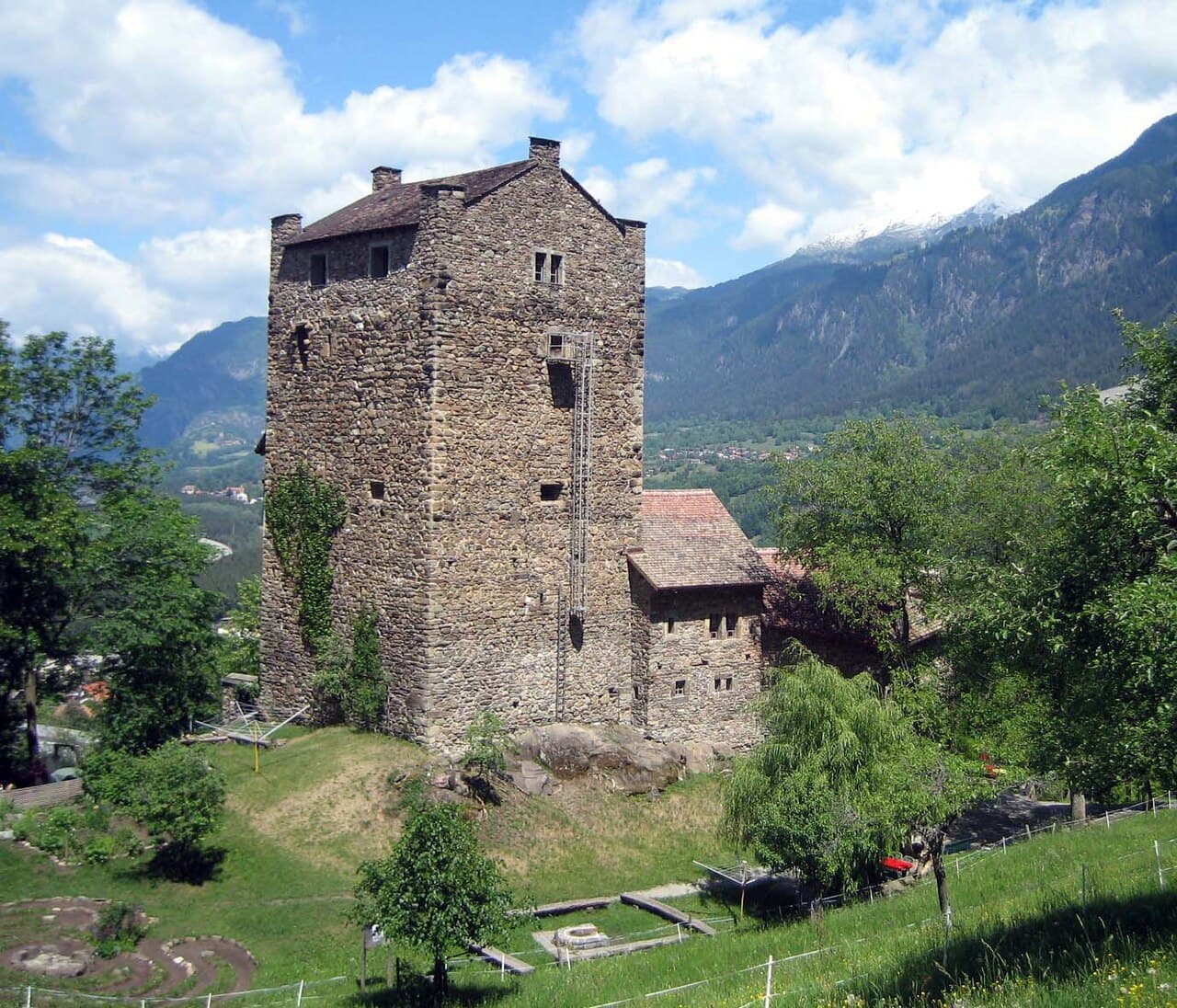
Ehrenfels Castle
Ehrenfels Castle stands as a remarkable example of a high medieval hill castle located near the village of Sils im Domleschg in Switzerland. Constructed in the first half of the 13th century, this fortress was initially built to serve as a stronghold for local nobility, notably the Lords of Ehrenfels, whose presence is first documented in 1257. The castle's strategic position on a prominent rocky spur provided natural defenses and commanded views over the surrounding valley, typical of hill castles designed for both protection and control of the region.
Medieval origins and early history
The original core of Ehrenfels Castle was a robust four-story bergfried, a tall defensive tower characteristic of medieval fortifications. This tower featured an elevated entrance on its northern side, accessible directly to the second floor, a defensive architectural element intended to prevent easy access by attackers. The bergfried served as the heart of the castle's defensive system and a symbol of feudal authority.
By 1320, the castle was under the ownership of Burkhard and Rudolf von Schauenstein, who also adopted the name Ehrenfels or Herrenfels, indicating the castle's importance as a noble seat. Around this time, the castle underwent significant expansions, including the addition of residential spaces and a ring wall encircling the bergfried. This ring wall likely featured multiple layers of defensive walls, enhancing the castle's fortifications during a period marked by regional conflicts and the need for robust defenses.
Ownership transitions and architectural evolution
By the early 15th century, the castle was recorded as owned by Hermann von Ehrenfels. In the late 15th or early 16th century, ownership transferred to Cazis Monastery, although the Ehrenfels-Schauenstein family continued to occupy the castle. This dual ownership reflects the complex feudal and ecclesiastical relationships typical of the period. During the 16th century, the castle was renovated to improve residential comfort, transforming the austere medieval fortress into a more habitable noble residence. This included the construction of a palas, or residential building, adjacent to the bergfried, reflecting the Renaissance-era shift in castle architecture from pure defense to domestic comfort.
Decline and ruin
Despite these improvements, Ehrenfels Castle was abandoned around 1600. Over the following centuries, the castle fell into ruin, with parts of its stonework quarried for other construction projects. By the 18th century, the castle was largely a ruin, and the male line of the Ehrenfels-Schauenstein family ended in 1742, leading to the property passing to the Buol family. The castle's decline mirrors the broader trend of medieval fortresses losing their military and residential relevance in the early modern period.
20th-century restoration and adaptive reuse
In 1933, the Schweizerische Burgenverein (Swiss Castle Association) acquired the ruins and initiated restoration efforts under the guidance of architect Eugen Probst. These efforts included clearing dense vegetation, stabilizing remaining structures, and partially leveling the ground. However, the restoration was conducted without formal archaeological investigation, resulting in some loss of historical context. The castle was transformed into a youth hostel, a function it continues to serve today, managed by the Swiss Foundation for Social Tourism. The hostel offers 38 beds, integrating heritage preservation with modern adaptive reuse.
Architectural features and current remains
The castle's remains prominently feature the well-preserved bergfried, which retains much of its original height and defensive character. The tower's elevated entrance was later modified to include access from the courtyard side facing the valley, and a southern entrance was added in the 1960s to facilitate modern use. Surrounding the bergfried are fragments of the ring wall, which exhibit evidence of multiple defensive layers, characteristic of 14th-century fortification enhancements.
The 16th-century palas adjacent to the bergfried, though partially ruined, reflects the castle's evolution from a military fortress to a noble residence emphasizing comfort. The castle's two-level layout on the rocky spur provided natural defensive advantages and controlled access points, typical of hill castles designed to maximize terrain benefits.
Today, Ehrenfels Castle stands as a testament to the layered history of medieval fortifications in Switzerland. Its preservation as a youth hostel allows visitors to experience a unique blend of historical ambiance and contemporary hospitality, making it a significant cultural and heritage site in the region.
Visitor experience and cultural significance
Visitors to Ehrenfels Castle can explore the ruins while staying overnight in the converted youth hostel, offering a rare opportunity to immerse themselves in medieval history within a functional modern setting. The castle's location in the scenic Domleschg valley adds to its appeal, providing panoramic views and a connection to the region's rich historical landscape.
The castle's transformation from a feudal stronghold to a youth hostel exemplifies successful adaptive reuse of historic structures, preserving architectural heritage while meeting contemporary needs. Its management by the Swiss Foundation for Social Tourism underscores the importance of cultural tourism and heritage conservation in Switzerland.
Frequently asked questions (FAQ)
- How do I visit Ehrenfels Castle and the youth hostel?
- Ehrenfels Castle operates as a youth hostel with 38 beds, open year-round. Visitors can book overnight stays to experience the historic site firsthand. The castle is accessible by local roads from Sils im Domleschg.
- What is the historical significance of Ehrenfels Castle?
- Ehrenfels Castle is a prime example of a 13th-century hill castle that evolved from a medieval fortress to a noble residence. It reflects the feudal history of the Domleschg valley and the architectural transitions from military defense to residential comfort.
- Can I explore the castle ruins without staying overnight?
- While the castle primarily functions as a youth hostel, day visitors may be able to explore certain areas of the ruins. It is recommended to check in advance with the hostel management for access and visiting hours.
- Why was Ehrenfels Castle abandoned around 1600?
- The castle was abandoned due to changes in military technology and living standards, which made such fortresses less practical. Additionally, the shift of noble residences to more comfortable locations contributed to its decline.
- Is Ehrenfels Castle accessible for people with mobility issues?
- Due to its hilltop location and medieval construction, accessibility is limited. Visitors with mobility challenges should contact the hostel in advance to inquire about accommodations and access options.
Photo gallery

Information
Sources & official resources
Verify the information above using these authoritative references.
Loading map...
Visitor reviews
No reviews yet. Been here? Write the first review and help other travelers!
Write the first reviewVisited this castle? Share your experience
Your review helps other travelers and adds first-hand knowledge to our encyclopedia.



