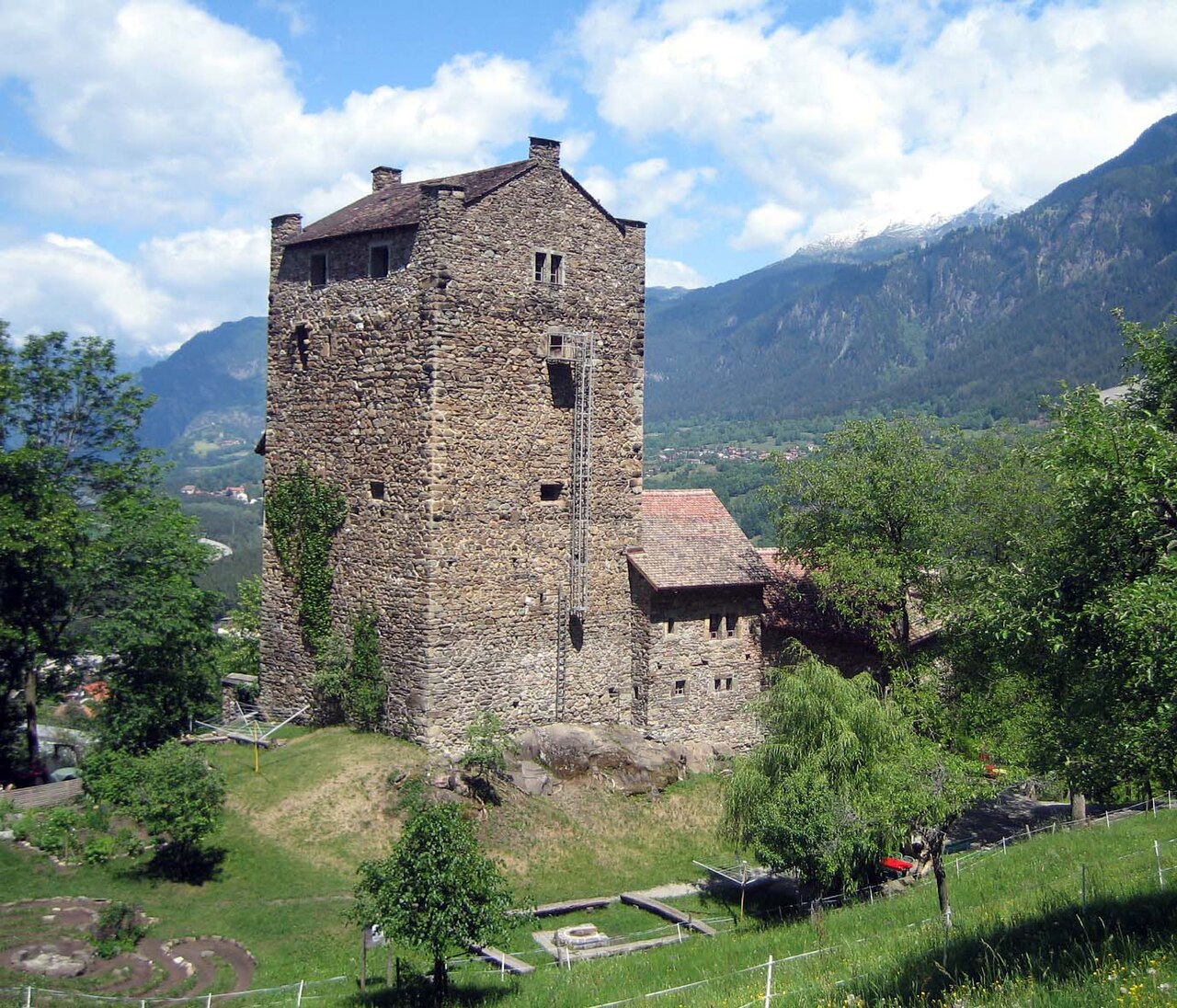
Baldenstein Castle
Baldenstein Castle stands as a significant high medieval fortress located in Sils im Domleschg, Switzerland. Its origins trace back to the 13th century, when it was established as the family seat of the Knights of Baldenstein, first documented in 1246. The castle's central tower, a key defensive and residential structure, was constructed around this time. Although detailed records of the Baldenstein family are scarce, the castle's early history reflects the turbulent feudal dynamics of the region.
The early history and ownership transitions
By 1289, ownership of Baldenstein Castle had passed to the Freiherr von Löwenstein. However, during local conflicts, the castle was lost in a war to the Freiherr von Rhäzüns. The peace treaty of that year restored Baldenstein to Löwenstein, with the condition that Schwarzenstein Castle be ceded to Rhäzüns. This exchange highlights the strategic importance of Baldenstein within the region's power struggles.
In 1349, the castle came under the control of the Übercastel family. Wilhelm von Übercastel sought to expand and fortify the castle, but his plans were initially blocked by the Bishop of Chur. Eventually, Wilhelm granted the Bishop certain rights, allowing the castle's fortifications to be enhanced. This interaction underscores the influence of ecclesiastical authorities in medieval castle affairs.
Architectural evolution and expansions
Originally, Baldenstein Castle featured a rectangular bergfried, a tall tower typical of medieval fortifications, serving as a last refuge and symbol of lordly power. During the late Middle Ages, an administrative and residential wing was added to the west of the bergfried, reflecting the castle's dual role as a military stronghold and noble residence.
Around 1400, the castle passed to the Freiherr von Stein. Through marriage in 1453, it transferred to the von Ringg family, later known as Ringg von Baldenstein. In 1562, Luzius Ringg sold the castle to Jakob Ruinelli, whose family resided there for several generations, marking a period of relative stability and continued development.
The Ruinelli family and the Bündner Wirren
Jakob Ruinelli's grandson, also named Jakob, played a notable role during the Bündner Wirren, a series of conflicts in the early 17th century in the Grisons region. In 1621, he accompanied Jürg Jenatsch to Rietberg Castle to assassinate Pompeius Planta, a key political figure. This event was part of the complex religious and political upheavals of the time. Tragically, Jakob Ruinelli was killed in 1627 during a drunken brawl among officers, illustrating the volatile nature of the period.
Following his death, the castle passed to the Rosenroll family. During the 16th and 17th centuries, the castle saw further expansion, including the replacement of the medieval residential wing with a larger new wing. The original medieval ring wall was also replaced by a crenelated defensive wall, enhancing the castle’s fortifications to meet evolving military needs.
Later ownership and restoration
In 1738, the castle was acquired by the Salis-Sils family, who held it for nearly fifty years. Subsequently, in 1782, it was inherited by Francesco Conrado from Chiavenna, Italy. Conrado became a member of the Senate of the Helvetic Republic following the French invasion of Switzerland in 1798, linking the castle’s history with broader European political changes.
The Conrado family, later adopting the name Conrad, still owns Baldenstein Castle today. In 1877, a fire destroyed much of the residential wing, which was subsequently rebuilt, giving the castle its current appearance. This restoration preserved the castle's historic character while adapting it for continued use.
Architectural significance and features
Baldenstein Castle exemplifies the architectural evolution of a high medieval hill castle adapted over centuries to meet changing defensive and residential needs. The bergfried remains a dominant feature, symbolizing medieval military architecture. The later residential wing and crenelated walls reflect Renaissance and early modern modifications, indicating the castle’s ongoing strategic and domestic importance.
The castle's location in Sils im Domleschg situates it within the historically contested region of the Grisons, where noble families, ecclesiastical powers, and emerging states vied for control. Its layered history of ownership and architectural adaptation provides valuable insights into the region’s feudal and political history.
Visiting Baldenstein Castle
Today, Baldenstein Castle remains privately owned by the Conrad family and is not generally open to the public. Its well-preserved structures offer a visible link to the high medieval period and subsequent centuries of Swiss history. The castle's enduring presence enriches the cultural landscape of Graubünden and serves as a testament to the region's complex past.
Frequently asked questions (FAQ)
- What is the historical significance of Baldenstein Castle?
- Baldenstein Castle dates back to the 13th century and holds great importance as a medieval fortress in the region. It played a crucial role in the defense of the area and offers insights into the feudal system of the time, showcasing the lifestyle and architecture of that era.
- When was Baldenstein Castle built?
- Construction of Baldenstein Castle began around 1250, making it one of the oldest structures in the area. Over the centuries, it has undergone various renovations, preserving its historical character while adapting to changing needs.
- Can I visit Baldenstein Castle?
- Yes, visitors are welcome to explore Baldenstein Castle. It offers guided tours that provide a fascinating look into its history and architecture, making it a great destination for history enthusiasts and tourists alike.
- What are the opening hours for Baldenstein Castle?
- Baldenstein Castle is typically open to visitors from May to October, with specific opening hours varying throughout the season. It is advisable to check the official website or contact the castle directly for the most current information before planning your visit.
- Is it possible to access Baldenstein Castle by public transportation?
- Yes, Baldenstein Castle is accessible by public transportation. There are local bus services that connect to Sils im Domleschg, allowing visitors to reach the castle conveniently without needing a car.
- What are the ticket prices for visiting Baldenstein Castle?
- Ticket prices for Baldenstein Castle are generally affordable, with discounts available for children, students, and seniors. It’s best to check the castle's official website for the latest pricing information and any special offers that may be available.
- When is the best time to visit Baldenstein Castle?
- The best time to visit Baldenstein Castle is during the late spring and summer months, from May to September, when the weather is pleasant. This period also coincides with the castle's full opening hours and various events that enhance the visitor experience.
- Are there any nearby attractions to Baldenstein Castle?
- Yes, there are several nearby attractions including the picturesque village of Sils im Domleschg, hiking trails, and other historical sites. Visitors can enjoy the stunning landscape of the Graubünden region, making it a perfect spot for a day trip.
Information
Loading map...
Visitor reviews
No reviews yet. Been here? Write the first review and help other travelers!
Write the first reviewVisited this castle? Share your experience
Your review helps other travelers and adds first-hand knowledge to our encyclopedia.