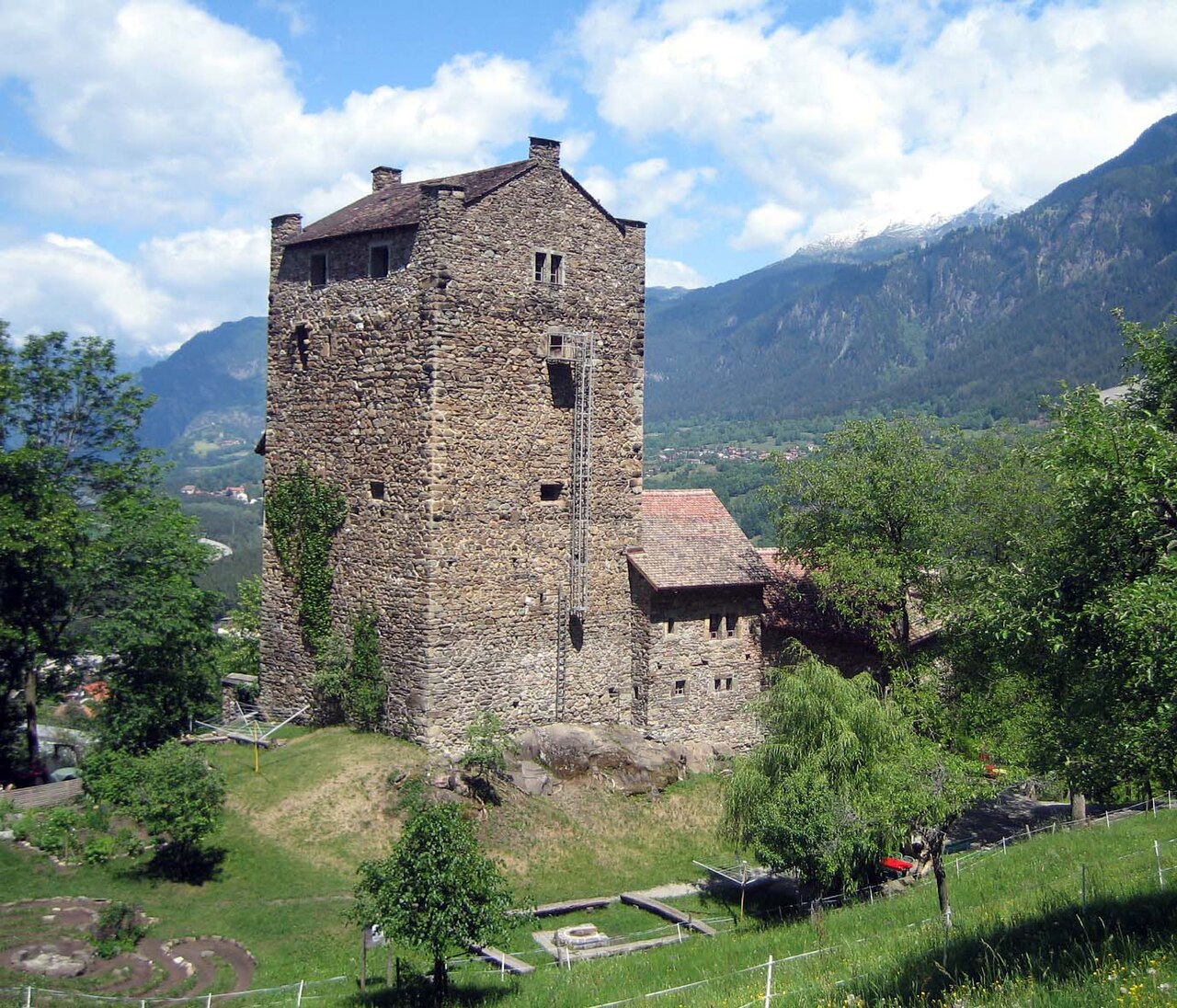
Hohenrätien Castle
Hohenrätien Castle stands prominently on a rock wall rising 250 meters above the Viamala river, overseeing crucial historic routes across the San Bernardino and Splügen Passes in the Swiss canton of Graubünden. The site’s strategic location has been significant since ancient times, with evidence of human activity dating back to the Bronze and Iron Ages. This elevated position provided natural defense and control over the vital alpine passes, making the castle an important medieval stronghold.
Before the castle’s construction, the site served religious purposes during the Roman era. Archaeological findings reveal that a religious structure existed here by the 4th or 5th century, possibly originally a temple dedicated to Mithras that was later converted into a Christian church. By the 5th century, a baptistery was added, and the complex became known as the Church of St. John. This church functioned continuously for over a millennium, serving as the parish church for the left side of the Rhine river until around 1500.
Early medieval religious significance and fortifications
The religious site was surrounded by a ring wall likely constructed during the early medieval period to protect the church and its precincts. By the High Middle Ages, the church not only served spiritual needs but also acted as a refuge during attacks. The surrounding area was governed by a parish vogt, a local official responsible for protection and administration.
In the 11th century, a series of fortifications were added to the site, including a two-story stone house that became the castle’s main tower. This period saw repairs and expansions of the outer ring wall and possibly the construction of the south-east tower and the priest's tower. These additions marked the transformation of the religious site into a fortified castle complex.
13th-century expansion and the rise of hochrialt
During the 13th century, the castle underwent significant enlargement. The main tower was expanded and enclosed by an inner defensive wall. Around the tower, storage facilities and workshops were established, forming an inner castle known as Hochrialt. This name likely connects to the Lords of Rialt, a noble family first recorded in 1170 at Niederrialt Castle in nearby Cazis.
Despite these improvements, the castle's prominence declined by the early 14th century. Theories for this decline include a damaging earthquake in 1295, which may have compromised the castle’s structural integrity, or economic factors such as the lack of a supporting nearby town and diminished traffic over the Viamala road. These factors likely led to the abandonment of both the town and the castle.
Later history and decline
Following abandonment, the bishop’s representatives vacated the priest’s tower and relocated to Fürstenau Castle. The Rialt family appears to have died out in the 14th century, and in 1359, the church’s patronage passed to Cazis Priory. By 1410, records described Hoch-Rialt as an abandoned fortress. A fire in the late 14th or early 15th century destroyed the south-east section of the castle.
In 1473, a new road was constructed on the opposite side of the river by the communities of Thusis, Masein, and Cazis. This bypassed Hohenrätien, removing any incentive to rebuild the fortress. Ownership passed to the Jecklin family in 1480, while the priest’s tower remained in use until 1505.
The name Hohenrätien was first recorded in 1573 by a humanist scribe who sought to link the castle to Raetus, the legendary ancestor of the Rhaetian people. Later, in 1581, the von Hohenrealta family inherited the castle and its lands.
Modern restoration and current use
In the late 19th century, there was a proposal to build an aerial tramway from Thusis to Hohenrätien, which was never realized. However, an alpine restaurant was established in the castle ruins, operating until 1914. Remnants of this restaurant remain visible today.
Since 1973, the Hohenrealta family foundation has collaborated with cantonal authorities and local volunteers on extensive restoration and archaeological work. This effort included roofing over buildings, cleaning and reinforcing towers, and excavating Roman and early medieval remains around the site in 1997 and 2001.
Architectural features of hohenrätien castle
The inner castle and main tower
The inner castle lies on the southwestern side of the ridge, dominated by the main tower. The tower’s ground floor contains a cistern capable of holding approximately 30,000 liters of water, an essential feature for sustaining inhabitants during sieges.
The second floor served as storage space, while the third floor housed the main entrance and reception hall, complete with a large fireplace and a latrine. The fourth floor was a single large bedroom, likely reserved for the lord or high-ranking resident.
Modern renovations have altered the tower’s interior but preserved its exterior. A glass roof now covers the tower, and wooden platforms have been installed at the height of the original floors, leaving the center open to allow natural light to permeate the structure.
Fortifications and auxiliary buildings
The castle’s fortifications include multiple ring walls and defensive towers, such as the south-east tower and the priest’s tower. Surrounding the inner castle were workshops and storage buildings, supporting the daily functions of the fortress.
Cultural significance and visitor experience
Today, Hohenrätien Castle is a well-preserved example of a high medieval fortress with deep historical layers spanning from the Roman period through the Middle Ages. The castle complex, including the church and baptistery, is available for rent for events, offering visitors a unique opportunity to experience a site rich in architectural and cultural heritage.
The castle’s location provides spectacular views of the surrounding alpine landscape and the Viamala gorge, enhancing its appeal for tourism and historical study.
Archaeological importance
Excavations have revealed significant details about the site’s evolution from a Roman religious center to a fortified medieval castle. These findings contribute valuable insights into the region’s history and the transition from pagan to Christian worship practices.
Frequently asked questions (FAQ)
- What is the historical significance of Hohenrätien Castle?
- Hohenrätien Castle, located in Sils im Domleschg, is a remarkable example of medieval architecture and serves as a testament to the region's feudal history. Built in the 12th century, it played a crucial role in the politics of the area, especially during the power struggles of the noble families in Graubünden.
- When was Hohenrätien Castle built?
- Hohenrätien Castle was constructed in the early 12th century, around the year 1200. Its strategic location and robust design reflect the architectural styles and defensive needs of the time.
- Can I visit Hohenrätien Castle?
- Yes, Hohenrätien Castle is open to visitors who wish to explore its historical grounds and enjoy the stunning views of the surrounding landscape. Guided tours are available during the peak tourist season, providing insights into its history and architecture.
- What are the opening hours for Hohenrätien Castle?
- The castle is typically open from May to October, with specific opening hours varying by month. It is advisable to check the official website for the most up-to-date information on visiting hours before planning your trip.
- Is it possible to access Hohenrätien Castle by public transport?
- Yes, Hohenrätien Castle can be accessed by public transport. Visitors can take a train or bus to Sils im Domleschg and then enjoy a short hike to reach the castle, making it an accessible destination for those using public transportation.
- When is the best time to visit Hohenrätien Castle?
- The best time to visit Hohenrätien Castle is during the summer months, from June to September, when the weather is pleasant and conducive for exploring the outdoor areas. Additionally, these months offer the highest number of guided tours and events at the castle.
- What are the ticket prices for Hohenrätien Castle?
- Ticket prices for Hohenrätien Castle are generally affordable, with discounts available for students and seniors. It is recommended to check the official site or visitor center for the exact pricing and any special offers available during your visit.
- Are there any nearby attractions to Hohenrätien Castle?
- Yes, there are several attractions near Hohenrätien Castle, including the picturesque village of Sils im Domleschg and various hiking trails offering beautiful views of the Alps. Additionally, nearby towns like Chur provide further cultural and historical exploration opportunities.
Information
Loading map...
Visitor reviews
No reviews yet. Been here? Write the first review and help other travelers!
Write the first reviewVisited this castle? Share your experience
Your review helps other travelers and adds first-hand knowledge to our encyclopedia.