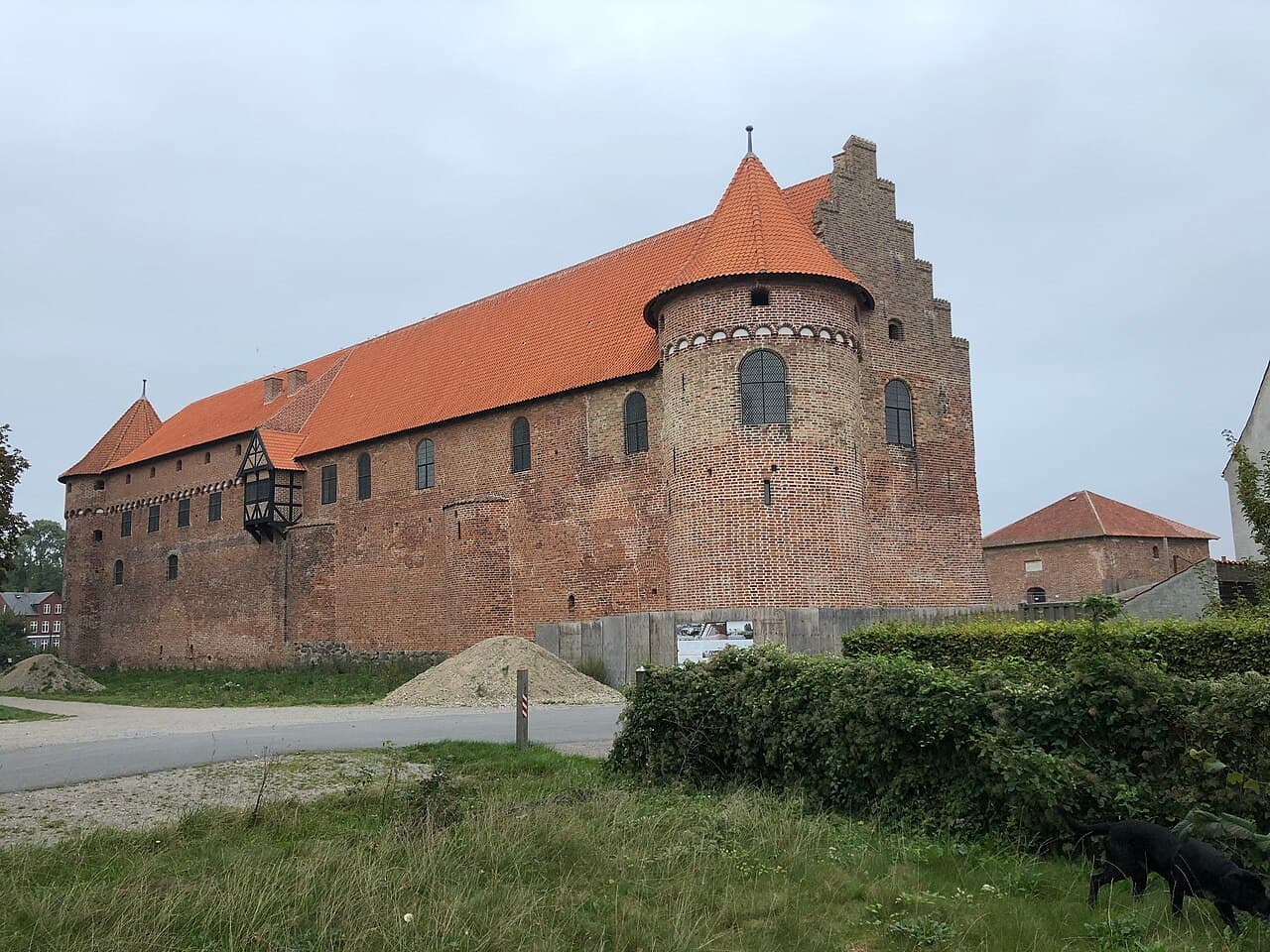
Nyborg Castle
Nyborg Castle stands as one of Denmark's most historically significant medieval fortresses, located in the town of Nyborg on the island of Funen. Founded in the late 12th century, it is recognized as the country's oldest preserved royal residence. The castle's strategic position by the Great Belt strait was crucial for controlling maritime and land routes, which contributed to its role as a political and military center throughout Danish history.
First mentioned in 1193, the castle was established around 1170 by Knud Prislavsen, a nephew of King Valdemar the Great. Archaeological evidence confirms the castle’s initial construction as a hill castle with a square layout, surrounded by a moat and fortified with high stone walls and towers at each corner. Early defenses included a large central fortress tower and a dry moat, later enhanced with water from the nearby Vindinge Å stream, which was channeled through a sophisticated system of canals and sluices to fill the moat, creating a formidable wet barrier.
The medieval political hub and the Danehof
Nyborg Castle's prominence rose as the permanent meeting place of the Danehof, Denmark's medieval parliament, from the 12th to the 15th centuries. This assembly convened in the castle's royal wing, known as the Kongefløjen, specifically on the second floor of the palace building constructed in the mid-13th century. This palace, built of brick and rising to three stories by the late 14th century, included a grand hall where kings and nobles gathered to discuss matters of state.
Several pivotal events in Danish history took place within Nyborg Castle’s walls. In 1276, King Erik Klipping secured recognition of his son Erik Menved as heir. In 1282, Erik Klipping issued the Håndfæstning, Denmark’s first coronation charter and constitution, marking a foundational moment in Danish governance. The castle was also the site of the sentencing of Erik Klipping’s murderers in 1287, underscoring its judicial and political importance.
Queen Margrete I and the Kalmar Union
In 1377, Queen Margrete I convened at Nyborg to secure her son Oluf's election as king, an act that paved the way for the Kalmar Union, uniting Denmark, Norway, and Sweden under one crown. Margrete's reign also saw the construction of Nyborg Vor Frue Church as a symbol of her gratitude for military victories, further emphasizing the castle’s role as a royal and religious center.
Renaissance transformations and royal residence
From the late 15th century, Nyborg Castle increasingly functioned as a royal residence. King Hans and Queen Christine made it their permanent home starting in 1481, and their son Christian II was born there in 1483. The castle underwent significant renovations during the reigns of Frederik I and Christian III in the 16th century, reflecting Renaissance architectural styles.
These modifications included the enlargement of windows to bring more light into the interiors, the addition of decorative wall paintings with geometric patterns, and the construction of a grand knights’ hall. The castle's defenses were also improved, and the surrounding town was fortified during the Reformation period, turning Nyborg into a princely residence with both ceremonial and military functions.
Architectural features and expansions
The castle’s layout originally included two main stone residential buildings and a palatium added along the western ring wall in the early 13th century. Later expansions added a northern wing, now lost, and a large eastern tower known as Knud's Tower, dating from the 14th century. In 1607, King Christian IV commissioned the Italian architect Domenicus Badiaz to add a spire to the main tower, enhancing its silhouette and linking it stylistically to Copenhagen’s Blåtårn (Blue Tower).
Military role and decline
During the 17th century, Nyborg was one of Denmark’s three major fortified towns, alongside Fredericia and Copenhagen. Its position by the Great Belt made it strategically important during the Swedish wars (1657–1659). The castle was captured by Swedish forces in 1659 but was soon relieved by a Dutch fleet under Admiral Michiel de Ruyter, Denmark’s ally at the time.
The wars caused severe damage to the castle, ending its role as a royal residence. Subsequently, it functioned primarily as a military garrison and fortress for approximately 250 years. Its fortifications were adapted to the Italian bastion style, characterized by thick earthworks and angled walls designed to withstand artillery attacks.
Much of the castle was dismantled starting in the late 17th century to provide building materials for local projects, including Odense Palace. The northern wing was demolished by the late 19th century. The military garrison was disbanded in 1913, after which efforts to preserve and restore the castle increased.
Archaeological discoveries and modern restoration
Extensive archaeological excavations between 2009 and 2018 have revealed new insights into the castle’s original layout and construction phases. Findings confirmed the presence of the lost northern wing and uncovered a 14th-century temporary kitchen and an advanced 16th-century sewer system, which was larger and older than similar systems found in Copenhagen’s Christiansborg Palace.
Restoration efforts have focused on preserving the medieval and Renaissance elements, including plans to raise the watchtower by 12 meters to restore historic views of the Great Belt. The castle grounds include well-preserved earthwork fortifications from the post-medieval period, featuring broad embankments and stone-arched poternes built using stone salvaged from the dismantled walls.
The castle’s central courtyard, or borggård, remains enclosed by a partially reconstructed ring wall atop medieval foundations. The site is part of the historic urban area known as Slotsholmen, which has strict heritage protections. Recent removal of 19th-century military buildings has allowed for new construction aligned with restoration goals.
Present-day museum and cultural significance
Today, Nyborg Castle operates as a museum under the administration of Østfyns Museer. Its interiors are furnished with period-appropriate pieces sourced from historic manor houses, recreating the atmosphere of its various historical phases. Visitors can explore three banquet halls representing key moments: the Danehof Room commemorates its parliamentary heritage; Margrete’s Hall honors Queen Margrete I’s legacy; and Christian III’s Hall reflects Renaissance elegance and the Reformation era.
The castle also hosts the annual Nyborg Voldspil, Denmark’s oldest outdoor theater, performed on the surviving ramparts. Efforts to have Nyborg Castle and its surroundings designated as a UNESCO World Heritage site have highlighted its role in Danish constitutional history, royal life, and military defense, although challenges remain regarding modern restoration interventions.
Nyborg Castle remains a key monument illustrating the evolution of Danish medieval and Renaissance architecture, governance, and military strategy, offering visitors a tangible connection to Denmark’s formative historical periods.
Frequently asked questions (FAQ)
- When was Nyborg Castle originally built?
- Nyborg Castle was originally built in the late 12th century, around 1170, making it Denmark's oldest preserved royal residence.
- What was the Danehof and why was it important at Nyborg Castle?
- The Danehof was Denmark's medieval parliament that met at Nyborg Castle from the 12th to the 15th centuries. It was the site where Denmark's first constitution was signed in 1282, marking a key moment in Danish governance.
- What architectural styles are represented at Nyborg Castle?
- Nyborg Castle features a mix of medieval and Renaissance architectural styles, including fortified stone walls, brick palace wings, and Renaissance decorative elements added during the 16th century.
- Is Nyborg Castle accessible to visitors today?
- Yes, Nyborg Castle operates as a museum managed by Østfyns Museer, offering visitors access to restored interiors, exhibition halls, and historical reenactments.
- What significant events took place at Nyborg Castle?
- Significant events include the signing of Denmark's first constitution in 1282, the sentencing of King Erik Klipping's murderers in 1287, and Queen Margrete I securing her son's election in 1377, which led to the Kalmar Union.
- How did the Swedish wars affect Nyborg Castle?
- During the Swedish wars (1657–1659), Nyborg Castle was captured and heavily damaged, ending its role as a royal residence and shifting to a military garrison for centuries.
- Are there any annual cultural events held at Nyborg Castle?
- Yes, the Nyborg Voldspil, Denmark's oldest outdoor theater, is performed annually on the castle's surviving ramparts.
Photo gallery

Information
Sources & official resources
Verify the information above using these authoritative references.
Loading map...
Visitor reviews
No reviews yet. Been here? Write the first review and help other travelers!
Write the first reviewVisited this castle? Share your experience
Your review helps other travelers and adds first-hand knowledge to our encyclopedia.



