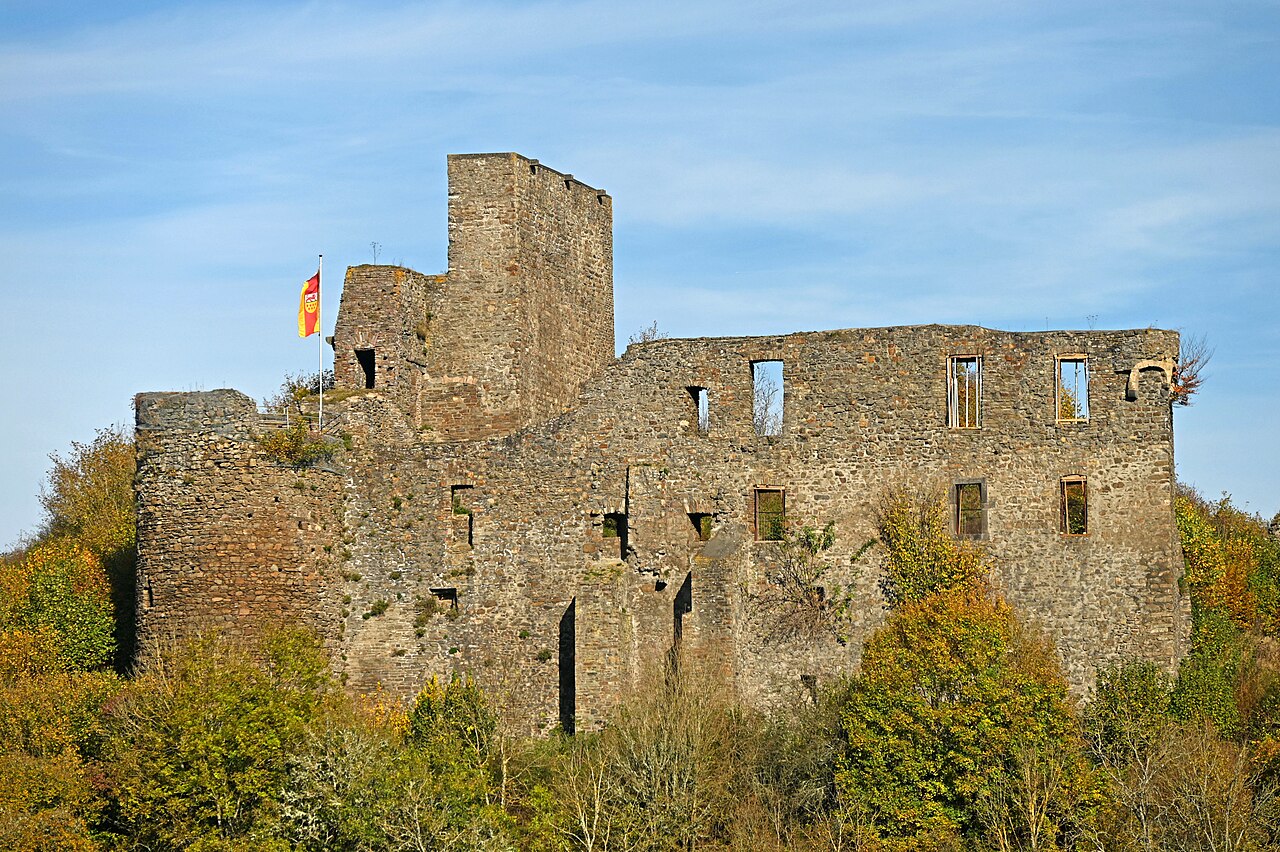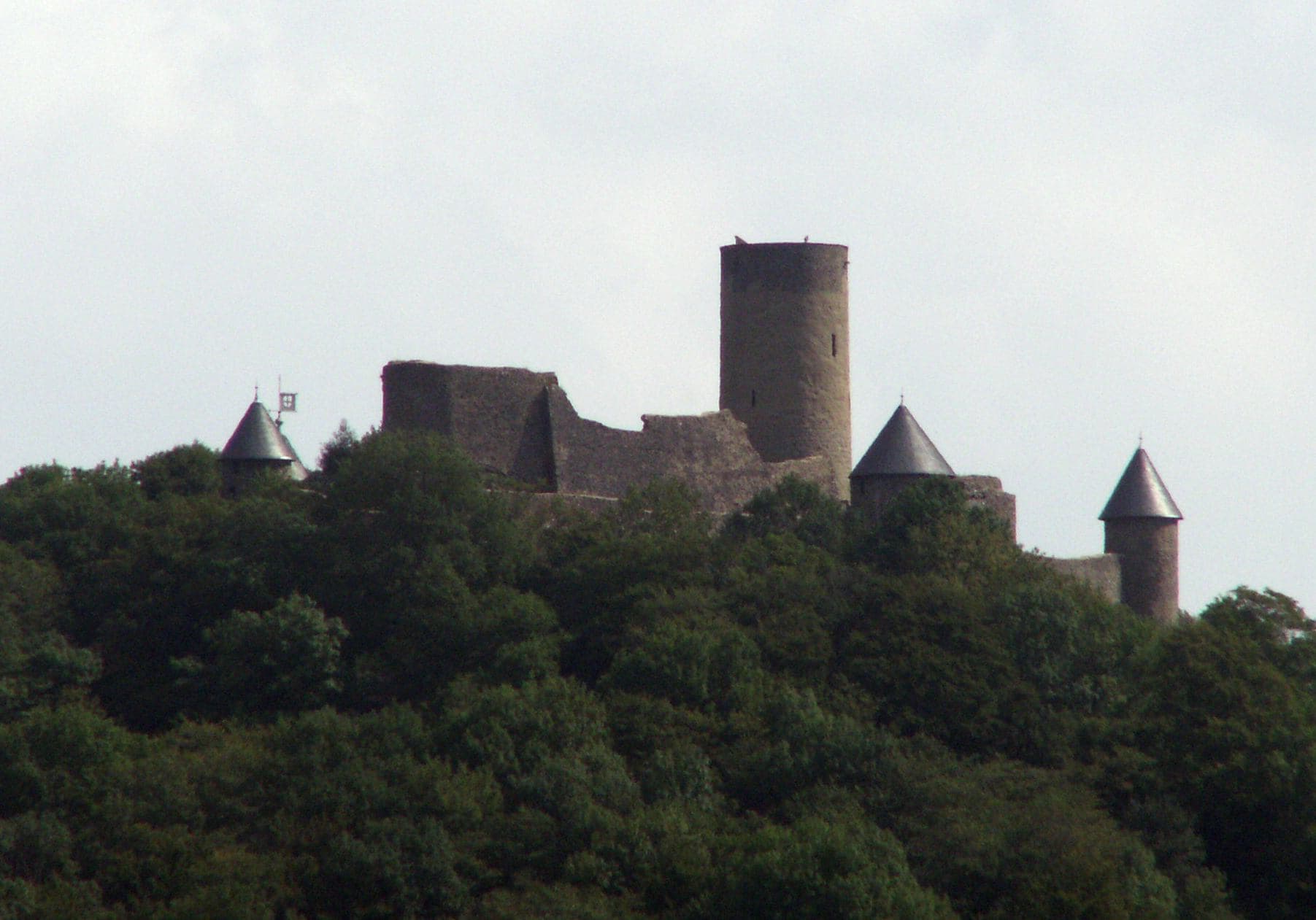
Nurburg Castle
Nürburg Castle is a striking ruined hilltop fortress located in the scenic Eifel Mountains near the village of Nürburg in Germany's Rhineland-Palatinate region. Perched at an elevation of approximately 678 meters on a volcanic basalt cone, the castle overlooks the famous Nordschleife (North Loop) of the Nürburgring racing circuit. This historic site offers visitors a glimpse into medieval military architecture and the strategic importance of the region throughout the centuries.
The castle's origins trace back to the 12th century, with the first recorded mention in 1166 under the names Noureberg or Mons Nore. However, archaeological and historical evidence suggests that the site was likely used as a Roman signal station prior to the medieval period, protecting a crucial Roman road that traversed the Eifel area. This early military function underscores the site's long-standing strategic significance.
Medieval origins and early history
The initial construction of Nürburg Castle is attributed to Count Ulrich von Are, who appears in documents dating from 1169. His father, Dietrich I von Are, is believed to have begun fortifying the mountain with a refuge castle. The von Are family, who styled themselves as the lords of Nürburg and Are, were vassals to the powerful Archbishops of Cologne and the Hohenstaufen emperors within the Holy Roman Empire. Their allegiance positioned Nürburg as a key defensive and administrative stronghold in the region.
By the late 13th century, the male lineage of the von Nürburg family had ended, leading to the transfer of ownership to the Electorate of Cologne around 1290. The Electorate appointed a bailiff (Amtmann) to oversee the castle and its surrounding lands, consolidating ecclesiastical control over this strategic fortress.
Architectural development and fortifications
The castle's construction evolved in three main phases. The earliest phase established the rectangular inner ward (Kernburg), which served as the core defensive and residential area. Between 1340 and 1369, under the administration of Amtmann Johann von Schleiden, a second ring of zwinger walls was constructed, creating an additional defensive perimeter around the inner ward.
In the 15th century, a third outer wall was added to protect the castellan's buildings, which housed the burgmann or castle knights serving the Electorate. Although these buildings have not survived, the walls themselves reinforced the castle's formidable defenses. The use of local volcanic basalt stone in the walls and towers provided durability and a distinctive dark appearance.
The castle's most prominent surviving feature is the bergfried or keep, a tall, rectangular tower approximately 20 meters in height. Originally used as a last refuge and lookout point, the bergfried later served as a prison until the mid-18th century. Its robust construction and commanding position make it a defining element of the castle's silhouette.
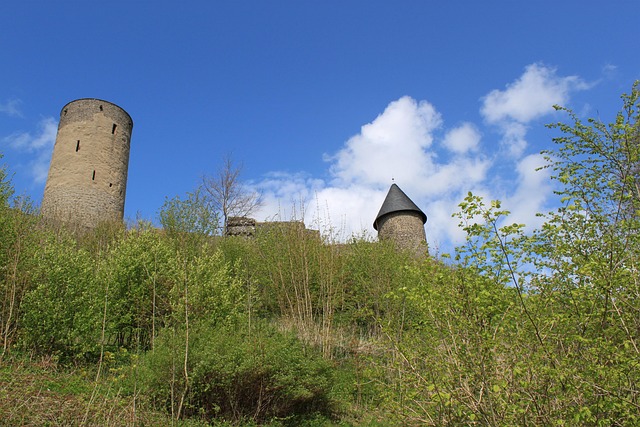
Photo by cocoparisienne
Decline, warfare, and destruction
By the 16th century, Nürburg Castle had fallen into a state of significant disrepair, prompting complaints from the bailiffs responsible for its upkeep. Several restoration efforts were undertaken to maintain the structure, but the castle's military importance diminished over time.
During the Thirty Years' War in 1633, the castle was captured and plundered by Swedish forces under General Heinrich von Baudissin. The conflict left the fortress damaged but still standing. In 1674, Imperial troops occupied Nürburg, but its fate was sealed in 1689 when French soldiers destroyed much of the castle during the War of the Palatine Succession. The destruction was so extensive that the castle was never fully rebuilt.
Following its military obsolescence, the bergfried was used as a prison until 1752, after which it was abandoned. The surrounding ruins became a convenient source of building material for local residents, accelerating the castle's decay.
Modern restoration and preservation
In 1818, the Prussian authorities undertook restoration of the bergfried to repurpose it as a trigonometric point for surveying. This project involved the demolition of the castle's forecourt, which had already deteriorated significantly.
In 1949, ownership of the ruins was transferred to the Rhineland-Palatinate State Department for Conservation. The site was entrusted to the Management of State Castles of Rhineland-Palatinate (Verwaltung der staatlichen Schlösser Rheinland-Pfalz), which has overseen several phases of archaeological excavation and restoration, notably between 1968-1974 and 1988-1989. More recent masonry repairs have continued since 2014 to stabilize and preserve the remaining structures.
Today, Nürburg Castle stands as a partially preserved monument showcasing medieval fortification techniques and the layered history of the Eifel region. Visitors can explore the ruins, including the bergfried, which now functions as an observation platform offering panoramic views of the surrounding landscape and the Nürburgring circuit below.
Castle layout and surviving features
The castle occupies an elongated site oriented west to east atop the volcanic basalt cone. Its design features a small rectangular core fortress surrounded by three successive defensive rings of stone walls. The inner core predates 1340, while the second ring was added between 1340 and 1369, and the third ring was constructed in the 15th century to protect the now-lost burgmann houses.
Surviving elements include sections of the enceinte walls and several towers with conical roofs, characteristic of medieval German castles. The bergfried remains the most intact structure, standing prominently at the center. The castle's only entrance was located on the eastern side, accessed originally by a drawbridge, though no trace of the forecourt survives today.
The castle is surrounded by mixed forest, enhancing its dramatic hilltop setting. In 1952, modern recreational facilities including a ski slope with lifts and a jumping hill were developed on the northern side of the hill, blending contemporary use with the historic site.
Visitor information and cultural significance
Nürburg Castle is accessible to the public for a fee, offering a unique combination of natural beauty, historical intrigue, and motorsport heritage due to its proximity to the Nürburgring. The site includes a small exhibition detailing the castle's history, enriching the visitor experience. Its preservation contributes to understanding medieval military architecture and the complex history of territorial control in the Rhineland.
Frequently asked questions (FAQ)
- How do I get to Nurburg Castle?
- Nurburg Castle is located in the picturesque town of Nürburg, Germany. The castle can be accessed by car, and there is ample parking available nearby. For those using public transport, you can take a train to the nearest station and then use local buses or taxis to reach the castle.
- What is the historical significance of Nurburg Castle?
- Nurburg Castle dates back to the 12th century and is a prime example of medieval architecture in the region. It has served various purposes throughout its history, including military defense and as a noble residence. The castle's strategic location on a hilltop made it an important stronghold during regional conflicts.
- When was Nurburg Castle built?
- Construction of Nurburg Castle began in 1166, making it one of the oldest castles in the region. Throughout the centuries, it has undergone several renovations and expansions, reflecting the architectural styles of different periods. The castle's rich history is evident in its well-preserved structures.
- Can I visit Nurburg Castle year-round?
- Yes, Nurburg Castle is open to visitors year-round, but opening hours may vary depending on the season. It's advisable to check the official website for the most current information on visiting hours. Guided tours are also available, offering insights into the castle's history and architecture.
- Why is Nurburg Castle a popular tourist attraction?
- Nurburg Castle attracts visitors due to its stunning views of the surrounding countryside and its rich historical background. The castle's architectural features, including its impressive towers and walls, also draw history enthusiasts and photographers. Additionally, the nearby Nürburgring racetrack adds to the allure for motorsport fans.
- Is it possible to explore the castle's interior?
- Yes, visitors can explore the interior of Nurburg Castle, which includes various rooms that showcase its historical significance. Guided tours are available, providing in-depth information about the castle's past and architectural details. Some areas may have restricted access for preservation purposes, so be sure to check with the guide.
- What are the ticket prices for visiting Nurburg Castle?
- Ticket prices for Nurburg Castle are quite reasonable, with discounts available for students and seniors. Children under a certain age may enter for free, making it a family-friendly destination. It’s best to check the official website for the latest pricing and any special offers.
- What is the best time to visit Nurburg Castle?
- The best time to visit Nurburg Castle is during the spring and early autumn months when the weather is mild and pleasant. This timing allows visitors to enjoy the scenic views and participate in outdoor activities surrounding the castle. Peak tourist season tends to be summer, so consider visiting during weekdays for a quieter experience.
- Are there any nearby attractions to visit?
- Yes, several attractions are located near Nurburg Castle, including the famous Nürburgring racetrack, which hosts various motorsport events throughout the year. Additionally, the beautiful Eifel National Park is nearby, offering hiking trails and stunning landscapes. Visitors can also explore the charming village of Nürburg itself for local shops and dining options.
Photo gallery


Information
Website
Visit websiteSources & official resources
Verify the information above using these authoritative references.
Loading map...
Visitor reviews
No reviews yet. Been here? Write the first review and help other travelers!
Write the first reviewVisited this castle? Share your experience
Your review helps other travelers and adds first-hand knowledge to our encyclopedia.