Neublankenheim Castle
Neublankenheim Castle, known locally as Burgruine Neublankenheim, stands as a compelling example of medieval fortification ruins in the Rhineland-Palatinate region of Germany. Located next to the L70 road between Ahütte and Ahrdorf, this castle occupies a strategic forested site that has witnessed centuries of history and transformation. Despite its current ruinous state, the remains of Neublankenheim Castle offer valuable insight into the architectural and feudal developments of the late High Medieval and Renaissance periods.
The origins of Neublankenheim Castle are somewhat obscured by time, with the first reliable documentary mention dating to 1341. At that time, the castle was granted as a fief by Margrave William V, Count of Jülich to Gerhard V von Blankenheim. Earlier references from 1272 are now generally considered to be a confusion with the nearby Blankenheim Castle, located approximately 18 kilometers to the northwest. Scientific analysis through dendrochronology has dated parts of the castle's construction to between 1335 and 1339, confirming its establishment in the early 14th century.
Historical evolution and ownership
The castle initially served as the seat of the von Blankenheim family, a noble lineage influential in the region. After the extinction of the Blankenheim line in 1470, ownership passed to the Lords of Mirbach. By 1521, the castle had fallen into significant disrepair. Dietrich von Mirbach described it as "destroyed" and sought aid from his feudal lord, Count Johann von Manderscheid, to restore the fortification. Unfortunately, these efforts did not succeed, and records from 1569 still depict the castle as dilapidated and unsuitable for habitation by the end of the 16th century.
In the late 18th century, around 1770, the castle and its surrounding lands were acquired by the Duchy of Arenberg. The political landscape shifted dramatically in 1794 when French revolutionary troops invaded the region. The castle was confiscated by French forces and later auctioned, marking the end of its role as a noble residence or military stronghold.
Architectural features and layout
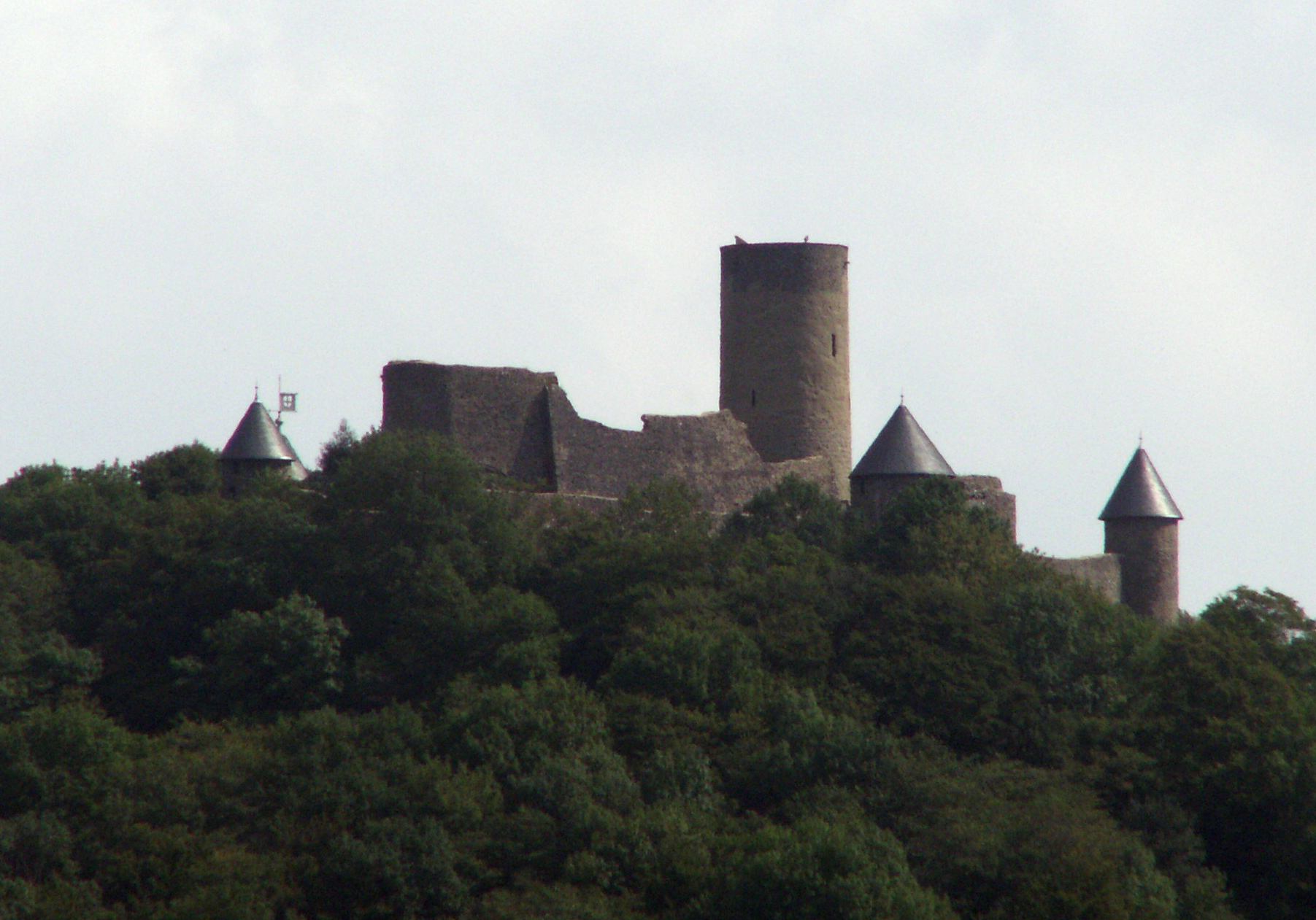
The ruins of Neublankenheim Castle today reveal a compact and robust defensive structure characteristic of medieval hill castles. The castle's footprint forms a roughly rectangular plan measuring approximately 40 by 20 meters. The most prominent surviving feature is the D-shaped keep standing at the southwestern corner, rising to a height of about 24 meters. This keep served as the primary fortified tower and last line of defense, typical of castles built in the High Medieval period.
The curtain walls enclose a courtyard and were originally designed for both defense and residential purposes. The walls are constructed in a square form, with remnants indicating the presence of towers or bastions at strategic points. The curtain walls and tower structures would have been equipped with battlements and arrow slits, allowing defenders to repel attackers effectively.
Building materials and construction techniques
The castle was primarily built using local stone, a common practice that ensured durability and integration with the natural landscape. The masonry work reflects the construction styles of the 14th century, with thick walls designed to withstand sieges and artillery of the period. The D-shaped keep is particularly notable for its curved exterior wall, which provided enhanced resistance to battering and improved fields of fire for defenders.
Decline and preservation efforts
Following its abandonment in the late 16th century, Neublankenheim Castle gradually deteriorated. The lack of maintenance and the impact of natural elements led to the collapse of many structures. By the time the Duchy of Arenberg took possession, the castle was largely a ruin. The confiscation and auction during the French revolutionary period further removed any possibility of restoration as a noble residence.
Modern preservation efforts began in the early 21st century. Consolidation work carried out in 2004 and 2006 stabilized the remaining walls and the keep, preventing further decay. These measures have made the ruins safely accessible to the public, allowing visitors to explore and appreciate the castle's historical significance and architectural features.
Visiting Neublankenheim Castle today
Today, the ruins of Neublankenheim Castle are freely accessible and offer a unique experience for history enthusiasts and tourists. The site’s atmospheric remains, particularly the towering D-shaped keep, provide a tangible connection to the medieval past. The castle’s location within a forested area adds to its mysterious and evocative character.
Visitors can explore the castle grounds, observing the layout of the curtain walls and imagining the life of its medieval inhabitants. The site is an excellent example of a hill castle that evolved through the High Medieval and Renaissance periods, reflecting the changing needs of defense and residence over time.
Nearby attractions and accessibility
Neublankenheim Castle’s proximity to the L70 road makes it relatively easy to reach by car. The surrounding Rhineland-Palatinate region is rich in historical sites, including other castles, medieval towns, and natural parks, offering visitors a comprehensive cultural experience.
Significance in castle architecture and heritage
Neublankenheim Castle exemplifies the transition from purely military fortifications to more residential and administrative functions seen in the late medieval period. Its enduring D-shaped keep is a significant architectural element that illustrates defensive innovations of the time. The castle’s history reflects broader socio-political changes in the Rhineland area, including feudal dynamics, noble succession, and the impact of revolutionary upheavals.
As a well-preserved ruin, Neublankenheim Castle contributes to the cultural heritage of Germany and serves as a valuable educational site for understanding medieval castle construction and history. Its conservation ensures that future generations can continue to explore and learn from this remarkable monument.
Frequently asked questions (FAQ)
- When was Neublankenheim Castle first mentioned in historical records?
- Neublankenheim Castle was first reliably mentioned in 1341 when it was granted as a fief by Margrave William V, Count of Jülich, to Gerhard V von Blankenheim.
- What is the architectural style of Neublankenheim Castle?
- Neublankenheim Castle features typical medieval hill castle architecture with a rectangular curtain wall and a distinctive D-shaped keep, reflecting construction techniques from the 14th century.
- Is Neublankenheim Castle accessible to visitors today?
- Yes, the ruins of Neublankenheim Castle are freely accessible to the public and have been consolidated to ensure safety during visits.
- What led to the decline of Neublankenheim Castle?
- The castle fell into disrepair by the early 16th century, was described as destroyed in 1521, and was not restored, leading to its abandonment and gradual ruin.
- How can visitors reach Neublankenheim Castle?
- The castle is located next to the L70 road between Ahütte and Ahrdorf in Rhineland-Palatinate, making it accessible by car and suitable for day trips.
Information
Address
Next to the L70 road from Ahütte to Ahrdorf
Loading map...
Visitor reviews
No reviews yet. Been here? Write the first review and help other travelers!
Write the first reviewVisited this castle? Share your experience
Your review helps other travelers and adds first-hand knowledge to our encyclopedia.