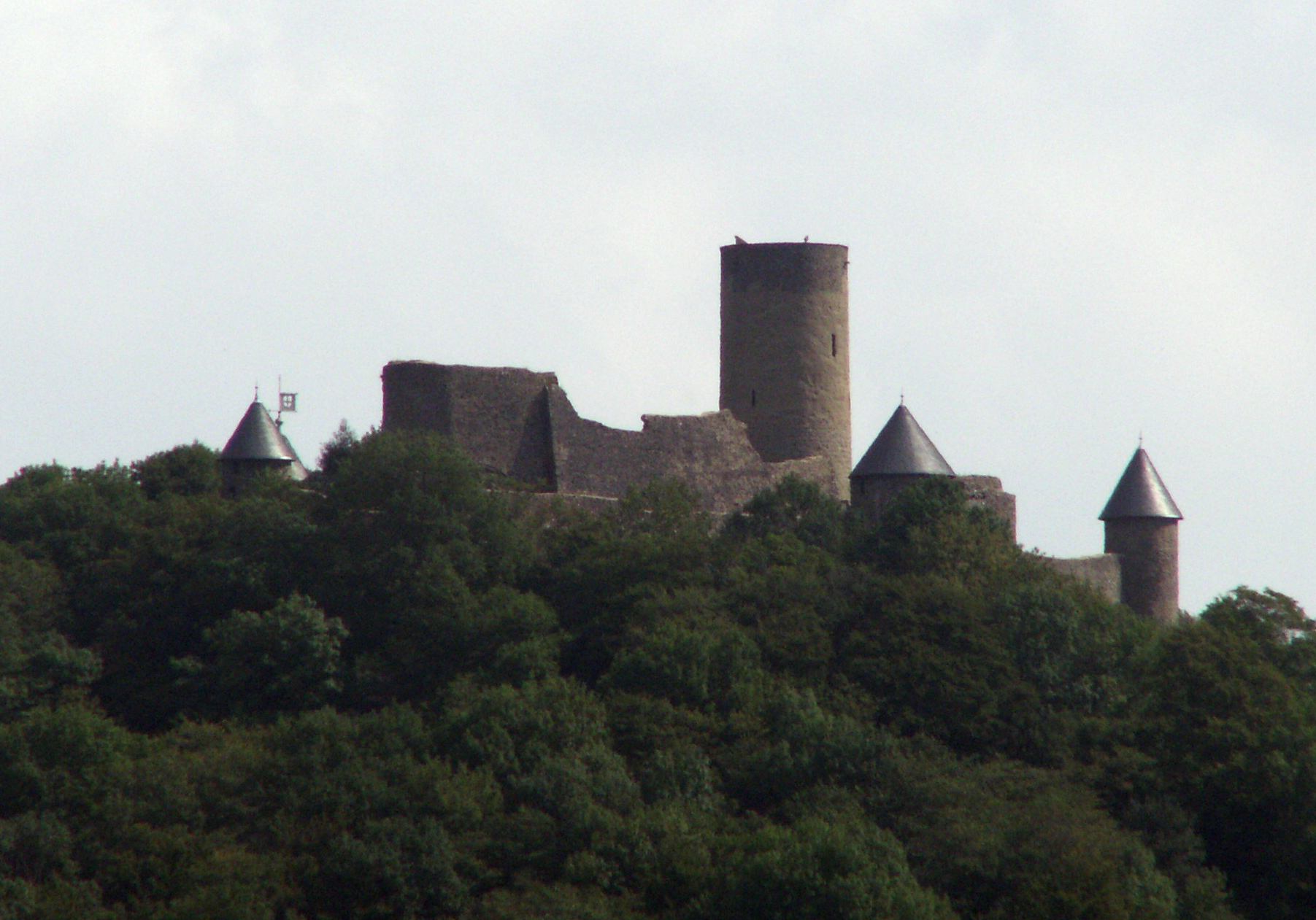
Ulmen Castle
Ulmen Castle, known locally as Burg Ulmen or the Ulmener Burgen, is a historic castle complex situated in the town of Ulmen in the Rhineland-Palatinate region of Germany. This castle stands prominently on a ridge overlooking the Ulmen Maar, a volcanic crater lake formed from an ancient eruption. The ridge itself is composed of tuff, a volcanic rock created from solidified ash and debris, providing a naturally defensible position for the castle.
The castle complex originally consisted of two main parts: the upper castle and the lower castle. While the lower castle has vanished almost entirely, the upper castle remains as a ruin and is a significant historical site. The upper castle is believed to have been constructed around the year 1000 AD, with the first documented mention recorded in 1074. This early medieval fortress was strategically important due to its elevated position and proximity to the maar.
Medieval origins and crusader connections
During the late 12th and early 13th centuries, Ulmen Castle was the residence of Heinrich von Ulmen, a knight who participated in the Fourth Crusade (1202–1204). Heinrich is notable for bringing back valuable Byzantine treasures, including the famous Limburg Staurothek, a reliquary now housed in Limburg Cathedral. This connection highlights the castle's role not only as a military stronghold but also as a cultural link between Western Europe and the Byzantine world.
Expansion and defensive enhancements
In 1292, the castle complex was expanded with the construction of the lower castle downhill from the upper fortress. This addition aimed to improve the defensive capabilities of the town of Ulmen. The castle and the town walls were integrated into a coordinated defense system, although the precise date of this fortification integration remains uncertain. During the 14th century, the castle became notorious as a base for robber barons, who exploited its strategic location to control trade routes and exert local power.
Transition to ecclesiastical control and legend
In 1490, Ulmen and its castle became part of the Electorate of Trier, a significant ecclesiastical principality within the Holy Roman Empire. This transition marked a shift from feudal knightly rule to ecclesiastical administration. Around 1508, local folklore gave rise to the legend of Knight Phillip Haust von Ulmen, who was said to have been rescued from captivity in the Holy Land by his devoted lady of the castle, adding a romantic dimension to the castle's history.
Destruction and decline in the early modern period
Between 1679 and 1689, Ulmen Castle suffered repeated damage from fires and military sieges during the wars of Louis XIV of France, known as the Sun King. French troops attacked the castle multiple times, ultimately leading to its destruction. By 1789, only the upper castle was partially restored, but it soon fell into disrepair again during the 19th century.
French revolutionary impact and quarrying
Following the French Revolutionary Wars, the region came under French control in 1794. The castle was confiscated by revolutionary authorities and subsequently passed into Prussian hands after the Congress of Vienna in 1815. In 1822, a citizen from nearby Cochem purchased the ruins and used the castle as a quarry for building materials. This practice accelerated the castle's physical decline.
In 1831, a devastating fire destroyed much of the town of Ulmen. The rebuilding efforts utilized stones salvaged from the castle ruins, further reducing the castle's remains.
Modern preservation and current status
In 1852, ownership of the castle ruins transferred to the municipality of Ulmen, which allowed the townspeople to use the site for various purposes, including hosting a sheep market. In 1913, the ruins were officially placed under monument protection, recognizing their cultural and historical importance.
Between 1967 and 1968, the upper castle ruins underwent restoration to stabilize the remaining structures. Today, the site includes the ring wall, remnants of the Kurtrier administrative house, an outer wall of the palas (main residential building), a cistern, and foundation walls of other former buildings. The lower castle has almost entirely disappeared, leaving little trace.
Visitor experience and cultural events
Ulmen Castle is freely accessible as a public town park. While the ruins are modest and have been consolidated in a way some find overly rigid, they offer a tangible connection to the region's medieval past. The castle grounds regularly host events, most notably an annual medieval market held every last weekend of June, attracting visitors interested in history and medieval culture.
The castle's location on the volcanic maar and its rich history from the early medieval period through the modern era make it a significant heritage site in the Rhineland-Palatinate. It stands as a testament to the region's turbulent history, from crusader knights and robber barons to French sieges and modern preservation efforts.
Frequently asked questions (FAQ)
- What is the historical significance of Ulmen Castle?
- Ulmen Castle, built in the 13th century, is a remarkable example of medieval military architecture in Germany. It served as a defensive stronghold and residence for local nobility, reflecting the feudal history of the region.
- When was Ulmen Castle constructed?
- Construction of Ulmen Castle began in the late 1200s, with various expansions and renovations occurring over the centuries. The castle's structure showcases elements from different architectural styles due to these modifications.
- Can I visit Ulmen Castle?
- Yes, Ulmen Castle is open to the public for visitors to explore its historical grounds and enjoy guided tours. It's advisable to check the official website for any specific visitor guidelines or restrictions before planning your trip.
- What are the opening hours for Ulmen Castle?
- Ulmen Castle typically opens to visitors from 10 AM to 5 PM, but hours may vary by season. It is recommended to verify the current opening times on the castle's website prior to your visit.
- Is Ulmen Castle accessible for visitors with disabilities?
- Ulmen Castle strives to accommodate all visitors, but some areas may be challenging due to the castle's medieval design and uneven terrain. It is best to contact the castle administration for specific accessibility information.
- When is the best time to visit Ulmen Castle?
- The best time to visit Ulmen Castle is during the spring and early fall when the weather is mild and the surrounding landscapes are at their most picturesque. Additionally, the castle often hosts special events during these seasons.
- What are the ticket prices for visiting Ulmen Castle?
- Ticket prices for Ulmen Castle are generally affordable, catering to families and groups. Discounts may be available for students and seniors, so be sure to check for any special offers on the castle's official site.
- What nearby attractions can I explore after visiting Ulmen Castle?
- After visiting Ulmen Castle, you can explore the charming village of Ulmen, which features beautiful landscapes and local shops. Additionally, nearby attractions include the scenic Laacher See and the historic towns of Cochem and Beilstein.
Information
Address
Behind Am Maarberg 1, Ulmen, Germany
Loading map...
Visitor reviews
No reviews yet. Been here? Write the first review and help other travelers!
Write the first reviewVisited this castle? Share your experience
Your review helps other travelers and adds first-hand knowledge to our encyclopedia.