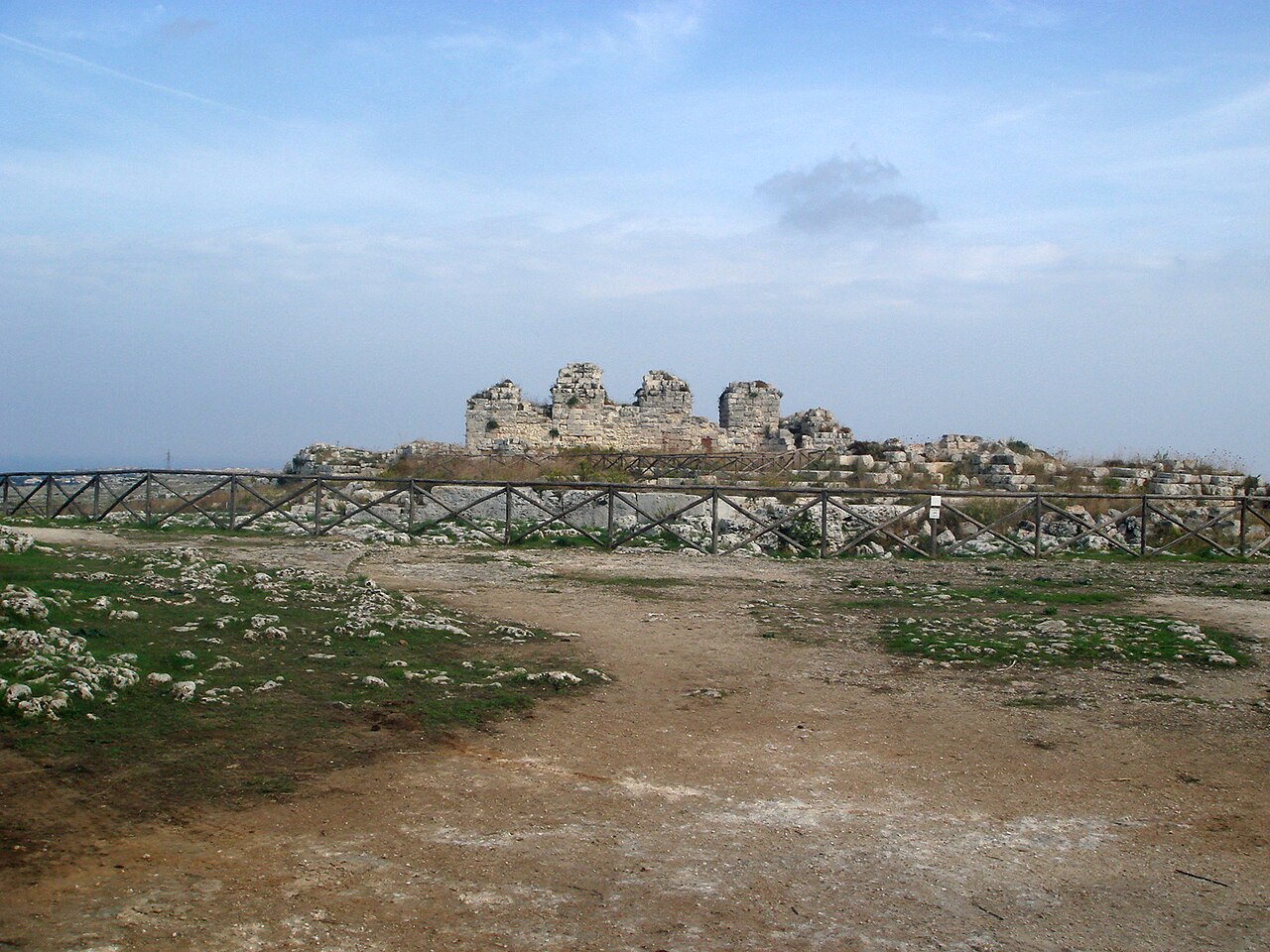
Noto Castle
Noto Castle, also known as Castello di Noto or Castello Reale, is a medieval fortress ruin located on the archaeological site of Noto Antica on Mount Alveria, north of the modern town of Noto in the province of Syracuse, Sicily, Italy. This site holds significant historical importance as it was once the heart of the ancient city of Noto, which played a crucial role throughout Sicily's complex history.
The origins of the settlement date back to the period when the indigenous Siculi tribes retreated inland to this naturally defensible rocky spur, shielded by deep ravines on either side, as the Greeks colonized the Sicilian coast. Over the centuries, the area saw successive occupations by the Byzantines, Romans, and Muslims. Under Muslim rule, the city flourished and became the capital of the historical province known as Val di Noto. It is believed that the initial fortifications, including the first iteration of what would become Noto Castle, were established during this period, reflecting the strategic importance of the site.
The Norman construction and medieval fortifications
The current remains of Noto Castle primarily date from 1091, when the Norman Duke Giordano, son of the renowned Roger of Altavilla, constructed the fortress. This construction was part of the Norman efforts to consolidate control over Sicily following their conquest. The castle was strategically positioned adjacent to the northern gate of the city and integrated into the city's defensive walls, serving both as a military stronghold and a symbol of Norman authority.
Throughout the High Medieval period, the castle underwent several modifications. In 1430, Duke Peter of Aragon reinforced its defenses, reflecting the ongoing military and political tensions in the region. Later, under the reign of Charles V in 1545, the fortress was modernized to adapt to evolving military technologies, particularly the increasing use of artillery. By 1675, during the Franco-Spanish War, the castle was equipped with guns, indicating its continued strategic role in regional defense.
Destruction and abandonment after the 1693 earthquake
On January 11, 1693, a catastrophic earthquake struck southeastern Sicily, devastating the region. The ancient city of Noto, including the castle, suffered extensive damage. The earthquake, followed by outbreaks of epidemic diseases, led to the abandonment of the site. Survivors relocated approximately 10 kilometers south, founding the new city of Noto, which was rebuilt in the Sicilian Baroque style and is today recognized as a UNESCO World Heritage Site.
Architectural features and current state of the castle
The remains of Noto Castle are situated within the overgrown ruins of the old city, offering a glimpse into the medieval military architecture of Sicily. The castle's position on Mount Alveria provided natural defensive advantages, enhanced by the castle's walls and towers. Although much of the structure lies in ruins, some portions of the fortifications are still visible, including sections of walls and foundations that outline the castle's former extent.
Today, the castle ruins are freely accessible to visitors, providing a quiet and evocative atmosphere that reflects its remote and historic character. The site offers insight into the layered history of Sicily, from ancient times through the medieval period and into the early modern era.
Historical significance and cultural heritage
Noto Castle stands as a testament to the complex history of Sicily, marked by successive waves of cultural influence and military conflict. Its origins in the Norman period highlight the island's integration into broader European medieval politics, while its earlier foundations under Muslim rule underscore the diverse heritage of the region.
The castle and the ruins of Noto Antica are important for understanding the historical development of urban fortifications in Sicily and the impact of natural disasters on settlement patterns. The relocation and reconstruction of Noto in the Baroque style further illustrate the resilience and cultural evolution of Sicilian communities.
Frequently asked questions (FAQ)
- How do I visit Noto Castle and the ruins of Noto Antica?
- Noto Castle is located on the archaeological site of Noto Antica, accessible by road from the modern town of Noto. Visitors can explore the ruins freely as the site is open and does not require an entrance fee. It is advisable to wear sturdy footwear due to uneven terrain.
- What is the historical importance of Noto Castle?
- Noto Castle was built in 1091 by the Norman Duke Giordano and served as a key defensive structure integrated into the city walls of the ancient city of Noto. It reflects the military architecture of the High Medieval period and the Norman consolidation of Sicily.
- When was Noto Castle built and by whom?
- The current castle was constructed in 1091 by Duke Giordano, son of Roger of Altavilla, during the Norman conquest of Sicily. It was built next to the northern city gate as part of the fortifications.
- Why was the original city of Noto abandoned?
- The original city of Noto was devastated by a massive earthquake in 1693, followed by epidemics that forced survivors to abandon the site. The city was rebuilt 10 kilometers south in the Sicilian Baroque style, which is now a UNESCO World Heritage Site.
- Is Noto Castle accessible to visitors today?
- Yes, the ruins of Noto Castle are freely accessible to the public. Visitors can explore the site and enjoy views of the surrounding landscape, though facilities are limited and the terrain can be rugged.
Information
Address
Strada Provinciale 64, Noto, Sicily, Italy
Loading map...
Visitor reviews
No reviews yet. Been here? Write the first review and help other travelers!
Write the first reviewVisited this castle? Share your experience
Your review helps other travelers and adds first-hand knowledge to our encyclopedia.