Maniace Castle
Maniace Castle, locally known as Castello Maniace, is a striking example of Swabian military architecture located at the extreme tip of the island of Ortygia in the historic city of Syracuse, Sicily. Constructed between 1232 and 1240 under the reign of the Holy Roman Emperor Frederick II, it stands on a site traditionally associated with an earlier Byzantine fortification attributed to the general George Maniakes, who reconquered Sicily from the Arabs in 1038. Though recent archaeological excavations have not revealed remains of this earlier fortress, the castle’s name preserves this historical connection.
The castle’s strategic position at the tip of Ortygia allowed it to control the harbor and city alongside the now-vanished Marchetto Castle. Unlike typical defensive castles placed at city entrances or borders, Maniace Castle’s location is somewhat eccentric, reflecting a complex defensive system of Syracuse that included other fortifications such as the Marieth Castle on the mainland.
Architectural design and features
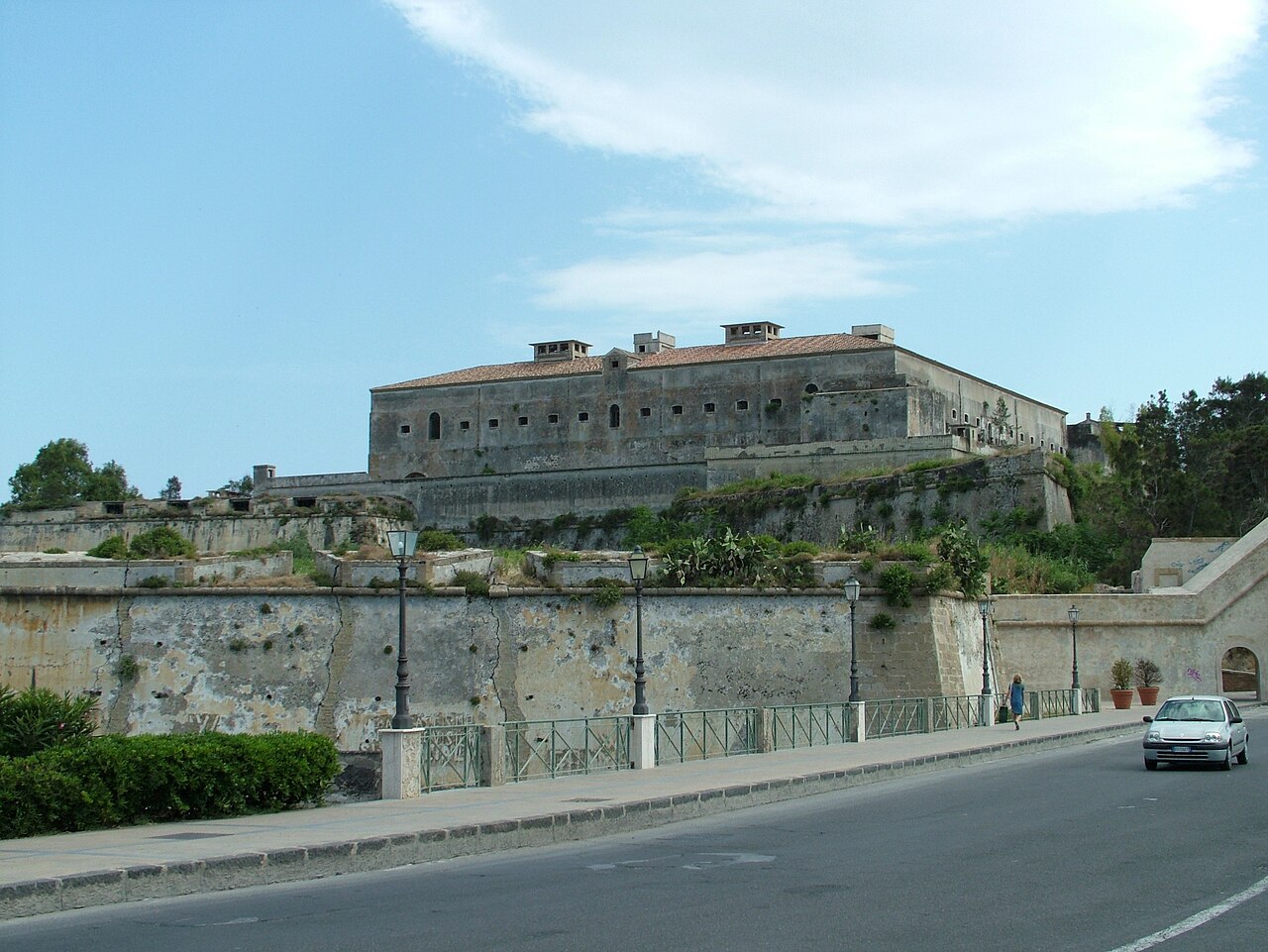
Maniace Castle is renowned for its robust Swabian Gothic architecture, characterized by massive walls, a grand hypostyle hall with rows of columns, and a courtyard that serves as the central module of the building. The castle’s design diverges from typical military fortresses of the era; it lacks a traditional baglio or square of arms, which would have allowed maneuvering of siege engines and artillery within the walls. The internal space is dominated by the hypostyle hall, which is architecturally impressive but not suited for military maneuvers.
The towers of the castle are enclosed by staircases, limiting their defensive utility. The absence of dedicated living quarters, food storage, and ammunition deposits within the main structure further complicates the understanding of its original function. These architectural peculiarities have led historians to debate whether the castle was primarily a war machine or served other roles.
Fortifications and modifications
Over the centuries, Maniace Castle underwent numerous modifications to adapt to evolving military technologies and political needs. In the 15th century, under Ferdinand II of Aragon, it was used as a prison and strengthened by Captain Goncalves of Cordoba. During the 16th century, under Charles V, Holy Roman Emperor, the castle was transformed into a true fortress with the addition of outer walls.
The 17th century saw further fortification with the addition of a southern battery known as The Diamond, named for its distinctive shape. The castle sustained damage from the 1693 earthquake and a devastating 1704 gunpowder explosion that destroyed part of the northwest tower and walls. Rebuilding efforts included the construction of warehouses within the castle walls.
During the Napoleonic Wars, the castle’s ramparts were equipped with modern cannons, and new barracks were constructed in 1838. It remained a military installation until the 1970s when it was demilitarized and later restored between 1993 and 2003.
Historical significance and royal connections
Maniace Castle played a significant role in the political and royal history of Sicily. It served as a royal residence during the 13th century and housed notable figures such as Peter III of Aragon and his wife Constance of Sicily after the Sicilian Vespers uprising. The castle was the site of important political events, including the signing of a truce in 1300 between Frederick III of Sicily and Robert of Anjou, King of Naples.
From 1302, the castle became the seat of the Royal Chamber, a feudal domain granted to Eleanor of Sicily as a royal dowry, remaining under the hereditary domain of the Queens of Sicily until 1537. It hosted several queens, including Costanza of Aragon, Maria d'Aragona, Bianca d'Aragona, and Germana de Foix, the latter being the widow of Ferdinand the Catholic.
The castle’s history is marked by dramatic events, such as the 1448 banquet where Captain Giovanni Ventimiglia accused guests of treason and had them executed. It also served as a prison and military garrison during various periods, reflecting its evolving role in Sicilian history.
Cultural heritage and visitor experience
Today, Maniace Castle stands as a testament to the layered history of Syracuse and Sicily. Its architectural features and historical associations make it a site of great cultural and heritage significance. Visitors can explore the grand hypostyle hall, admire the castle’s robust walls and towers, and learn about its complex past through onsite exhibitions.
The castle is accessible to the public for a fee and offers a unique glimpse into the military and royal history of medieval and early modern Sicily. Its location on Ortygia provides stunning views of the harbor and city, enhancing the visitor experience.
Archaeological insights and ongoing debates
Despite its imposing presence, Maniace Castle continues to intrigue scholars due to the absence of certain typical military features and its unusual design. The lack of evidence for the earlier Byzantine fortress and the castle’s atypical layout have led to ongoing debates about its original purpose. Some propose that it was more symbolic or residential rather than purely defensive.
Recent archaeological work has helped clarify some aspects but also highlighted the complexity of the castle’s history. The castle’s integration into the broader defensive system of Syracuse, including the Marieth Castle and later fortifications ordered by Charles V, underscores its strategic importance despite its enigmatic design.
Frequently asked questions (FAQ)
- What is the historical significance of Maniace Castle?
- Maniace Castle, built in the 12th century, is a remarkable example of medieval military architecture in Sicily. It was commissioned by the Norman King Roger II and served as a strategic fortress to protect the city of Syracuse from invasions, showcasing the blend of Norman and Arab influences in its design.
- When was Maniace Castle constructed?
- Construction of Maniace Castle began in 1239 and was completed by 1240. The castle was named after the Byzantine general George Maniakes, reflecting its historical roots and importance in the region's defense.
- How do I get to Maniace Castle?
- Maniace Castle is located on the island of Ortigia in Syracuse, Italy, easily accessible by walking from the city center. Public transportation options, such as buses and taxis, also serve the area, making it convenient for visitors.
- What are the opening hours for Maniace Castle?
- Maniace Castle is typically open to visitors from 9:00 AM to 7:30 PM during the summer months and from 9:00 AM to 5:30 PM during the winter. It is advisable to check the official website or local tourism information for any seasonal changes or holidays.
- Can I buy tickets in advance for a visit to Maniace Castle?
- Yes, tickets for Maniace Castle can often be purchased in advance through the official website or at local tourism offices. This is a great way to avoid long lines and ensure your entry on busier days.
- Is Maniace Castle accessible for visitors with disabilities?
- Yes, Maniace Castle has made efforts to improve accessibility for visitors with disabilities. Ramps and designated pathways are available, although some areas may still present challenges due to the castle's historical architecture.
- What is the best time to visit Maniace Castle?
- The best time to visit Maniace Castle is during the spring and fall when the weather is mild, and the crowds are smaller. Visiting early in the morning or later in the afternoon can also enhance your experience with fewer tourists around.
- Are there any nearby attractions to visit after exploring Maniace Castle?
- Yes, nearby attractions include the stunning Cathedral of Syracuse, the Fountain of Arethusa, and the archaeological park featuring the Greek Theatre. These sites provide a rich cultural experience that complements your visit to Maniace Castle.
- What are the ticket prices for Maniace Castle?
- Ticket prices for Maniace Castle are generally affordable, with discounts available for students and seniors. It is recommended to check the latest pricing on the official website before your visit to ensure you have the most accurate information.
Information
Address
Via del Castello Maniace, Syracuse, Italy
Loading map...
Visitor reviews
No reviews yet. Been here? Write the first review and help other travelers!
Write the first reviewVisited this castle? Share your experience
Your review helps other travelers and adds first-hand knowledge to our encyclopedia.