Euryalus Fortress
Euryalus Fortress stands as a monumental example of ancient Greek military architecture, dominating the Epipolae plateau near Syracuse, Italy. Built between 402 and 397 BCE under the rule of Dionysius I, the fortress was designed to protect the city from sieges, particularly those posed by the powerful Carthaginian forces during the turbulent period of Sicilian conflicts. Its strategic location on the highest point of the Epipolae hill, approximately 120 meters above sea level, provided commanding views over the surrounding territory and control over approaches to the city.
The fortress's origins are closely tied to the military history of Syracuse, especially during the Athenian Sicilian Expedition (415-413 BCE). Although the fortress itself was not yet constructed during this campaign, the importance of the Epipolae plateau was well recognized by contemporaries such as the historian Thucydides. The Athenians initially seized the hill but failed to maintain control, a setback that contributed to their eventual defeat. Recognizing the critical defensive value of this position, Dionysius I initiated the construction of the fortress shortly after the Athenian withdrawal, creating a fortified complex that would evolve over centuries.
Historical development and military significance
The initial construction phase between 402 and 397 BCE established a robust defensive structure intended to deter and withstand sieges, especially from the Carthaginians, who were Syracuse's main rivals for dominance in the western Mediterranean. The fortress was part of a broader system of fortifications that included the city's walls and other defensive installations on the Epipolae plateau.
Throughout the 4th and 3rd centuries BCE, the fortress underwent significant modifications to adapt to changing military technologies and tactics. After innovations in siege warfare introduced by figures such as Demetrius Poliorcetes, enhancements were made to strengthen the fortress's walls, towers, and defensive ditches. Later Syracusan rulers, including Agathocles and Hiero II, contributed to its reinforcement, ensuring the fortress remained a formidable bastion against external threats.
During the Roman siege of Syracuse (214-212 BCE), Euryalus Fortress played a critical role in the city's defense. Despite the eventual Roman conquest led by Marcus Claudius Marcellus, the fortress's design allowed it to resist prolonged assaults, highlighting its strategic resilience. The fortress continued to be used and adapted during the Byzantine period, when parts were dismantled and rebuilt to counter the threat of Arab invasions.
Architectural features and layout
Euryalus Fortress covers approximately 15,000 square meters atop the Epipolae plateau, featuring a complex and multi-layered defensive system. The fortress is divided into two main sections: a western irregular quadrilateral area with towers and barracks, and an eastern section linked to the city's defensive walls, housing large cisterns for water storage.
Defensive ditches and tunnels
Approaching the fortress, visitors encounter a series of four defensive ditches of varying size and depth, designed to impede attackers. The third ditch is particularly notable, measuring about 17 meters wide and 9 meters deep, and is connected to an underground tunnel system that includes a drawbridge and internal staircases. This subterranean network allowed defenders to move unseen and launch surprise counterattacks, a sophisticated feature for its time.
The central keep and towers
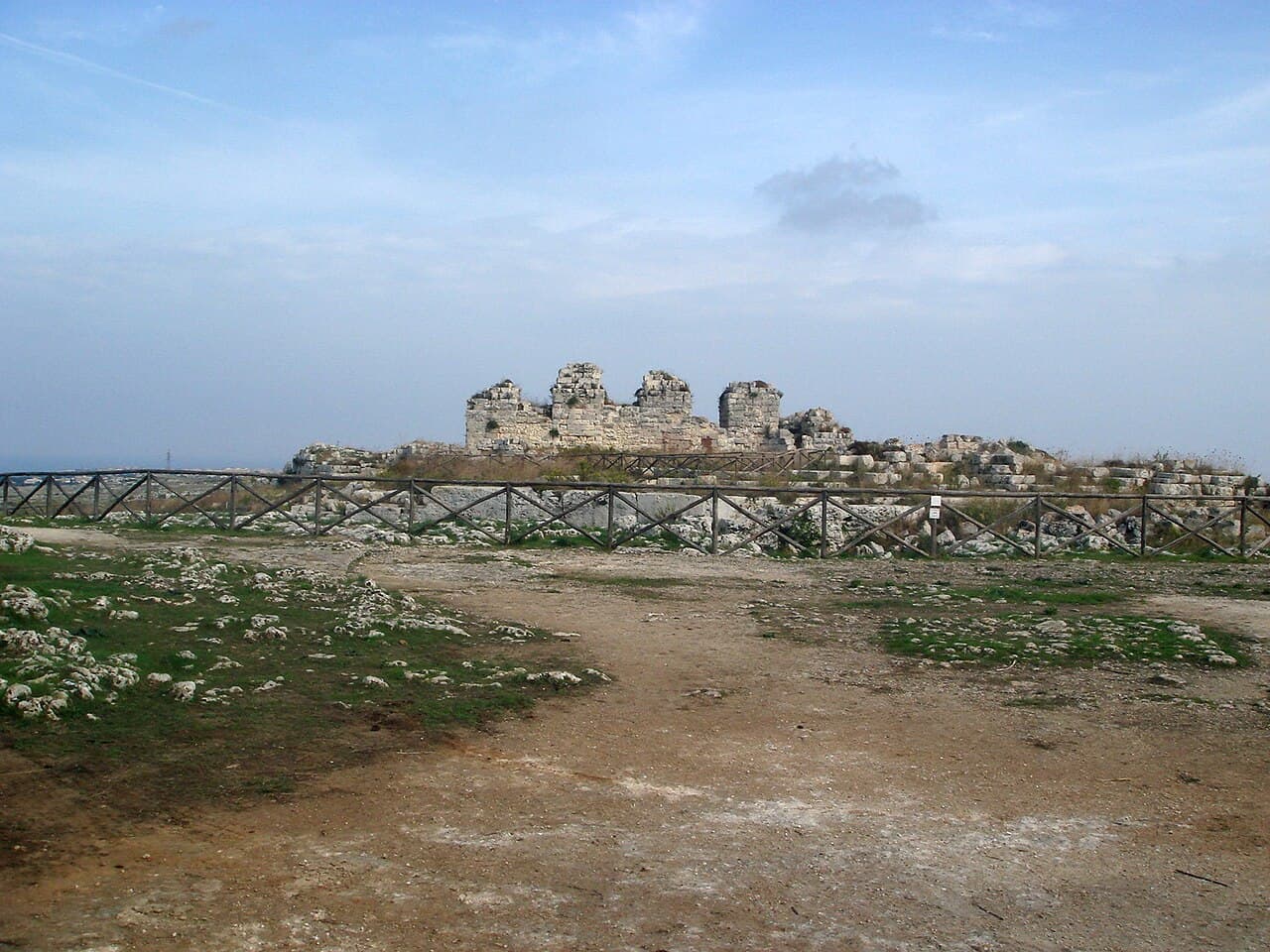
The heart of the fortress is the mastio, a trapezoidal central keep surrounded by five square towers approximately 15 meters high, forming a pentagonal arrangement known as a pentapylon. These towers were equipped to mount catapults, enhancing the fortress's offensive and defensive capabilities. The original lion-head rainwater spouts from the 4th century BCE, which adorned the towers, have been relocated to the Museo Paolo Orsi in Syracuse.
Water management systems
Water supply was crucial for sustaining a garrison during sieges. The fortress contains three large cisterns near the eastern section and an additional cistern and watchtower on the western high point. These cisterns collected and stored rainwater, ensuring the defenders could withstand prolonged blockades.
The tryplon gate complex
The fortress's eastern main gate, known as the Tryplon or Trypilon, consists of three successive gates within a thick wall approximately five meters wide. This gate was heavily fortified with multiple towers and featured a double vaulted passage, linking directly to the city's Dionysian walls. The design limited the effectiveness of frontal assaults and battering rams, making the entrance a formidable obstacle for attackers.
Later history and modern preservation
Following the Roman conquest, the fortress remained an important military site and was adapted during the Byzantine era to meet new defensive needs. Stones and materials from older structures were repurposed to repair and strengthen the fortress against Muslim incursions.
In the 20th century, King Victor Emmanuel III visited the fortress in 1939, underscoring its cultural significance. During World War II, the fortress's extensive tunnels were used to protect archaeological artifacts from bombing raids, preserving key elements of Syracuse's heritage.
After the Santa Lucia earthquake of 1990 caused damage and led to a long closure, the site was reopened in 2016 with the inauguration of an antiquarium. This museum houses a collection of artifacts found on-site, including a sword, a helmet, and stone-throwing catapult missiles, providing visitors with a tangible connection to the fortress's military past.
Visitor experience and significance
Today, Euryalus Fortress offers a remarkable glimpse into ancient military engineering and the strategic importance of Syracuse in the classical Mediterranean world. Its well-preserved walls, towers, ditches, and underground passages illustrate the evolution of defensive architecture over several centuries. The site is a valuable cultural landmark that attracts historians, archaeologists, and tourists interested in ancient warfare and Greek colonial history.
Visitors can explore the extensive remains, including the imposing central keep, the defensive ditches, and the sophisticated water cisterns. The nearby antiquarium enriches the experience by displaying key artifacts and providing historical context. The fortress's location on the Epipolae plateau also offers panoramic views of the surrounding landscape and the city of Syracuse.
Frequently asked questions (FAQ)
- When was Euryalus Fortress built and by whom?
- Euryalus Fortress was constructed between 402 and 397 BCE by Dionysius I, the tyrant of Syracuse, to protect the city from Carthaginian attacks.
- What is the significance of the Tryplon gate at Euryalus Fortress?
- The Tryplon gate is a heavily fortified entrance consisting of three successive gates and multiple towers, designed to withstand frontal assaults and connect directly to Syracuse's city walls.
- Can visitors see artifacts from the fortress on-site?
- Yes, the antiquarium opened in 2016 near the fortress displays artifacts such as a sword, helmet, and catapult missiles found during excavations.
- How did the fortress adapt to changes in siege warfare?
- The fortress underwent several renovations under rulers like Agathocles and Hiero II to strengthen defenses against evolving siege technologies, including the addition of towers for mounting catapults.
- Is Euryalus Fortress accessible to visitors today?
- Yes, Euryalus Fortress is open to visitors who can explore the extensive remains and the nearby antiquarium, offering insight into ancient military architecture.
Photo gallery

Photo by Giovanni Dall'Orto•Attribution
Information
Website
Visit websiteSources & official resources
Verify the information above using these authoritative references.
Loading map...
Visitor reviews
No reviews yet. Been here? Write the first review and help other travelers!
Write the first reviewVisited this castle? Share your experience
Your review helps other travelers and adds first-hand knowledge to our encyclopedia.