Norwich Castle
Norwich Castle stands as a monumental symbol of Norman conquest and medieval fortification in the city of Norwich, Norfolk. Founded in the aftermath of the Norman Conquest of England by William the Conqueror between 1066 and 1075, it is a prime example of a high medieval hill castle constructed to assert Norman authority in an important regional center. This castle was the only royal fortress in East Anglia during the late 11th and early 12th centuries, underscoring its strategic and political significance.
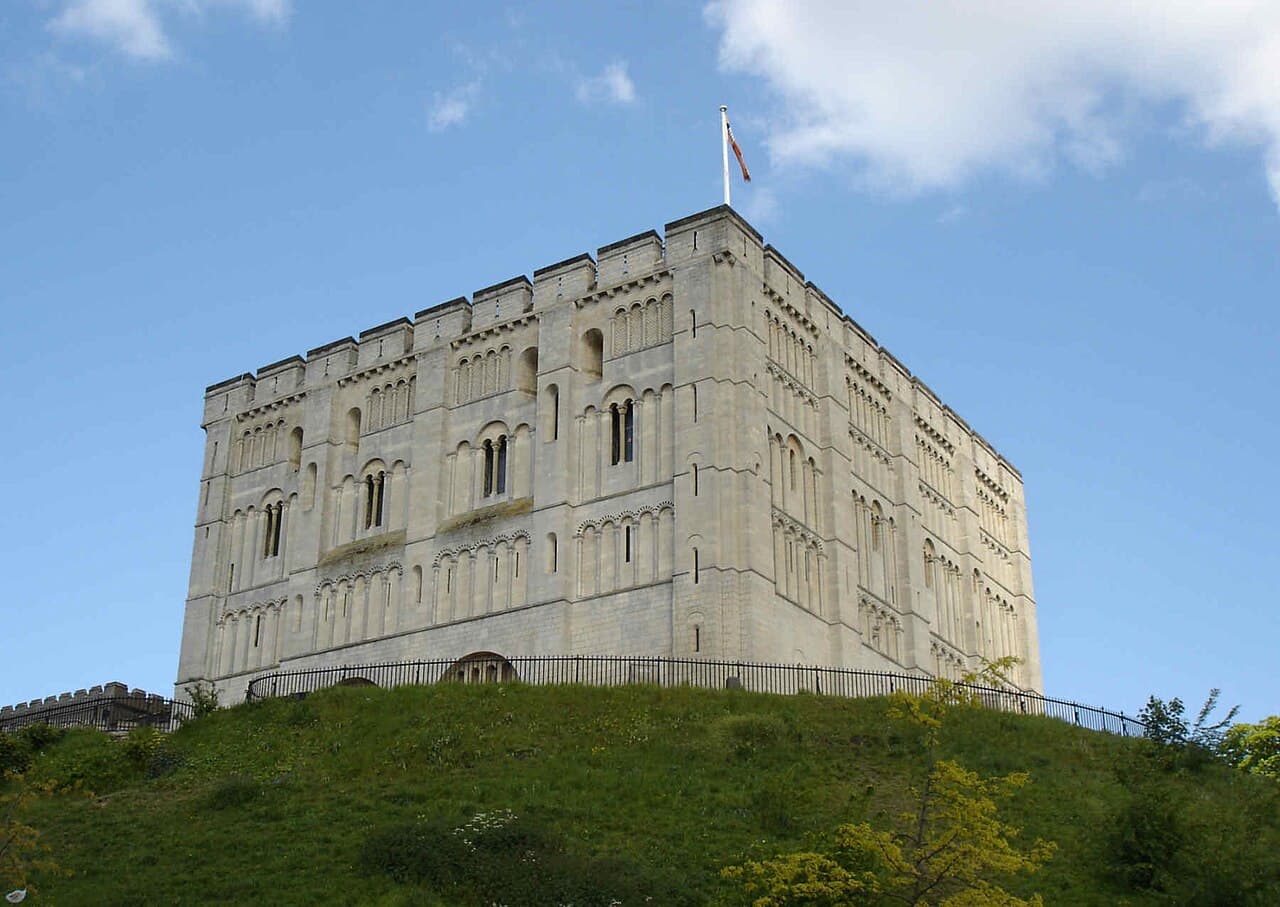
The castle began as a motte and bailey structure, featuring a raised earthwork mound (motte) surrounded by a wooden palisade and an enclosed courtyard (bailey). Around 1100, the wooden fortifications were replaced with a massive stone keep, built predominantly of Caen stone over a flint core, which has survived to the present day. This keep is a rare example of a hall keep, measuring approximately 29 by 27 meters at the base and standing about 21 meters tall. Its exterior is distinguished by blind arcading, decorative arches embedded in the stone walls, which 19th-century antiquarian G. T. Clark praised as the most ornamented keep in England.
Architectural features and construction
The keep and its design
The stone keep was constructed between 1094 and 1121, replacing the original wooden structures. The entrance was originally located on the first floor on the eastern side, accessed via a now-demolished external stone stairway leading to the Bigod Tower, a forebuilding that served as a gatehouse and defensive feature. The interior layout of the keep, largely lost due to later modifications, is believed to have included a two-story great hall, a chapel, a kitchen, and numerous latrines, reflecting the keep’s dual role as a defensive stronghold and residence.
Motte, bailey, and outer defenses
The motte was artificially raised and the surrounding ditch deepened around 1100 to enhance defensive capabilities. The original Norman wooden bridge crossing the inner ditch was replaced in the 19th century. While the outer and inner curtain walls no longer survive, archaeological evidence confirms their former existence, enclosing the bailey and providing layered defense.
Prison expansions and modifications
From the early 13th century until 1887, Norwich Castle served as a county gaol. Extensive prison buildings were erected atop the motte in the late 18th and early 19th centuries. Architect John Soane led a major reconstruction between 1789 and 1793, removing the keep’s interior walls to create cells for male felons and adding separate facilities for debtors and women prisoners. Later, in 1827–1828, architect William Wilkins expanded the prison with three radiating wings containing 240 cells, an octagonal governor’s house with family apartments, a chapel, a committee room, and a mill house with a treadwheel for pumping water. These additions obscured the original Norman entrance and significantly altered the castle’s silhouette.
Historical significance and events
Military and political history
Norwich Castle was a focal point during several key historical events. It was besieged during the Revolt of the Earls in 1075 and captured by Hugh Bigod in 1174 amid the Revolt of 1173–1174. The castle was recorded in the Domesday Survey of 1086 as one of 48 royal castles in England, highlighting its importance in the Norman consolidation of power.
Role in local and social history
In 1190, the castle provided refuge to the Jewish community during anti-Jewish violence in East Anglia, though tragically many who could not reach the fortress were killed. From 1220 onward, the castle’s role as a prison became central, housing state prisoners from as early as 1264. It remained a county gaol for over six centuries, witnessing public executions behind the castle and later private executions within the prison walls. Notable executions include Robert Kett, leader of Kett’s Rebellion in 1549, and James Blomfield Rush, executed in 1849 for murder.
Conversion to museum and cultural heritage
After ceasing to function as a prison in 1887, Norwich Castle was converted into a museum and art gallery, opening in 1895 under the direction of architect Edward Boardman. The castle is now managed by the Norfolk Museums Service and is part of the Norwich 12 heritage sites, a collection of important historic buildings in the city.
The museum’s collections include significant archaeological finds from the region, including Anglo-Saxon and Viking artifacts, as well as decorative arts and fine art spanning the 17th to 20th centuries. Among the notable exhibits are the Harford Farm Brooch, a large collection of butterflies by Margaret Fountaine, and the early 20th-century needlework of Lorina Bulwer. Visitors can explore interactive displays, the dungeon, and the battlements, gaining insight into both the castle’s martial past and its cultural significance.
Preservation and architectural legacy
The castle’s stone keep remains a well-preserved example of Norman military architecture, despite the extensive alterations made during its use as a prison. Repairs to the keep’s outer stonework were carried out several times, notably by Anthony Salvin between 1835 and 1839 using Bath stone. The castle precinct includes a historic gallows site and a burial area for executed felons, marked by a commemorative stone plaque.
Designated a scheduled ancient monument in 1915 and a Grade I listed building in 1954, Norwich Castle continues to be a vital cultural landmark. Its architectural features, historical associations, and role as a museum make it a key destination for understanding Norman England and the evolution of medieval fortifications in East Anglia.
Frequently asked questions (FAQ)
- How do I visit Norwich Castle museum?
- Norwich Castle museum is open to visitors throughout the year, typically offering access to its galleries, exhibitions, and castle grounds. It is advisable to check the official Norfolk Museums Service website for current opening hours and ticketing information before planning your visit.
- What is the historical significance of Norwich Castle?
- Norwich Castle is a prime example of Norman military architecture and played a crucial role in the consolidation of Norman power in East Anglia. It served as a royal fortress, a prison for over six centuries, and now functions as a museum showcasing regional history and art.
- Can I explore the medieval architecture of Norwich Castle?
- Yes, visitors can explore the well-preserved Norman stone keep, including its exterior features such as blind arcading and battlements. Although the interior has been modified over time, the castle grounds and museum exhibits provide detailed insights into its medieval origins and architectural evolution.
- Is Norwich Castle accessible for people with disabilities?
- Norwich Castle museum strives to provide accessibility for all visitors, including those with disabilities. Facilities and services may include ramps, lifts, and accessible restrooms. It is recommended to contact the museum in advance to ensure specific needs can be accommodated.
- When was Norwich Castle converted into a museum?
- Norwich Castle ceased functioning as a prison in 1887 and was converted into a museum and art gallery, opening to the public in 1895. This transformation preserved the castle as a cultural and historical landmark.
Photo gallery

Information
Sources & official resources
Verify the information above using these authoritative references.
Loading map...
Visitor reviews
No reviews yet. Been here? Write the first review and help other travelers!
Write the first reviewVisited this castle? Share your experience
Your review helps other travelers and adds first-hand knowledge to our encyclopedia.