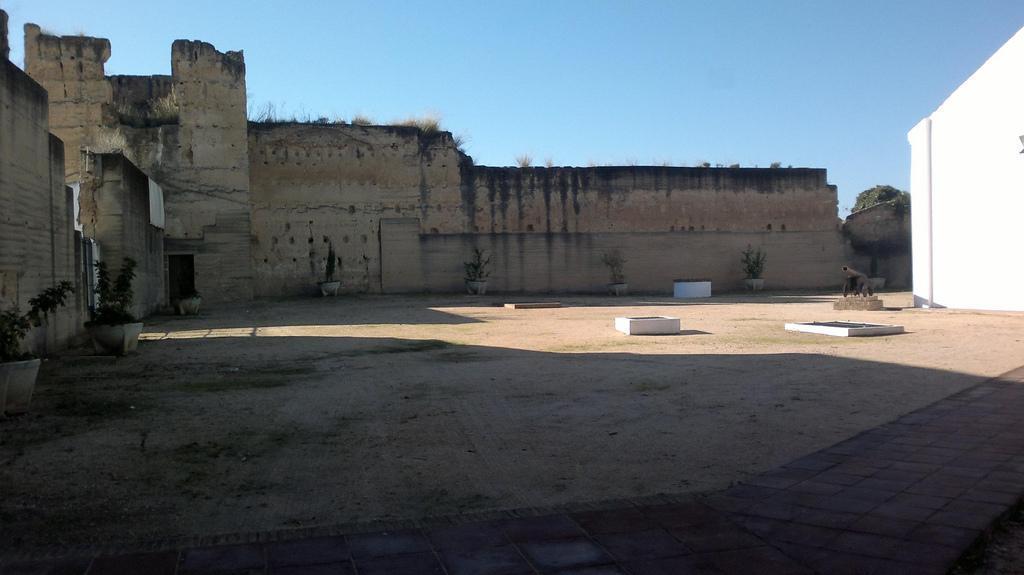
Niebla Castle
Niebla Castle, located in the town of Niebla, Spain, is a remarkable example of a late medieval hill castle that embodies a rich history spanning Islamic and Christian periods. The castle's origins trace back to the Taifa period when Muslim rulers first fortified the site with a citadel. This strategic location on a hilltop overlooking the surrounding lands provided a commanding defensive position, which was later transformed under Christian rule into the imposing fortress visible today.
The construction of the current castle began in 1402 under the direction of Don Enrique de Guzmán, the second Duke of Medina Sidonia and fourth Duke of Niebla. He ordered the demolition of the old Moorish Alcázar to erect a new fortress-palace that combined military strength with noble residential luxury. Despite the transformation, the builders preserved significant elements of the original Islamic architecture, most notably the Muslim Tower of Homage, which remains a defining feature of the castle.
Architectural design and layout
The castle exhibits a rectangular layout divided by an inner wall that separates two main areas: the patio de armas (courtyard of arms) and the luxurious residential quarters. The main structure is fortified by ten towers, six of which are square-shaped, including the prominent Tower of Homage positioned at the corner. These square towers anchor the corners and ends of the inner wall, providing robust defensive points.
Alternating with the square towers are four semicircular towers, which enhance the castle's defensive capabilities by allowing better angles of fire and coverage. The walls extend from the Tower of Homage and the northwest corner tower to form a barbican that encloses the central building on three sides: east, south, and west. This barbican includes six additional towers and connects to the older Almohade wall near the Puerta de Sevilla and Puerta del Socorro, integrating earlier fortifications into the castle's defenses.
Later additions in the late 15th century introduced an adarve (wall walk) and a second barbican, completing the defensive circuit. The combination of square and semicircular towers, thick walls, and multiple layers of fortifications reflect the military architectural advancements of the period, designed to withstand artillery and siege warfare.
Historical significance and events
The castle's history is deeply intertwined with the noble House of Guzmán, particularly during the late 15th and early 16th centuries. Enrique de Guzmán and his successor, Juan Alonso Pérez de Guzmán, the third Duke, used the castle as both a fortress and a symbol of their authority in the region.
In 1508, the castle was captured by Crown forces during the sack of Niebla, marking a significant military episode. Over the next century, the castle gradually declined, suffering neglect and damage. Important repairs were undertaken in the early 1600s, but the structure continued to deteriorate.
The 1755 Lisbon earthquake severely damaged the castle, particularly the keep or torre del homenaje, which was left truncated. The castle regained military importance during the Peninsular War in the early 19th century. In 1810, the French army occupied Niebla and restored parts of the fortifications to establish a garrison.
In 1811, the castle endured a five-day siege by allied Spanish and British troops under General Joaquín Blake. Although the castle resisted the siege, the French withdrew in 1812, deliberately detonating parts of the fortress and causing extensive destruction that reduced the castle to ruins.
Construction materials and techniques
The castle's construction showcases a blend of materials reflecting both Islamic and Christian building traditions. The walls incorporate sillarejo (roughly cut stone blocks), sillares (finely dressed stone blocks), and tapial (rammed earth) techniques. The use of rammed earth, where damp earth is compressed to form solid walls, was common in Moorish fortifications and was retained in parts of the castle.
This combination of materials contributed to the castle's formidable defenses, with thick walls capable of absorbing artillery fire. The masonry work also reflects the skill of medieval craftsmen who adapted older Islamic fortifications to new military needs.
Current condition and preservation efforts
Today, Niebla Castle stands as a partially restored fortress that offers insight into its layered history. Restoration efforts began in the mid-20th century, following its designation as a Historic-Artistic Monument in 1945, alongside the city walls of Niebla. These campaigns have stabilized the ruins, reconstructed key sections, and preserved important architectural elements such as the defensive walls, towers, and the keep.
The castle's layout, with its two large courtyards and series of square towers, remains visible and accessible to visitors. The surviving keep at the northeast corner, despite being truncated, continues to symbolize the castle's historical role as a noble stronghold and military bastion.
Visitor experience and cultural importance
Visitors to Niebla Castle can explore its extensive fortifications, admire the blend of Islamic and Christian architectural features, and appreciate the castle's strategic hilltop position overlooking the town and surrounding countryside. The castle is a significant cultural landmark that reflects the complex history of Andalusia, marked by centuries of conflict, conquest, and noble power.
Its preservation allows for educational opportunities and cultural tourism, contributing to the understanding of medieval military architecture and the historical evolution of Spanish castles. The castle's integration with the old city walls enhances the visitor experience, providing a comprehensive view of Niebla's fortified heritage.
Frequently asked questions (FAQ)
- What are the visiting hours for Niebla Castle?
- Niebla Castle is generally open to visitors during daytime hours, typically from 10:00 AM to 6:00 PM, but it's advisable to check locally for seasonal variations or special closures.
- How do I get to Niebla Castle?
- Niebla Castle is located in the town of Niebla in Andalusia, Spain. It is accessible by car and public transport, with the castle situated near the town center, making it easy to reach on foot.
- What is the historical significance of Niebla Castle?
- Niebla Castle is historically significant as a late medieval fortress built over a former Moorish citadel, reflecting the region's transition from Islamic to Christian rule and its role in noble power struggles.
- Can I explore the towers and walls of Niebla Castle?
- Yes, visitors can explore many of the castle's towers and defensive walls, which have been partially restored to provide insight into medieval military architecture and offer panoramic views of the surrounding area.
- Is there an entrance fee to visit Niebla Castle?
- Entrance to Niebla Castle is often free or involves a small fee, but it is recommended to verify current ticket prices with the local tourist office or official site before visiting.
Information
Sources & official resources
Verify the information above using these authoritative references.
Loading map...
Visitor reviews
No reviews yet. Been here? Write the first review and help other travelers!
Write the first reviewVisited this castle? Share your experience
Your review helps other travelers and adds first-hand knowledge to our encyclopedia.