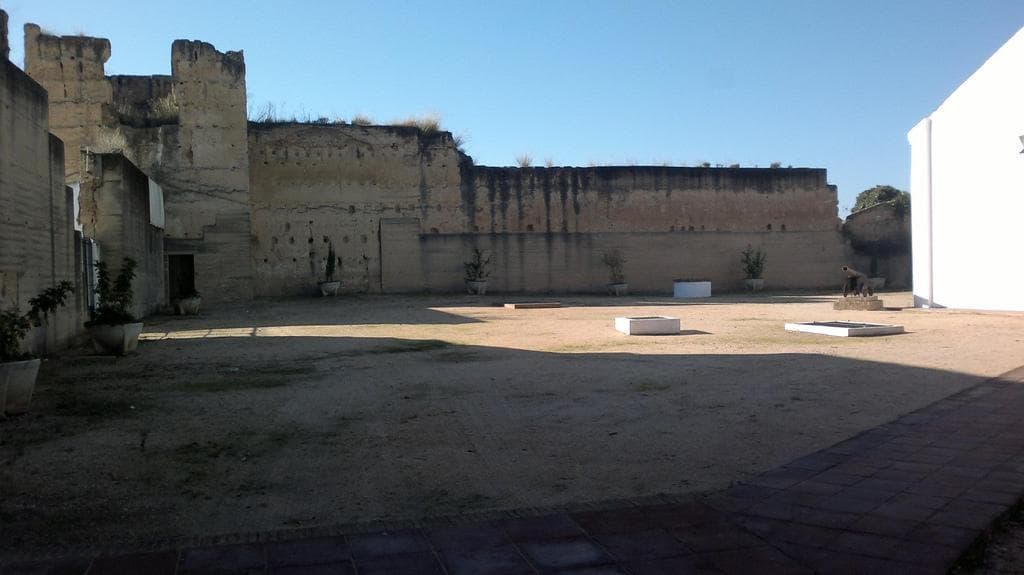
Moguer Castle
Moguer Castle, located in the town of Moguer in the province of Huelva, Spain, is a significant example of a late medieval hill castle with a history that likely extends back to the Moorish period. Though the earliest documented reference to the castle dates from 1362, the site is believed to have been fortified earlier, possibly during the Moorish occupation of the Iberian Peninsula. The castle underwent substantial renovation and enlargement during the 14th century, which shaped much of its current form and defensive features.
Architectural design and construction materials
The castle is constructed primarily from a combination of mud-based mortar gravel, clay, and lime, materials typical of the region and period. It is laid out on an imperfect square plan, measuring approximately 44 by 45 metres (144 ft × 148 ft). This layout is fortified by four large corner towers, each measuring about 9 by 9 metres (30 ft × 30 ft), which provided strong defensive points and living quarters. Each tower contains two chambers with covered brick domes, a notable architectural feature that adds both strength and fire resistance to the structure.
Defensive features
The castle was originally surrounded by a moat, as indicated by historical documents, though the moat is no longer visible today. The presence of a moat would have significantly enhanced the castle's defensive capabilities by impeding attackers and providing a clear line of sight for defenders. The four towers were topped by battlements, which allowed defenders to shield themselves while observing and firing upon approaching enemies.
Access and layout
Access to the castle was traditionally from the northwest side, corresponding to the current Santo Domingo Street. Entry was via a ramp, which would have been easier for horses and carts to navigate compared to steps, and also easier to defend. This entrance placement reflects strategic considerations, likely influenced by the topography and urban development of Moguer.
Later modifications and current use
In addition to its medieval structures, the castle includes an 18th-century cellar measuring approximately 22 by 10.5 metres (72 ft × 34 ft). This cellar is currently used as the headquarters of the Tourist Office, integrating the castle into the modern cultural and administrative life of Moguer. The cellar's size and robust construction suggest it was used for storage and possibly wine production or other goods in the post-medieval period.
Historical context and significance
Moguer Castle occupies a strategic position in the province of Huelva, an area with a rich history of cultural exchanges and conflicts, particularly during the Reconquista. The castle's design reflects typical late medieval military architecture in southern Spain, combining functional defensive elements with residential chambers within the towers. Its survival and adaptation over the centuries provide valuable insights into the evolution of fortifications in the region.
Architectural style and preservation
The castle's architectural style is consistent with late medieval military construction in Andalusia, characterized by practical fortification techniques rather than ornamental design. The use of local materials such as mud-based mortar and lime is typical for the period and region, reflecting resource availability and construction traditions.
Today, Moguer Castle is well preserved in terms of its main structural elements, though some features like the moat have disappeared. Its continued use for public functions, such as housing the Tourist Office, ensures ongoing maintenance and public engagement with the site.
Visiting Moguer Castle
Visitors to Moguer can explore the castle's exterior and its imposing towers, which dominate the town's skyline. Although the interior access may be limited due to its current administrative use, the castle remains a prominent historical landmark offering insight into the military architecture of the 14th century. Its location within the town makes it accessible for tourists interested in medieval history and Spanish heritage.
Frequently asked questions about Moguer Castle
- What is the historical significance of Moguer Castle? Moguer Castle is a key example of late medieval military architecture in southern Spain, with origins possibly dating back to the Moorish period.
- Can visitors enter the castle? While the castle’s exterior and towers can be viewed, interior access may be restricted as parts of the castle serve as the Tourist Office headquarters.
- When was Moguer Castle built? The castle was renovated and enlarged in the 14th century, with the earliest record from 1362, but it likely existed earlier.
- What materials were used in the castle’s construction? It was built using mud-based mortar gravel, clay, and lime, typical of the region and period.
- Is the castle surrounded by a moat? Historical documents confirm a moat once surrounded the castle, though it is no longer visible today.
- Where is the entrance to Moguer Castle? The main entrance was on the northwest side, now Santo Domingo Street, accessed via a ramp.
- What is the current condition of Moguer Castle? The castle is well preserved, with its main structures intact and adapted for modern use.
Frequently asked questions (FAQ)
- What is the historical significance of Moguer Castle?
- Moguer Castle is a key example of late medieval military architecture in southern Spain, with origins possibly dating back to the Moorish period.
- Can visitors enter the castle?
- While the castle’s exterior and towers can be viewed, interior access may be restricted as parts of the castle serve as the Tourist Office headquarters.
- When was Moguer Castle built?
- The castle was renovated and enlarged in the 14th century, with the earliest record from 1362, but it likely existed earlier.
- What materials were used in the castle’s construction?
- It was built using mud-based mortar gravel, clay, and lime, typical of the region and period.
- Is the castle surrounded by a moat?
- Historical documents confirm a moat once surrounded the castle, though it is no longer visible today.
- Where is the entrance to Moguer Castle?
- The main entrance was on the northwest side, now Santo Domingo Street, accessed via a ramp.
- What is the current condition of Moguer Castle?
- The castle is well preserved, with its main structures intact and adapted for modern use.
Photo gallery

Information
Loading map...
Visitor reviews
No reviews yet. Been here? Write the first review and help other travelers!
Write the first reviewVisited this castle? Share your experience
Your review helps other travelers and adds first-hand knowledge to our encyclopedia.



