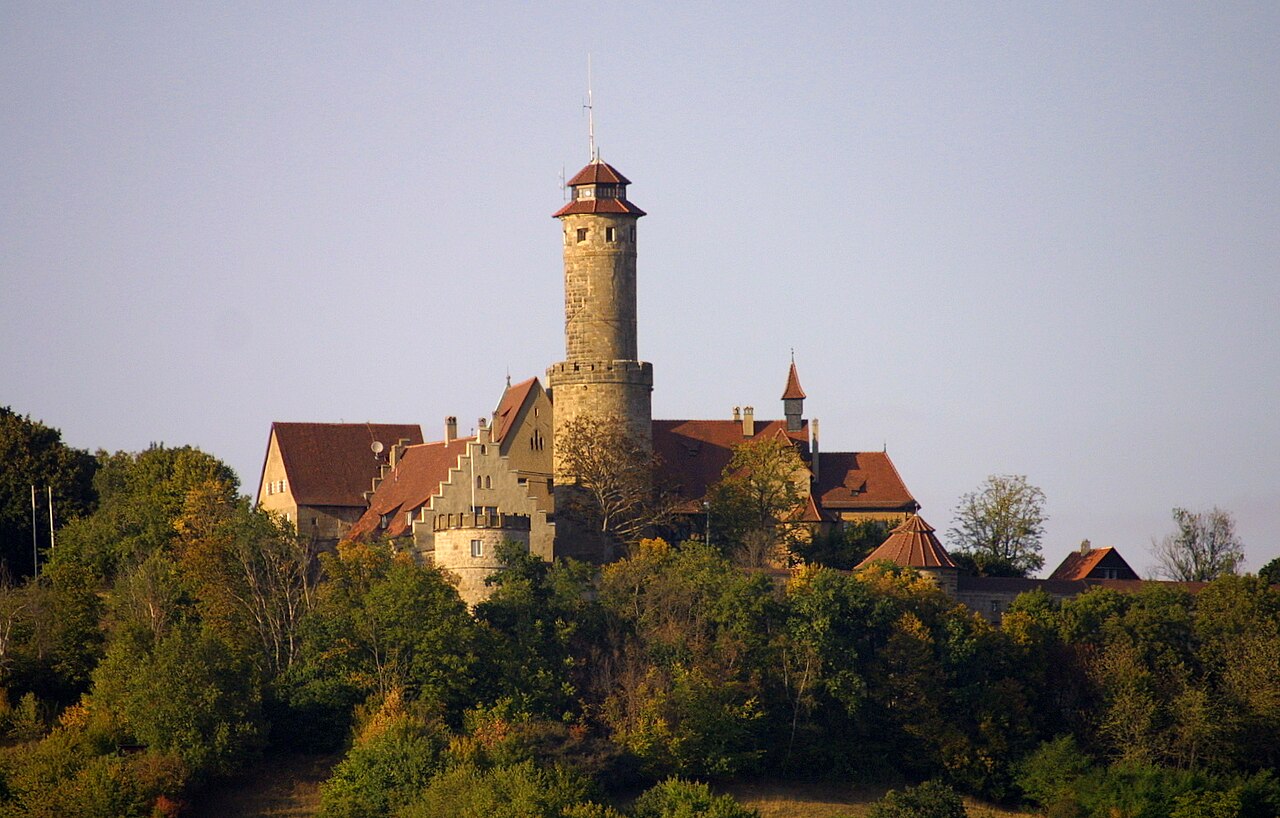
New Residence Bamberg
The New Residence Bamberg stands as a remarkable historic palace located prominently on the cathedral square of Bamberg, Germany. This Renaissance and Baroque palace served as the principal residence of the Prince-Bishops of Bamberg and reflects centuries of architectural evolution and political history. Its construction began in the early 17th century, marking a significant transformation in the urban layout of Bamberg's cathedral precinct.
Early construction and renaissance origins
Construction of the New Residence commenced in 1604 under the direction of Prince-Bishop Johann Philipp von Gebsattel. The initial design embodied the principles of Renaissance architecture, characterized by its balanced proportions, symmetry, and restrained decorative elements. The building was conceived as a two-winged structure intended to replace the older episcopal court located across the square. This phase established the New Residence as a symbol of the Prince-Bishops' temporal power and their embrace of contemporary architectural ideals.
Baroque expansion and architectural features
Between 1697 and 1703, the New Residence underwent a significant expansion under Prince-Bishop Lothar Franz von Schönborn. The renowned architect Leonhard Dientzenhofer was commissioned to design and oversee the addition of a Baroque front section, which introduced a more elaborate and ornate style to the complex. Although the original plans envisioned a larger building, financial constraints limited the scope, leaving some stonework near the entrance on Obere Karolinenstraße unfinished to this day.
The resulting palace is a four-winged sandstone complex that harmoniously blends the earlier Renaissance wings with the later Baroque additions. This architectural juxtaposition offers visitors a vivid illustration of evolving styles across the 17th century.
Interior ceremonial rooms
The interior of the New Residence comprises over 40 ceremonial rooms, each richly decorated to reflect the status and cultural aspirations of its occupants. The Marble Hall and Mirror Room are particularly notable for their exquisite stucco work by Antonio Bossi, which adds a refined artistic touch to the spaces.
The Imperial Hall, located on the second floor of the central wing, features trompe-l’oeil frescoes painted by Melchior Steidl between 1707 and 1709. These frescoes create an illusion of three-dimensional architectural decoration and depict sixteen imperial figures, mainly from the Habsburg dynasty, spanning from Henry II of the Ottonian dynasty to Leopold I and Joseph I. This artistic program serves as a visual narrative of imperial lineage and legitimacy.
The White Hall, originally the chamber of the grand marshal, was transformed into a formal dining room in 1772 by Count von Seinsheim. Adjacent to it, the Antichamber played a crucial role in court ceremonies during the 18th century and is decorated with valuable tapestries and ceiling paintings illustrating mythological scenes related to Aeneas, integrating classical themes into the palace’s iconography.
The Chinese Cabinet, adjoining the Antichamber, showcases original wooden paneling, an intricately inlaid floor, Chinese lacquered furnishings, and ceramics. It also houses a late Rococo writing desk that belonged to Prince-Bishop Adam Friedrich von Seinsheim, exemplifying the period's fascination with Asian art and design influences.
Historical significance and notable events
Throughout its history, the New Residence has been a focal point of regional and European political and cultural developments. After the secularization reforms in Bavaria in 1803, the palace transitioned from an ecclesiastical residence to a royal dwelling. It housed prominent figures such as Wilhelm, the first Duke in Bavaria, from 1799, and King Maximilian II, who resided there between 1848 and 1864.
The residence also served as a refuge for Otto von Wittelsbach, the first modern King of Greece, who lived there in exile with his wife Amalia from June 1863 until their deaths. Their presence is commemorated within the palace grounds, including a memorial in the Rosary Garden.
A tragic historical event occurred on June 1, 1815, when Marshal Louis-Alexandre Berthier committed suicide by jumping from an upper window of the residence to avoid capture by advancing Russian troops. This event is marked by a commemorative plaque on Residenzstraße.
In the early 20th century, the palace briefly assumed a political role when it became the seat of Bavaria’s government under Minister-President Hoffmann in 1919. During this period, Bavaria's first democratic constitution was adopted in the nearby Hall of Mirrors at the Harmony building on Schillerplatz, underscoring the residence’s proximity to key political developments.
Cultural institutions and current use
Since 1933, the New Residence complex has housed the Bamberg State Gallery, which contains important paintings transferred from the municipal collection, enriching the cultural heritage of the site. Additionally, since 1965, part of the eastern wing has been home to the Bamberg State Library, continuing the palace’s longstanding association with governance, culture, and scholarship.
The rosary garden and exterior features
The Rosary Garden, situated between the wings of the New Residence, opens eastward to provide picturesque views of Bamberg and the Jura hills. Originally a Renaissance garden from the 16th century, it was redesigned in 1733 by Prince-Bishop Friedrich Karl von Schönborn as a Baroque garden under the guidance of master builder Balthasar Neumann.
The garden features a Rococo pavilion designed by Johann Jakob Michael Kühel and sculptures representing antique myths by Ferdinand Tietz, dating from 1760 to 1761. The garden beds are carefully arranged with approximately 4,500 rose bushes bordered by box hedges, creating a harmonious and fragrant landscape.
Within a blind arch of the garden wall stands a memorial dedicated to Otto I and his wife Amalia, inscribed in Greek and German, linking the garden’s beauty with the palace’s historical narrative.
Architectural highlights
Architectural highlights of the New Residence include the main and secondary entrances, distinguished chimneys, and a prominent staircase that contribute to the complex’s historic character. These features exemplify the craftsmanship and stylistic transitions from Renaissance restraint to Baroque exuberance.
Preservation and heritage status
The New Residence is a well-preserved historic monument protected under heritage conservation laws. Its continuous use, careful maintenance, and adaptive reuse as a cultural institution have ensured that the palace remains a vital part of Bamberg’s architectural and historical landscape.
Frequently asked questions (FAQ)
- How do I visit the New Residence Bamberg?
- The New Residence Bamberg is open to visitors, typically during regular museum hours. It is advisable to check the official website or contact the Bamberg State Gallery for current opening times and any guided tour availability.
- What architectural styles are featured in the New Residence Bamberg?
- The New Residence Bamberg showcases a blend of Renaissance and Baroque architectural styles, reflecting its phased construction from the early 17th to the early 18th century.
- When was the New Residence Bamberg built?
- Construction began in 1604 under Prince-Bishop Johann Philipp von Gebsattel, with significant Baroque expansions occurring between 1697 and 1703 under Prince-Bishop Lothar Franz von Schönborn.
- Can I see the Rosary Garden during my visit?
- Yes, the Rosary Garden is part of the New Residence complex and is accessible to visitors. It features Baroque landscaping with a Rococo pavilion and sculptures, offering scenic views of Bamberg.
- Is the New Residence Bamberg wheelchair accessible?
- Accessibility may be limited in some parts of the historic building due to its age and architectural features. Visitors with mobility concerns should inquire in advance about specific accommodations.
Information
Sources & official resources
Verify the information above using these authoritative references.
Loading map...
Visitor reviews
No reviews yet. Been here? Write the first review and help other travelers!
Write the first reviewVisited this castle? Share your experience
Your review helps other travelers and adds first-hand knowledge to our encyclopedia.