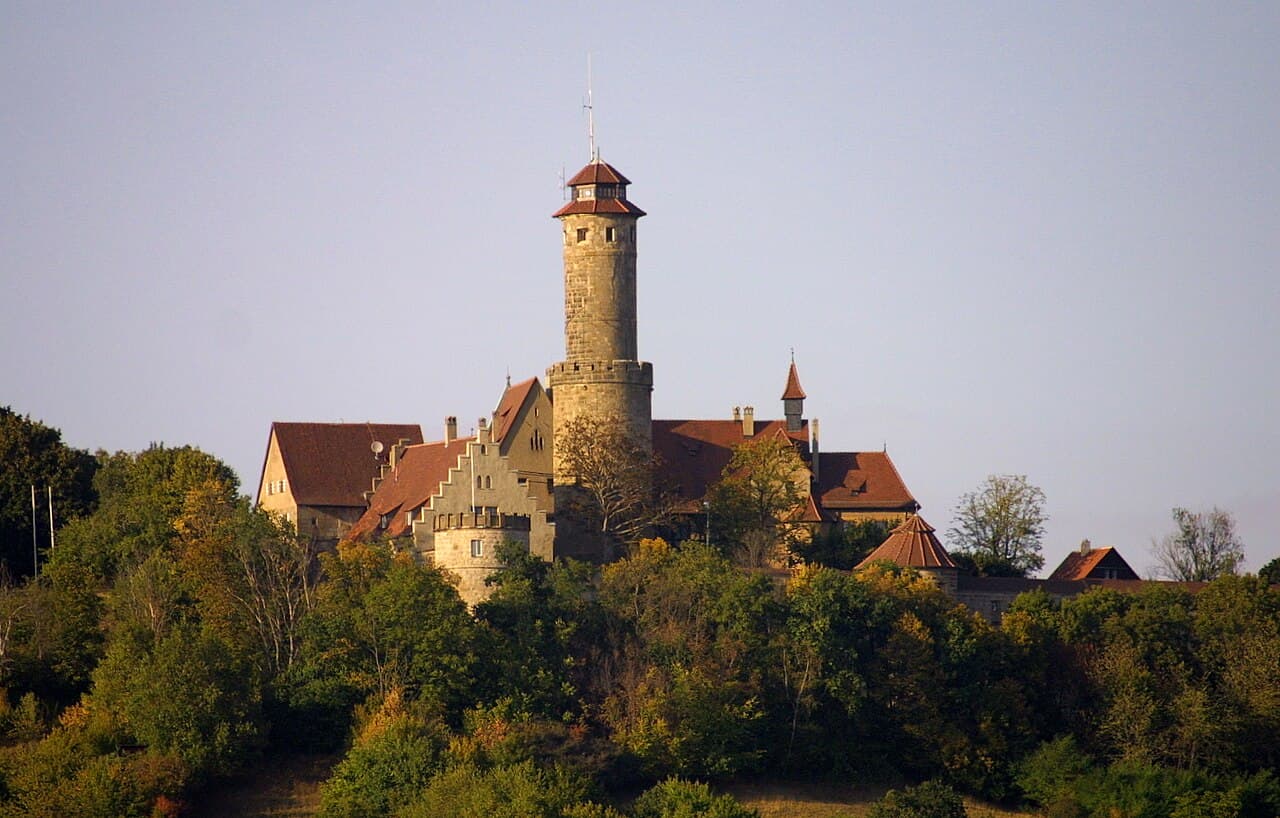
Altenburg Castle — Germany castle

Altenburg Castle

Altenburg Castle in Bamberg: historic hilltop fortress and bishop's residence
Bamberg, Germany
High Medieval (11th–13th c.)
Restored

Altenburg Castle stands prominently on the highest of Bamberg's seven hills, serving as one of the city's most iconic landmarks. This hill castle in Upper Franconia, Bavaria, Germany, has a rich history dating back to at least the 12th century, with its first recorded mention in 1109. Originally constructed as a Fliehburg, or refuge castle, it was designed primarily as a defensive stronghold where local inhabitants could seek shelter during times of conflict rather than as a permanent residence.

Medieval origins and episcopal residence

The earliest phase of Altenburg Castle likely replaced an even earlier wooden palisade structure, reflecting the strategic importance of its elevated location overlooking Bamberg. In 1251, the castle came under the ownership of the prince-bishops of Bamberg (Fürstbischöfe), who transformed it into a richly furnished episcopal residence. From 1305 until its destruction in 1553, Altenburg served as the primary residence for Bamberg's bishops, symbolizing both their spiritual authority and temporal power in the region.

Architectural features and medieval fortifications

The castle complex was originally fortified with robust defensive walls and included a prominent 33-meter keep dating from the 13th century, which remains one of the few surviving medieval structures today. This keep was an essential element of the castle's defense system and also served as a watchtower. An iron basket suspended from the upper section of this tower was historically used to send fire signals to Giechburg Castle, located approximately 20 kilometers away near Scheßlitz, illustrating the castle's role in regional communication and defense networks during the High Middle Ages.

Destruction and decline in the 16th century

Altenburg Castle's medieval prominence came to an abrupt end during the Second Margrave War in 1553. The castle was almost completely destroyed by the forces of Margrave Albert Alcibiades of Brandenburg-Kulmbach, a conflict that devastated many fortifications in the region. Following this destruction, the castle lost its status as a bishop's residence and was subsequently repurposed as a prison for a period, marking a significant decline in its importance and condition.

19th-century restoration and cultural significance

By the early 19th century, Altenburg Castle was in a state of decay until it was acquired in 1801 by Adalbert Friedrich Marcus, a Bamberg physician who undertook a comprehensive restoration. Marcus's efforts preserved the castle's remaining structures and revitalized its presence on the Bamberg skyline. The castle also gained cultural significance through its association with the renowned writer E.T.A. Hoffmann, who frequently stayed in one of the castle's wall towers between 1808 and 1813. The Hoffmannsklause restaurant, located in the newer palace building constructed in 1901–1902, commemorates this connection.

The altenburgverein and public access

In 1818, the Altenburgverein e.V. Bamberg was founded by Anton von Grafenstein, the city's postmaster, to maintain and preserve the castle. This society continues to manage the castle, which is now open to the public. Visitors can explore the castle grounds, including the well-preserved keep, defensive walls, and the Knights' Hall, which hosts events such as weddings and celebrations. The castle's terrace offers a panoramic view of Bamberg and the surrounding Franconian landscape, making it a popular destination for both tourists and locals.

Architectural evolution and notable features

The castle's architecture reflects various phases of construction and restoration. While much of the medieval structure was lost, the 19th-century rebuilding incorporated elements that respected the original Gothic and Romanesque styles. The vaulted kitchen room, built in 1834, and the gatehouse area, now housing the restaurant, are examples of this adaptive reuse. The castle also features a Zwinger, a defensive enclosure, which historically housed a brown bear named Poldi from 1952 to 1982. Today, the Zwinger contains a stuffed bear, serving as a unique historical curiosity.

Historical descriptions and cultural legacy

Altenburg Castle has been described as the "symbol of Bamberg" by early 20th-century author Dietrich Amende, highlighting its slender tower that dominates the Franconian landscape. Alongside the nearby Giechburg Castle, Altenburg historically controlled the Main River valley, underscoring its strategic importance. Its enduring presence and layered history make it a significant cultural and architectural monument in southern Germany.

Visiting altenburg castle today

Today, Altenburg Castle is a well-restored historic site offering visitors a glimpse into medieval fortification and episcopal life. The castle's restaurant provides a charming setting for dining with views over Bamberg, while the castle grounds and towers invite exploration and reflection on the region's rich past. The castle's accessibility and maintained condition make it an essential stop for those interested in medieval architecture, German history, and cultural heritage.

Frequently asked questions (FAQ)

What are the opening hours of Altenburg Castle?
Altenburg Castle is typically open to visitors from 9 AM to 6 PM from April to October, and from 10 AM to 5 PM during the winter months. It's advisable to check the official website before your visit, as hours may vary on holidays or special events.
How do I get to Altenburg Castle?
Altenburg Castle is conveniently located in Bamberg, Germany, and can be reached by public transport or on foot from the city center. If you are driving, there is parking available nearby, but be mindful of local parking regulations.
When was Altenburg Castle built?
Altenburg Castle was originally constructed in the 11th century and has undergone several renovations and expansions over the centuries. Its historical significance lies in its role as a royal residence and military stronghold throughout various periods of German history.
Can I take guided tours of Altenburg Castle?
Yes, guided tours are available and highly recommended to fully appreciate the rich history and architectural details of Altenburg Castle. Tours are usually offered in multiple languages, and it’s best to book in advance during peak tourist seasons.
Why is Altenburg Castle significant in German history?
Altenburg Castle holds significant historical value as it served as a residence for the bishops of Bamberg and played a key role in the region's political and cultural development. Its architecture reflects various styles and eras, showcasing the evolution of castle design in Germany.
Is it possible to host events at Altenburg Castle?
Yes, Altenburg Castle can be rented for special events such as weddings, conferences, and private parties. The stunning backdrop of the castle along with its historical ambiance makes it a unique venue for memorable occasions.
What is the ticket price for visiting Altenburg Castle?
Entrance tickets for Altenburg Castle typically cost around €8 for adults, with discounts available for students, seniors, and children. Family tickets and group rates may also be offered, so it's a good idea to check the latest pricing on the official website.
What is the best time to visit Altenburg Castle?
The best time to visit Altenburg Castle is during the spring and summer months when the weather is pleasant, and the surrounding gardens are in full bloom. Additionally, many cultural events and festivals take place during this time, enhancing the visitor experience.
Are there any nearby attractions to visit along with Altenburg Castle?
Yes, after visiting Altenburg Castle, you can explore other nearby attractions such as the UNESCO World Heritage Site of Bamberg's Old Town, the New Residence, and the Rose Garden. These sites offer a deeper insight into the city's rich history and stunning architecture.

Photo gallery

Altenburg Castle
Click to view

Public domain

1 photo • Click any image to view in full screen

Information

Hill Castle

Loading map...

Visitor reviews

No reviews yet. Been here? Write the first review and help other travelers!

Write the first review

Visited this castle? Share your experience

Your review helps other travelers and adds first-hand knowledge to our encyclopedia.

Write a review

(5/5)

0/2000 characters

Your review will be visible after admin approval

Nearby castles

1.6 km

New Residence Bamberg

Bamberg, Germany

The New Residence Bamberg stands as a remarkable historic palace located prominently on the cathedral square of Bamberg, Germany. This Renaissance and Baroque palace served as the principal residence of the Prince-Bishops of Bamberg and reflects centuries of architectural evolution and political history. Its construction began in the early 17th century, marking a significant transformation in the urban layout of Bamberg's cathedral precinct. Early construction and renaissance origins Construction of the New Residence commenced in 1604 under the direction of Prince-Bishop Johann Philipp von Gebsattel. The initial design embodied the principles of Renaissance architecture, characterized by its balanced proportions, symmetry, and restrained decorative elements. The building was conceived as a two-winged structure intended to replace the older episcopal court located across the square. This phase established the New Residence as a symbol of the Prince-Bishops' temporal power and their embrace of contemporary architectural ideals. Baroque expansion and architectural features Between 1697 and 1703, the New Residence underwent a significant expansion under Prince-Bishop Lothar Franz von Schönborn. The renowned architect Leonhard Dientzenhofer was commissioned to design and oversee the addition of a Baroque front section, which introduced a more elaborate and ornate style to the complex. Although the original plans envisioned a larger building, financial constraints limited the scope, leaving some stonework near the entrance on Obere Karolinenstraße unfinished to this day. The resulting palace is a four-winged sandstone complex that harmoniously blends the earlier Renaissance wings with the later Baroque additions. This architectural juxtaposition offers visitors a vivid illustration of evolving styles across the 17th century. Interior ceremonial rooms The interior of the New Residence comprises over 40 ceremonial rooms, each richly decorated to reflect the status and cultural aspirations of its occupants. The Marble Hall and Mirror Room are particularly notable for their exquisite stucco work by Antonio Bossi, which adds a refined artistic touch to the spaces. The Imperial Hall, located on the second floor of the central wing, features trompe-l’oeil frescoes painted by Melchior Steidl between 1707 and 1709. These frescoes create an illusion of three-dimensional architectural decoration and depict sixteen imperial figures, mainly from the Habsburg dynasty, spanning from Henry II of the Ottonian dynasty to Leopold I and Joseph I. This artistic program serves as a visual narrative of imperial lineage and legitimacy. The White Hall, originally the chamber of the grand marshal, was transformed into a formal dining room in 1772 by Count von Seinsheim. Adjacent to it, the Antichamber played a crucial role in court ceremonies during the 18th century and is decorated with valuable tapestries and ceiling paintings illustrating mythological scenes related to Aeneas, integrating classical themes into the palace’s iconography. The Chinese Cabinet, adjoining the Antichamber, showcases original wooden paneling, an intricately inlaid floor, Chinese lacquered furnishings, and ceramics. It also houses a late Rococo writing desk that belonged to Prince-Bishop Adam Friedrich von Seinsheim, exemplifying the period's fascination with Asian art and design influences. Historical significance and notable events Throughout its history, the New Residence has been a focal point of regional and European political and cultural developments. After the secularization reforms in Bavaria in 1803, the palace transitioned from an ecclesiastical residence to a royal dwelling. It housed prominent figures such as Wilhelm, the first Duke in Bavaria, from 1799, and King Maximilian II, who resided there between 1848 and 1864. The residence also served as a refuge for Otto von Wittelsbach, the first modern King of Greece, who lived there in exile with his wife Amalia from June 1863 until their deaths. Their presence is commemorated within the palace grounds, including a memorial in the Rosary Garden. A tragic historical event occurred on June 1, 1815, when Marshal Louis-Alexandre Berthier committed suicide by jumping from an upper window of the residence to avoid capture by advancing Russian troops. This event is marked by a commemorative plaque on Residenzstraße. In the early 20th century, the palace briefly assumed a political role when it became the seat of Bavaria’s government under Minister-President Hoffmann in 1919. During this period, Bavaria's first democratic constitution was adopted in the nearby Hall of Mirrors at the Harmony building on Schillerplatz, underscoring the residence’s proximity to key political developments. Cultural institutions and current use Since 1933, the New Residence complex has housed the Bamberg State Gallery, which contains important paintings transferred from the municipal collection, enriching the cultural heritage of the site. Additionally, since 1965, part of the eastern wing has been home to the Bamberg State Library, continuing the palace’s longstanding association with governance, culture, and scholarship. The rosary garden and exterior features The Rosary Garden, situated between the wings of the New Residence, opens eastward to provide picturesque views of Bamberg and the Jura hills. Originally a Renaissance garden from the 16th century, it was redesigned in 1733 by Prince-Bishop Friedrich Karl von Schönborn as a Baroque garden under the guidance of master builder Balthasar Neumann. The garden features a Rococo pavilion designed by Johann Jakob Michael Kühel and sculptures representing antique myths by Ferdinand Tietz, dating from 1760 to 1761. The garden beds are carefully arranged with approximately 4,500 rose bushes bordered by box hedges, creating a harmonious and fragrant landscape. Within a blind arch of the garden wall stands a memorial dedicated to Otto I and his wife Amalia, inscribed in Greek and German, linking the garden’s beauty with the palace’s historical narrative. Architectural highlights Architectural highlights of the New Residence include the main and secondary entrances, distinguished chimneys, and a prominent staircase that contribute to the complex’s historic character. These features exemplify the craftsmanship and stylistic transitions from Renaissance restraint to Baroque exuberance. Preservation and heritage status The New Residence is a well-preserved historic monument protected under heritage conservation laws. Its continuous use, careful maintenance, and adaptive reuse as a cultural institution have ensured that the palace remains a vital part of Bamberg’s architectural and historical landscape.

Post-Renaissance (17th–18th c.)
Details
7.6 km

Seehof Castle

Bavaria, Germany

Seehof Castle is a magnificent example of Baroque architecture nestled in the picturesque region of Bavaria, Germany. Constructed in 1686 under the patronage of Marquard Schenk von Stauffenberg, the castle was designed by the renowned architect Antonio Petrini. This elegant residence is distinguished by its striking four corner towers, which prominently rise above the surrounding landscape, symbolizing the grandeur and defensive character typical of noble estates of the period.The castle underwent extensive renovation by the Free State of Bavaria, which has allowed visitors today to explore its splendidly restored interiors. The rooms within the castle reflect the opulence of the Baroque era, featuring intricate woodwork, decorative stuccoes, and period furnishings that evoke the lifestyle of the aristocracy in the late 17th and 18th centuries. The careful restoration ensures that guests can appreciate both the architectural and artistic heritage preserved within the castle walls.Architectural features and layoutSeehof Castle'sThe castle's facades are adorned with classical Baroque elements such as pilasters, cornices, and window frames that emphasize verticality and rhythm. The interiors boast grand halls and chambers designed for both official functions and private living, with elaborate ceiling frescoes and richly decorated fireplaces.The historic gardens and water featuresOne of the defining attractions of Seehof Castle is its extensive 18th-century gardens, which have been partially restored to reflect their original design. The gardens are laid out in the formal Baroque style, featuring geometric parterres, manicured lawns, and carefully arranged flower beds that create a harmonious landscape complementing the castle architecture.A highlight of the garden is the impressive water cascade, a series of ornamental fountains and water features that operate during the summer months on the hour, providing a captivating display of Baroque garden engineering. These water elements serve both aesthetic and symbolic purposes, demonstrating the control of nature and the wealth of the castle's owners.The orangerie and winter quartersThe Orangerieparterre has been restored to offer visitors a sensory experience with the fragrant presence of pomeranian, orange, and lemon trees. These exotic plants evoke the allure of southern climates and were a symbol of prestige and sophistication in European aristocratic gardens.The Orangeriegebäude, originally designed as the winter quarters for these delicate southern plants, has been repurposed into an inviting excursion café. It also houses an exhibition of original works by the famous Frankish garden sculptor Ferdinand Tietz. Tietz's rococo sculptures are a distinctive feature of the castle park, adding artistic value and historical depth to the garden experience. His enchanting figures exemplify the playful elegance and intricate craftsmanship characteristic of the Rococo movement.Historical significance and cultural heritageSeehof Castle stands as a testament to the cultural and architectural ambitions of the Bavarian nobility during the Baroque period. Its construction under Marquard Schenk von Stauffenberg reflects the era's emphasis on grandeur, representation, and the integration of art and nature.The castle and its gardens have witnessed centuries of history, including changes in ownership, periods of neglect, and eventual restoration efforts that have preserved its legacy. Today, it serves not only as a historical monument but also as a cultural venue, attracting visitors interested in architecture, garden design, and Baroque art.Visiting seehof castleVisitors to Seehof Castle can explore the restored rooms, stroll through the elegant gardens, and enjoy the seasonal water cascade displays. The orangerie café offers a pleasant spot to relax while appreciating the surrounding sculptures and botanical beauty.The castle is accessible for day trips from major Bavarian cities, making it a popular destination for those seeking to experience authentic Baroque architecture and garden artistry in a serene setting.

Post-Renaissance (17th–18th c.)
Details
10.2 km

Lisberg Castle

Lisberg, Germany

Lisberg Castle is one of the oldest surviving castles in the Franconia region of Germany, with its first documented mention dating back to around 820 AD. This historic fortress has witnessed centuries of regional power shifts and architectural evolution, making it a remarkable example of medieval and early modern castle construction. Originally owned by the Babenberger family, who were the earls of the region, Lisberg Castle served as a sanctuary for the local population during turbulent times. Historical significance and ownership The castle's strategic location in the Steigerwald area allowed it to play a unique role in regional conflicts. Lisberg Castle was simultaneously under the possession of the Catholic prince-bishops of Bamberg and the Protestant Margraves of Ansbach. This dual ownership was unusual and provided a form of protection to the castle and its inhabitants. When political or military tensions escalated, the people of Lisberg could switch allegiances between these powers, effectively avoiding the fate of destruction that befell the other 31 castles in the surrounding Steigerwald region. Architectural evolution and features Romanesque elements The oldest surviving structure within Lisberg Castle is the Romanesque donjon, a fortified tower that served as the primary defensive stronghold and residence. This donjon features thick stone walls and narrow windows typical of early medieval fortifications. Adjacent to the donjon is the dark prison, a grim reminder of the castle's defensive and judicial functions during the Middle Ages. The castle's inner gate also retains its original Romanesque style, characterized by rounded arches and robust masonry. Gothic and Renaissance additions Subsequent architectural developments introduced elements from later styles. The women's house within the castle complex exemplifies Gothic architecture, featuring pointed arches and more elaborate stonework that contrast with the earlier Romanesque austerity. Around 1600, the castle was expanded with the construction of a Renaissance palace, reflecting the changing tastes and increased comfort desired by its noble inhabitants. This palace includes larger windows, decorative facades, and more spacious interiors. Interior highlights Among the castle's notable interior spaces are the large kitchen and the great hall. The great hall was redesigned in 1776 by Otto Philipp von Muenster, a prominent noble associated with the castle. This renovation introduced refined decorative elements and updated the hall to suit the social functions of the time. The kitchen remains a significant example of the castle's service areas, illustrating the domestic life of its noble residents. Later history and preservation Over the centuries, Lisberg Castle was home to various noble families, with the Freiherrn of Muenster being among the most influential lords. The castle's continuous occupation and maintenance have helped preserve its diverse architectural elements. Today, the castle is owned by Hans Fischer, who has undertaken efforts to revive and maintain the property, ensuring its legacy endures. Architectural and cultural importance Lisberg Castle stands as a testimony to the layered history of Franconia, showcasing architectural styles from the Romanesque through Gothic to Renaissance periods. Its unique history of dual religious ownership and strategic survival during regional conflicts adds to its cultural significance. The castle's preservation allows visitors and scholars to explore the evolution of medieval fortifications and noble residences in Germany. Visiting Lisberg Castle Visitors to Lisberg Castle can explore its historic structures, including the donjon, women's house, and Renaissance palace. The castle's interiors, featuring the great hall and large kitchen, offer insights into noble life across centuries. While the castle remains a private property, arrangements for tours or visits may be possible through the current owner. Frequently asked questions When was Lisberg Castle built? Lisberg Castle was first mentioned in historical records around 820 AD, making it one of the oldest castles in Franconia. What architectural styles are present at Lisberg Castle? The castle features Romanesque, Gothic, and Renaissance architectural elements, reflecting its long history and various expansions. Who were the notable owners of Lisberg Castle? The Babenberger family, the Catholic prince-bishops of Bamberg, the Protestant Margraves of Ansbach, and the Freiherrn of Muenster were among the significant owners. Can visitors tour Lisberg Castle? As a privately owned property, visiting arrangements depend on the owner, but the castle's historical significance makes it a potential destination for guided tours. Why did Lisberg Castle survive regional destruction? Its dual ownership allowed the local people to switch allegiances, protecting it from the fate that befell many other castles in the Steigerwald area.

Early Medieval (5th–10th c.)
Details

