New Castle of Pylos
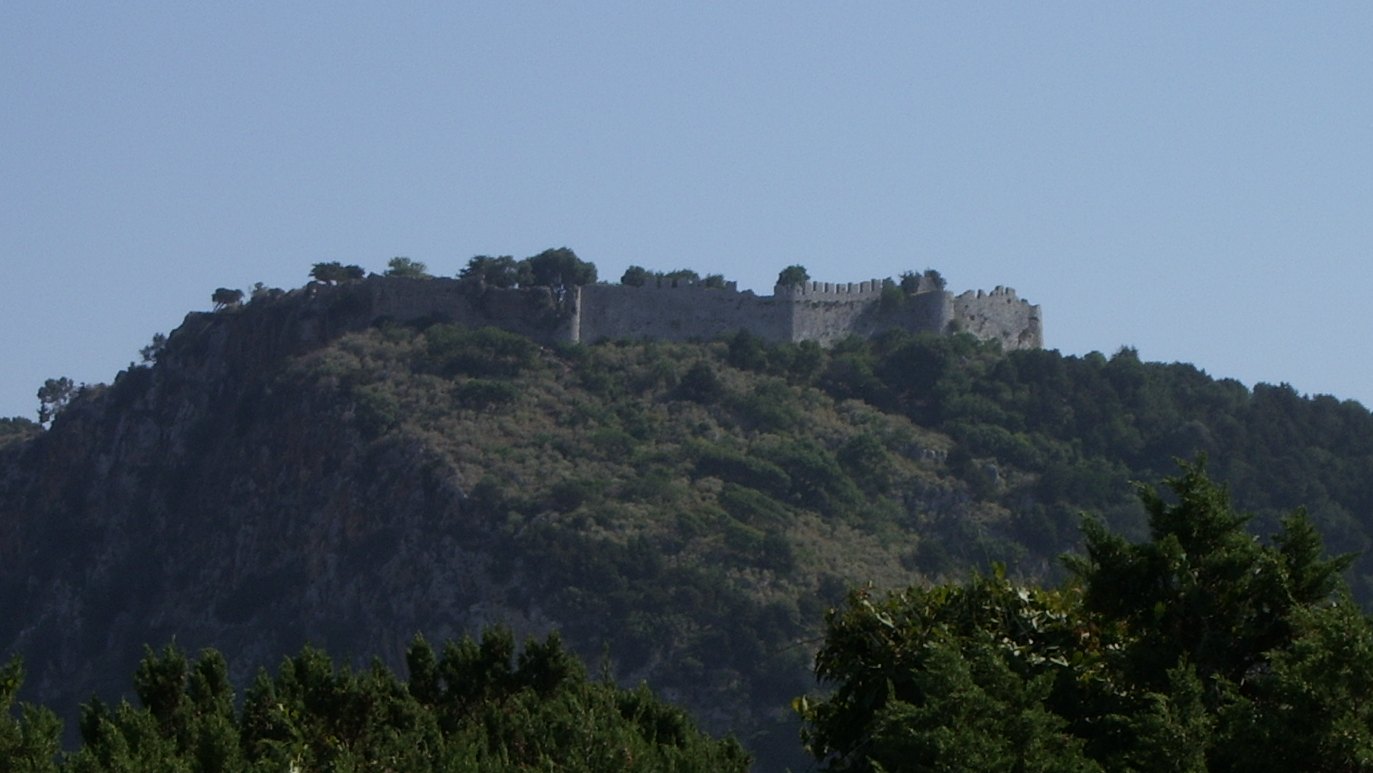
New Castle of Pylos, also known as New Navarino Fortress or Neokastro, is a significant Ottoman fortification located near the town of Pylos in the southwestern Peloponnese, Greece. Constructed in 1572 by the Ottoman admiral Uluç Ali Reis, the fortress was strategically positioned at the southern entrance of the Bay of Pylos to guard this vital maritime gateway. This bastioned fortress exemplifies the trace italienne style of fortification, a revolutionary design adapted to withstand the destructive power of gunpowder artillery that emerged during the Renaissance period.
Historical background and strategic importance
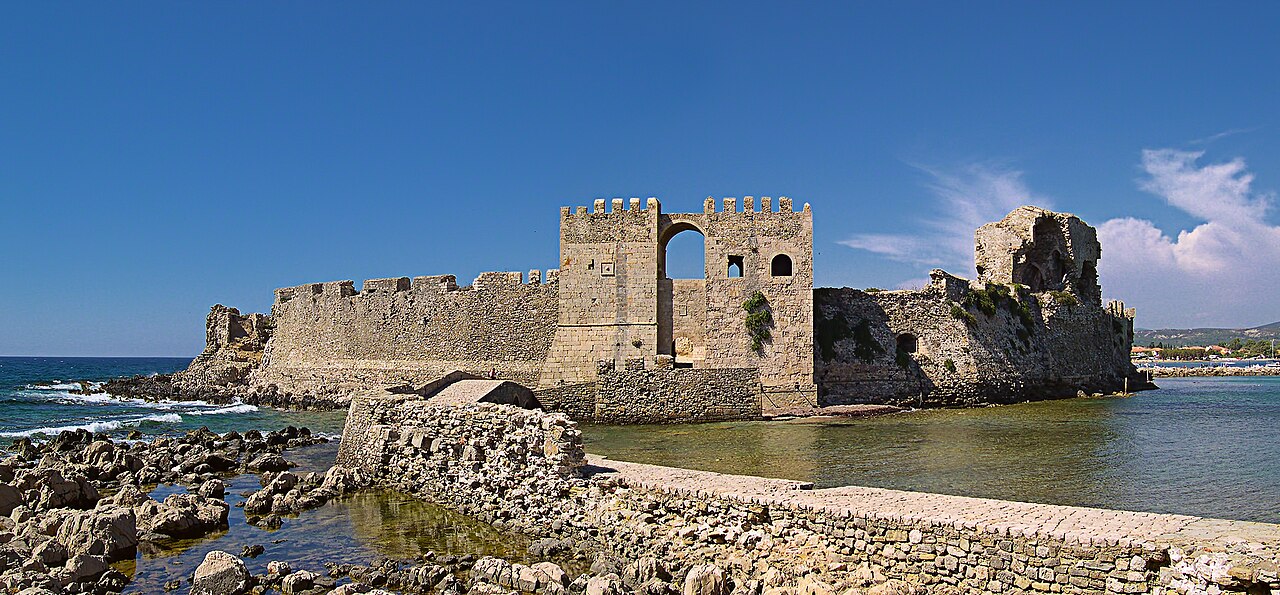
The New Navarino Fortress was built shortly after the Battle of Lepanto (1571), a pivotal naval engagement between the Ottoman Empire and the Holy League. Its construction was part of the Ottoman effort to secure their western maritime frontiers and maintain control over the Peloponnese region. The fortress complemented the older Old Navarino Castle, a 13th-century Crusader stronghold at the northern entrance of the bay, creating a formidable defense system for the bay's access.
Throughout its history, the fortress played a crucial role in various military conflicts. In 1645, it served as the Ottoman base for the invasion of Crete during the Cretan War. Later, during the Morean War (1684–1699), the fortress was captured by the Republic of Venice under the command of Francesco Morosini, marking a significant shift in regional power. The Venetians controlled the fortress until 1715, when the Ottomans recaptured the Peloponnese. The fortress also saw action during the Russo-Turkish War (1768–1774), when Russian forces briefly occupied it in 1770 during the Orlov revolt.
During the Greek War of Independence starting in 1821, the fortress was besieged by Greek revolutionaries. Despite a surrender agreement promising safe passage, the Ottoman garrison was massacred. The fortress changed hands several times, including occupation by Ibrahim Pasha of Egypt and eventual capture by the French Morea expedition in 1828. After Greek independence, the modern town of Pylos was established outside the fortress walls in 1830.
Architectural features and design
New Navarino Fortress is a prime example of a bastioned fortress designed according to the principles of the trace italienne or star fort style, which emerged in response to the development of powerful cannon artillery. Unlike the medieval Old Navarino Castle, which was built primarily for defense against siege engines and infantry assaults, New Navarino features thick, angled walls and bastions that allowed defenders to cover all approaches with overlapping fields of fire.
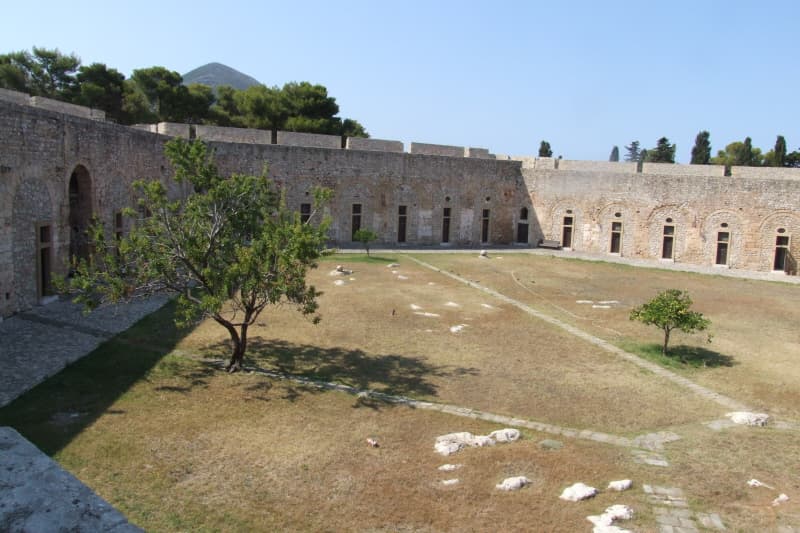
The fortress is roughly rectangular, with six pentagonal bastions projecting from its walls. These bastions were designed to eliminate blind spots and enable defenders to fire along the faces of adjacent walls. Two of the most prominent bastions face the sea, overseeing and protecting the harbor entrance. The walls are thick and sloped, constructed to absorb and deflect cannonballs.
At the heart of the fortress lies a citadel, which was further fortified with an additional dry moat and surrounded by its own set of defensive walls. The fortress was armed with nearly 60 guns, reflecting its role as a major artillery stronghold. The layout includes multiple defensive layers, with a focus on both landward and seaward defense.
Construction materials and techniques
The fortress was built using local limestone and other durable materials, common in Ottoman military architecture of the period. The walls were constructed with a combination of stone masonry and earthworks to create the thick, angled surfaces necessary to withstand artillery bombardment. The bastions and curtain walls were carefully engineered to provide structural stability and resilience.
Role in regional conflicts and military history
New Navarino Fortress was a focal point in the struggle for control over the Peloponnese and the eastern Mediterranean. Its strategic location at the bay's southern entrance allowed control over naval traffic and served as a staging ground for military operations.
During the Cretan War, the fortress was a key Ottoman base for launching attacks against Venetian-held Crete. In the Morean War, its capture by Venetian forces under Francesco Morosini was part of a broader campaign to wrest the Peloponnese from Ottoman control.
The fortress's capture by Russian forces in 1770 during the Orlov revolt was a notable event, although the occupation was short-lived. The Russians destroyed parts of the fortress upon their withdrawal to prevent its immediate reuse by Ottoman forces.
During the Greek War of Independence, the fortress was besieged by Greek revolutionaries. Despite the garrison's surrender under assurances of safe passage, a massacre occurred, marking a tragic episode in the conflict. The fortress later fell to Ibrahim Pasha and was eventually taken by French forces during the Morea expedition, underscoring its continued military significance into the 19th century.
Post-military use and preservation
Following the establishment of the modern Greek state, the fortress lost its military importance. The town of Pylos was founded outside its walls in 1830, shifting the population center away from the fortress. The citadel was repurposed as a prison for many years, reflecting a common fate for such fortifications after their military use ended.
Today, New Navarino Fortress stands as a well-preserved example of Renaissance military architecture in Greece. Its bastioned walls, bastions, and moat remain largely intact, offering valuable insights into Ottoman defensive design and the evolution of fortifications in the early modern period. The fortress is a significant cultural and historical landmark, attracting visitors interested in military history and architecture.
Visitor information and cultural significance
New Navarino Fortress is accessible to the public and is a popular site for tourists visiting Pylos. Its commanding views over the Bay of Pylos and the surrounding landscape provide a tangible connection to the region's turbulent history. The fortress is also part of the broader historical narrative of the Peloponnese, reflecting the complex interactions between the Ottoman Empire, Venice, Russia, and Greece.
Efforts have been made to preserve the fortress and promote its historical importance. It serves as a reminder of the strategic maritime conflicts that shaped the eastern Mediterranean and stands alongside the nearby Old Navarino Castle as a testament to the region's layered military past.
Frequently asked questions (FAQ)
- How do I get to New Navarino Fortress in Pylos?
- New Navarino Fortress is located near the town of Pylos in the Peloponnese region of Greece. It is accessible by car or local transport from Pylos town center, with clear signage directing visitors to the site.
- What is the historical significance of New Navarino Fortress?
- New Navarino Fortress was built by the Ottomans in 1572 to protect the Bay of Pylos and played key roles in various conflicts including the Cretan War, Morean War, and Greek War of Independence.
- Can visitors explore the bastions and walls of New Navarino Fortress?
- Yes, visitors can walk along the thick bastioned walls and explore the fortress grounds, including the prominent sea-facing bastions that overlook the harbor.
- When is the best time to visit New Navarino Fortress?
- The best time to visit is during spring and autumn when the weather is mild and the site is less crowded, allowing for a comfortable exploration of the fortress and surrounding views.
- Is there an entrance fee to visit New Navarino Fortress?
- Entrance to New Navarino Fortress is generally free, but it is advisable to check locally for any changes or special exhibitions that may require a ticket.
Photo gallery

Information
Loading map...
Visitor reviews
No reviews yet. Been here? Write the first review and help other travelers!
Write the first reviewVisited this castle? Share your experience
Your review helps other travelers and adds first-hand knowledge to our encyclopedia.