Nevern Castle
Nevern Castle, known in Welsh as Castell Nanhyfer, is a significant ruined fortress located near the village of Nevern in Wales. As one of the earliest stone castles built in the region, it played a crucial role during the Norman expansion into Welsh territories in the early 12th century. The castle's strategic position on a hill spur overlooking the Gamman stream gorge provided natural defenses, making it a valuable stronghold in the turbulent medieval period.
The origins of the site predate the Norman conquest of Pembrokeshire around 1108. It likely served as the residence of Cuhelyn, a local Welsh ruler in the 11th century, highlighting its longstanding importance in regional power dynamics. Following the Norman incursion from southwest England, Robert FitzMartin established a motte-and-bailey castle here, incorporating a large enclosed courtyard or bailey. This early timber and earthwork fortress was central to Norman efforts to control the surrounding landscape.
The castle in the context of medieval Welsh and Norman conflicts
The history of Nevern Castle is deeply intertwined with the ongoing conflicts between Welsh princes and Norman lords. In 1136, after the Battle of Crug Mawr, Welsh forces recaptured the castle, reflecting the ebb and flow of territorial control in the region. Subsequently, the castle and the wider area of Ceredigion were contested between the Welsh principalities of Gwynedd and Deheubarth. By 1153, Deheubarth had secured control.
The political landscape shifted again in 1171 when Rhys ap Gruffydd, ruler of Deheubarth, reconciled with King Henry II of England. As part of this reconciliation, lands including Nevern Castle returned to Anglo-Norman hands. The castle passed to William FitzMartin, son of Robert FitzMartin, who strengthened alliances through marriage to Rhys’s daughter Angharad in the 1170s. This period likely saw the castle's transformation from timber to stone, reflecting broader trends in castle construction and military architecture.
In 1189, William FitzMartin joined the crusade led by Richard the Lionheart, leaving the castle vulnerable. Welsh forces under Rhys ap Gruffydd and his son Gruffydd retook the fortress. Internal Welsh conflicts further shaped the castle’s fate; in 1194, Rhys ap Gruffydd was imprisoned there by his sons Hywel Sais and Maelgwn. Hywel later released him, causing Maelgwn to flee into exile. The following year, Hywel deliberately damaged Nevern Castle to prevent it from falling into English hands.
After Rhys’s death in 1197, succession disputes continued until the Anglo-Normans reconquered northern Pembrokeshire in 1204. William FitzMartin regained control but focused on establishing Newport Castle, three kilometers east, signaling Nevern’s decline as a military stronghold.
Architectural evolution and castle remains
Originally constructed as a motte-and-bailey fortress in the early 12th century, Nevern Castle occupies a strategic spur overlooking a gorge carved by the Gamman stream. The castle’s layout features a large triangular bailey protected by earthworks and wooden palisades. These fortifications used the natural steep slopes down to the river gorge to enhance defense.
Access was controlled through a northern gate flanked by raised earth ramparts, creating a defensive passage into the bailey. Within the bailey, initial wooden buildings served domestic and economic functions. During the 12th century, some timber structures were replaced with stone buildings constructed from local slate, clay, and finely cut sandstone. This blend of materials reflects both Welsh and Anglo-Norman architectural influences.
The western tip of the bailey hosts the main motte, an artificial mound that originally supported a wooden tower. This was later replaced by a round stone keep, demonstrating the transition to more durable fortifications. On the opposite side, a smaller motte was built atop a natural rock outcrop, separated from the main bailey by a deep, broad ditch approximately eight meters wide and deep. The summit of this smaller motte contains remnants of a rectangular tower and a surrounding small ring wall, adding an extra layer of defense.
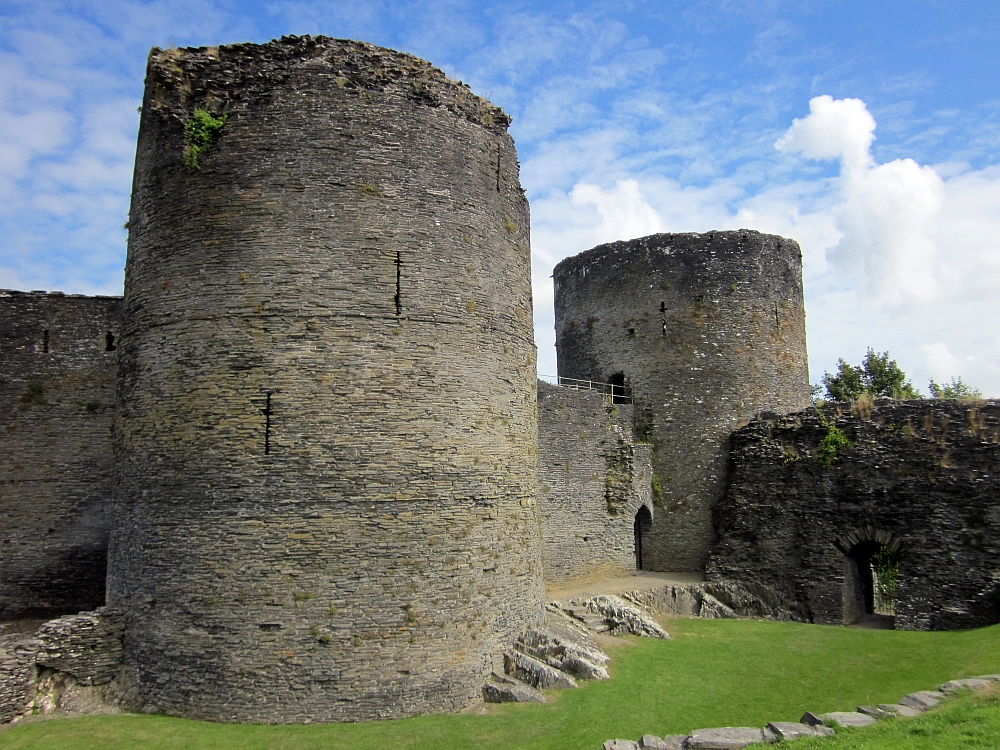
Today, the most prominent features of Nevern Castle are its extensive earthworks, including banks, ditches, and mounds that outline the original fortification. Only limited masonry fragments remain, mainly associated with the towers that once crowned the mounds. These remnants provide valuable insights into the castle’s construction phases and its role in the medieval power struggles between Welsh princes and Norman lords.
Later history and preservation efforts
Following its decline in military importance after the early 13th century, Nevern Castle gradually fell into ruin. The focus of regional power shifted to newer fortifications such as Newport Castle. In the modern era, the castle grounds came under community stewardship during the 1980s, reflecting a growing local interest in preserving Welsh heritage sites.
Between 2008 and 2010, archaeological surveys were conducted to better understand the castle’s historical and architectural significance. These investigations uncovered further details about the site’s layout, construction techniques, and phases of occupation. Today, Nevern Castle is a Scheduled Monument, protected for its cultural and historical importance as a testament to the complex medieval struggle between Welsh and Norman powers in Pembrokeshire.
Visitors to Nevern Castle can explore the well-defined earthworks and appreciate the strategic location that once made it a formidable fortress. The site offers a tangible connection to Wales’s rich medieval past and the dynamic interactions between native Welsh rulers and Anglo-Norman invaders.
Frequently asked questions (FAQ)
- How do I get to Nevern Castle?
- Nevern Castle is located near the village of Nevern in Wales. It can be reached by local roads from nearby towns, with parking available close to the site. Visitors should check local maps or visitor centers for the best route.
- What is the historical significance of Nevern Castle?
- Nevern Castle is one of the earliest stone castles in Pembrokeshire, playing a key role in Norman expansion and Welsh resistance during the 12th century. Its history reflects the complex medieval conflicts between Welsh princes and Anglo-Norman lords.
- Can I visit the remains of Nevern Castle?
- Yes, the castle remains are accessible to the public. Visitors can explore the earthworks, mounds, and limited masonry fragments that mark the site. It offers insight into medieval castle architecture and local history.
- When was Nevern Castle built?
- Nevern Castle was originally constructed as a motte-and-bailey fortress in the early 12th century, around 1108, during the Norman expansion into Wales.
- Why is Nevern Castle in ruins?
- The castle was deliberately damaged in 1195 to prevent its capture by enemy forces and declined in importance after the early 13th century when focus shifted to Newport Castle. Over time, it fell into ruin and is now preserved as a historical monument.
Information
Sources & official resources
Verify the information above using these authoritative references.
Loading map...
Visitor reviews
No reviews yet. Been here? Write the first review and help other travelers!
Write the first reviewVisited this castle? Share your experience
Your review helps other travelers and adds first-hand knowledge to our encyclopedia.