Castell Henllys
Castell Henllys, meaning 'castle of the old court' in Welsh, is a significant Iron Age hillfort located near Newport in north Pembrokeshire, Wales. This archaeological site is renowned for its extensive excavations and experimental archaeology projects that have been ongoing for over two decades. The site offers a rare glimpse into prehistoric life through its reconstructed roundhouses and granary, built directly on their original foundations dating back approximately 2,000 years, making it the only site in Britain with such authentic architectural reconstructions.
Historical context and archaeological significance
The hillfort at Castell Henllys dates from the Iron Age, approximately between 500 and 100 BCE. It was a fortified settlement characterized by a series of earthworks including ditches and banks that provided defense and demarcation. These fortifications lie to the north of the site, marking the original entrance to the hillfort. Excavations have uncovered numerous remains of Iron Age roundhouses within the enclosure, illustrating the domestic architecture and settlement patterns of prehistoric communities in this region.
Adjacent to the hillfort, archaeologists discovered a farmstead settlement that shows evidence of continued occupation into the Romano-British period. This continuity highlights the strategic and economic importance of the location over several centuries, bridging the prehistoric and Roman eras in Wales.
Reconstruction archaeology and experimental farming
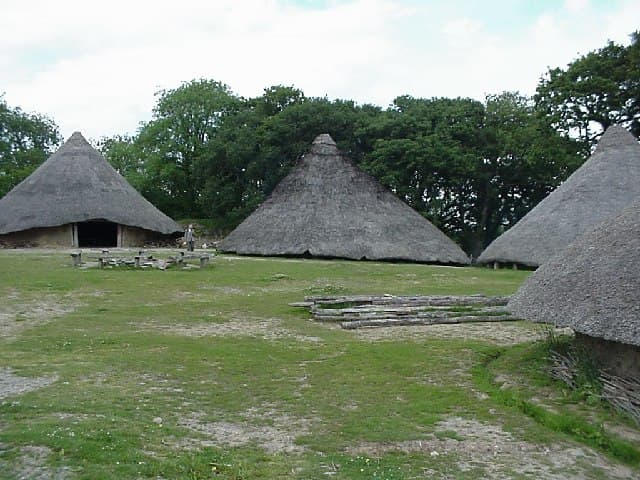
One of the most distinctive aspects of Castell Henllys is its role as a center for reconstruction archaeology. Archaeologists and volunteers have rebuilt four Iron Age roundhouses and a granary on their original foundations, using traditional materials and techniques inferred from archaeological evidence. These reconstructions provide invaluable insights into Iron Age construction methods, spatial organization, and daily life.
Alongside the architectural reconstructions, the site also hosts experimental prehistoric farming activities. These agricultural experiments aim to understand the crops, tools, and farming practices that would have sustained the hillfort's inhabitants. This hands-on approach enriches the interpretation of archaeological findings and educates visitors on the challenges and innovations of Iron Age agriculture.
Site layout and architectural features
The hillfort is situated on a natural hill, providing a defensible position with commanding views of the surrounding landscape. The earthwork defenses consist of multiple ditches and banks forming concentric rings around the summit. These fortifications would have slowed and deterred attackers, while also symbolizing the community's control over the territory.
Within the enclosure, the reconstructed roundhouses are circular structures with thatched roofs supported by wooden posts. Their walls are built using wattle and daub techniques, reflecting typical Iron Age domestic architecture. The granary is elevated on stilts to protect stored grain from moisture and pests, demonstrating an understanding of food preservation.
Educational and visitor engagement
Castell Henllys serves as an active educational resource, particularly during the summer months when it offers training programs for young archaeologists. These programs provide practical experience in excavation, recording, and conservation techniques, fostering new generations of heritage professionals.
The site is also a popular visitor attraction, offering guided tours, interpretive displays, and hands-on activities that bring the Iron Age to life. The immersive experience of walking through reconstructed buildings and seeing live farming demonstrations helps visitors connect with the prehistoric past in a tangible way.
Management and conservation
Castell Henllys is owned and managed by the Pembrokeshire Coast National Park Authority. The site is carefully maintained to preserve its archaeological integrity while accommodating public access. Conservation efforts focus on protecting the earthworks and reconstructed structures from natural erosion and visitor impact.
The ongoing archaeological work at Castell Henllys continues to contribute valuable knowledge about Iron Age society in Wales, making it a key site for both research and heritage tourism.
Frequently asked questions (FAQ)
- What is Castell Henllys and why is it significant?
- Castell Henllys is an Iron Age hillfort in Pembrokeshire, Wales, notable for its archaeological excavations and reconstructed roundhouses on original foundations, providing unique insights into prehistoric life.
- When was Castell Henllys built?
- The hillfort dates from the Iron Age, approximately between 500 and 100 BCE, with evidence of continued occupation into the Romano-British period.
- Can visitors explore reconstructed buildings at Castell Henllys?
- Yes, visitors can explore four reconstructed Iron Age roundhouses and a granary built on original foundations, offering a tangible experience of prehistoric architecture.
- What kind of educational activities are available at Castell Henllys?
- During summer, the site offers training programs for young archaeologists, providing hands-on experience in excavation and conservation techniques.
- Who manages Castell Henllys?
- The site is owned and managed by the Pembrokeshire Coast National Park Authority, which oversees its conservation and public access.
Photo gallery

Information
Current owner
Pembrokeshire Coast National Park Authority
Loading map...
Visitor reviews
No reviews yet. Been here? Write the first review and help other travelers!
Write the first reviewVisited this castle? Share your experience
Your review helps other travelers and adds first-hand knowledge to our encyclopedia.