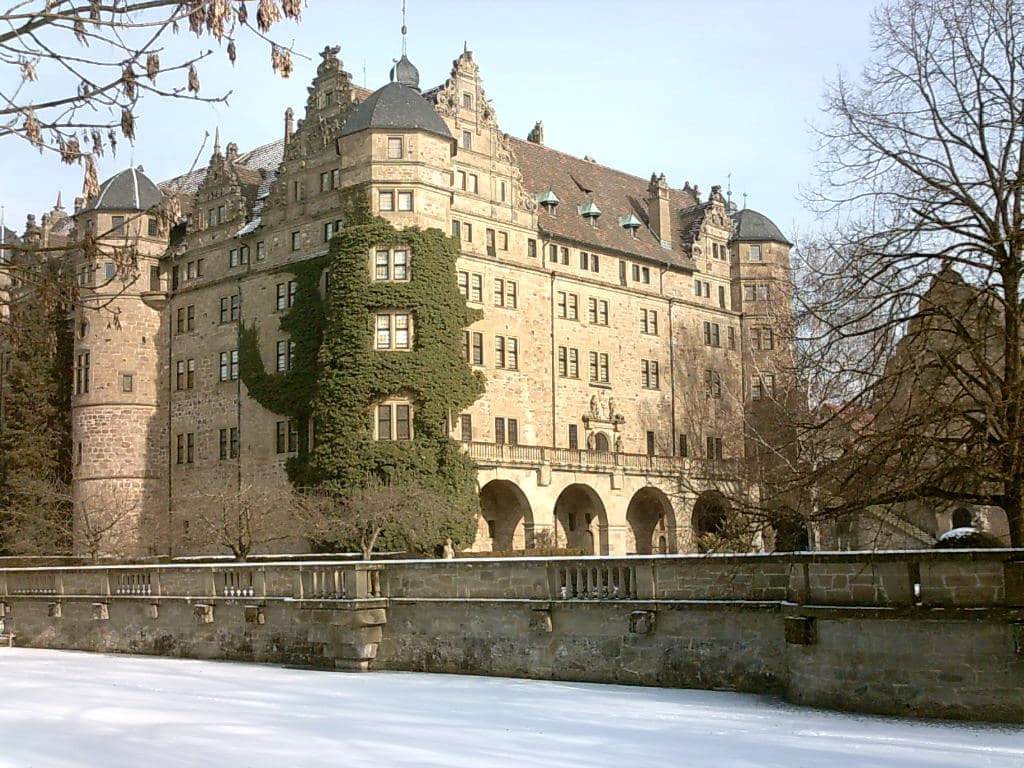
Neuenstein Castle
Neuenstein Castle stands as a remarkable example of Renaissance architecture and noble heritage in the heart of Neuenstein, Germany. Its origins trace back to the 13th century, when the site was first established as a moated fortress by the Hohenstaufen dynasty. Strategically located on a sandbank amidst swampy terrain near a medieval trade route connecting the Rhine to the Danube, the castle played a vital role in regional defense and commerce.
The earliest documented owners were the Lords of Stein around 1230, whose descendants adopted the name "von Neuenstein." By the early 14th century, the castle passed into the hands of the House of Hohenlohe, a noble family that has maintained ownership to this day. A notable figure from the mid-13th century was Gottfried von Hohenlohe, a loyal supporter of Emperor Frederick II and tutor to his son Conrad IV. Surviving an assassination attempt in 1250, Gottfried was rewarded with several fiefdoms including the lands around Neuenstein.
Medieval origins and strategic importance
Initially constructed as a Romanesque moated castle, Neuenstein was built to control the surrounding wetlands and oversee the key trade route passing nearby. The original fortress featured a robust bergfried (keep) at its northwestern corner, which still survives today. This tower served as the last line of defense and a symbol of the lord's authority.
Throughout the High and Late Medieval periods, the castle and its estates were divided among various branches of the Hohenlohe family, reflecting the complex feudal inheritance practices of the era. Despite these divisions, Neuenstein remained a significant seat of power and administration within the region.
Renaissance transformation and architectural evolution
The castle underwent its most significant transformation during the 16th century under the direction of Count Louis Casimir of Hohenlohe-Neuenstein (1517–1568), who established the Neuenstein branch of the family. This period marked the adoption of the Renaissance architectural style, characterized by symmetry, proportion, and classical details.
The master builder Balthasar Wolff from Heilbronn oversaw extensive renovations that expanded the castle into a closed four-winged complex rising six floors high. The castle's length of approximately 41 meters and its grand Rittersaal (Knight's Hall) measuring over 10 meters wide exemplify the scale and ambition of this project.
Distinctive Renaissance features include the two tall round towers with conical roofs at the castle's corners, designed both for defense and to convey prestige. The main entrance is approached via a bridge over the surrounding moat, with sculpted coats of arms above the doorway commemorating Count Louis Casimir and his wife, Anna von Solms-Laubach.
Interior spaces and museum collections
Inside, Neuenstein Castle preserves several historically significant rooms in excellent condition. The Imperial Hall remains largely original and served as a ceremonial space for receptions and official functions. Adjacent is the vaulted King’s Chamber, notable for its distinctive ceiling design.
One of the castle's unique features is its fully operational late medieval kitchen, preserved almost exactly as it would have appeared centuries ago, offering visitors a rare glimpse into historic culinary practices.
The castle also houses a rich museum collection established in 1878, one of Germany's oldest private family museums. The collection includes Renaissance artworks, hunting weapons with trophies, and a fascinating cabinet of curiosities. Among the prized artifacts are a hat once owned by Swedish King Gustav II Adolf, a shoe worn by Empress Catherine the Great, and an unusually large bladder stone from the Count of Nimburg.
Later history and restoration efforts
Following the death of Wolfgang Julius von Hohenlohe-Neuenstein in 1698, the family relocated their main residence to Öhringen, leading to a period of decline for Neuenstein Castle. Over the next two centuries, the castle was repurposed for various practical uses, including as a breeding and workhouse, retirement home, and orphanage, which impacted its condition.
Restoration efforts began in the late 19th century, focusing initially on the impressive Imperial Hall. Between 1906 and 1925, renowned castle architect Bodo Ebhardt directed extensive renovations. His work included adding an extra floor to improve residential comfort while carefully preserving the castle's Renaissance character.
Despite mid-20th century expropriations of other family estates, Neuenstein Castle remains a residence of the current Prince of Hohenlohe-Oehringen (1933–2024) and continues to serve as a museum preserving the family's legacy.
Architectural features and site layout
Neuenstein Castle is a hill castle featuring a closed four-winged design typical of Renaissance noble residences. The castle rises to six floors and extends about 41 meters in length. The original Romanesque bergfried at the northwestern corner is a striking medieval remnant contrasting with the later Renaissance additions.
The two round towers at other corners, topped with conical roofs, reflect Renaissance defensive architecture adapted for status and comfort rather than purely military purposes. The moat and bridge remain key elements of the castle's defensive layout, while the sculpted coats of arms above the entrance symbolize the castle's noble heritage.
The interior spaces, including the Rittersaal (Knight’s Hall), the Imperial Hall, and the King’s Chamber, showcase a blend of medieval and Renaissance architectural details, with vaulted ceilings, ornate woodwork, and historic furnishings.
Cultural significance and visitor experience
As one of the oldest private museums in Germany, Neuenstein Castle offers visitors a unique opportunity to explore centuries of noble history and architectural evolution. The museum's extensive collections provide insight into Renaissance art, hunting traditions, and aristocratic life.
The preservation of original features such as the late medieval kitchen and the Imperial Hall enhances the educational value of the site, making it a significant cultural landmark in the Baden-Württemberg region.
Visitors can appreciate the castle's harmonious blend of medieval fortification elements and Renaissance residential elegance, reflecting the historical transitions in castle architecture and noble lifestyles.
Access and location
Located in the center of the town of Neuenstein, the castle historically relied on the nearby Eschelbacher Steige route for the transport of building materials and supplies. Today, it remains easily accessible for visitors interested in exploring the rich heritage of the Hohenlohe family and the architectural grandeur of Renaissance Germany.
Preservation status
Neuenstein Castle is well preserved, with extensive restorations ensuring the survival of its key architectural and historical features. The castle continues to function as a residence and museum, maintaining its dual role as a living heritage site and cultural institution.
Frequently asked questions (FAQ)
- When was Neuenstein Castle originally built?
- Neuenstein Castle was originally established in the early 13th century by the Hohenstaufen dynasty as a moated fortress.
- What architectural style characterizes Neuenstein Castle?
- The castle is primarily built in the Renaissance style, with significant 16th-century renovations that expanded and transformed the original medieval structure.
- Is Neuenstein Castle open to the public for visits?
- Yes, Neuenstein Castle houses one of Germany's oldest private family museums and is open to visitors interested in its history and collections.
- What notable artifacts are displayed in the castle museum?
- The museum displays Renaissance artworks, hunting weapons, a cabinet of curiosities, and unique items such as a hat of Swedish King Gustav II Adolf and a shoe of Empress Catherine the Great.
- Who was the architect responsible for the early 20th-century restoration?
- The renowned castle architect Bodo Ebhardt oversaw extensive restoration work between 1906 and 1925, preserving the castle's historical character.
- What is the significance of the original Romanesque keep at Neuenstein Castle?
- The Romanesque bergfried is the oldest surviving part of the castle, dating back to the initial 13th-century construction and symbolizing its medieval origins.
Photo gallery

Photo by No machine-readable author provided. Xocolatl assumed (based on copyright claims).•Public domain
Information
Sources & official resources
Verify the information above using these authoritative references.
Loading map...
Visitor reviews
No reviews yet. Been here? Write the first review and help other travelers!
Write the first reviewVisited this castle? Share your experience
Your review helps other travelers and adds first-hand knowledge to our encyclopedia.



