Colombier Castle
Colombier Castle stands as a remarkable historical monument in Colombier, Switzerland, embodying a rich architectural and cultural evolution from antiquity through the modern era. Originally constructed in the 11th century as a fortified tower, the castle was built atop the ruins of a grand Roman villa, one of the largest known in Switzerland. This villa, developed between the 1st and 4th centuries AD, featured luxurious residential quarters, baths with intricate mosaics and frescoes, terraced gardens, and a peristyle courtyard, reflecting the opulence and social status of its Roman owners.
The castle’s strategic location on a hill overlooking Lake Neuchâtel and the surrounding Alps provided both natural defense and commanding views, which were crucial throughout its history. Over the centuries, Colombier Castle transformed from a Roman aristocratic residence to a medieval fortified stronghold, and later into a military facility, illustrating the shifting political and social landscapes of the region.
Roman origins and early medieval transition
Archaeological excavations in the mid-19th century revealed the extensive remains of the Roman villa beneath the castle, including foundations, roof tiles, and a column shaft discovered during reservoir construction in 1840. The villa was built in multiple phases, evolving into a palatial mansion with amenities such as at least two baths, richly decorated with mosaics and frescoes, and expansive terraced gardens oriented towards the lake and mountains.
Following the decline of Roman authority, the site transitioned into an aristocratic curtis during the early medieval period, from the 5th to the 11th centuries. This residence was unfortified but held great regional importance, hosting significant events such as the 938 double marriage of Queen Berthe of Burgundy and her daughter Adélaïde to kings Hugues d’Arles and Lothaire II of Italy. The site remained under the control of various rulers including the Burgundians, Merovingians, and Carolingians, reflecting its continued political significance.
Medieval fortification and architectural evolution
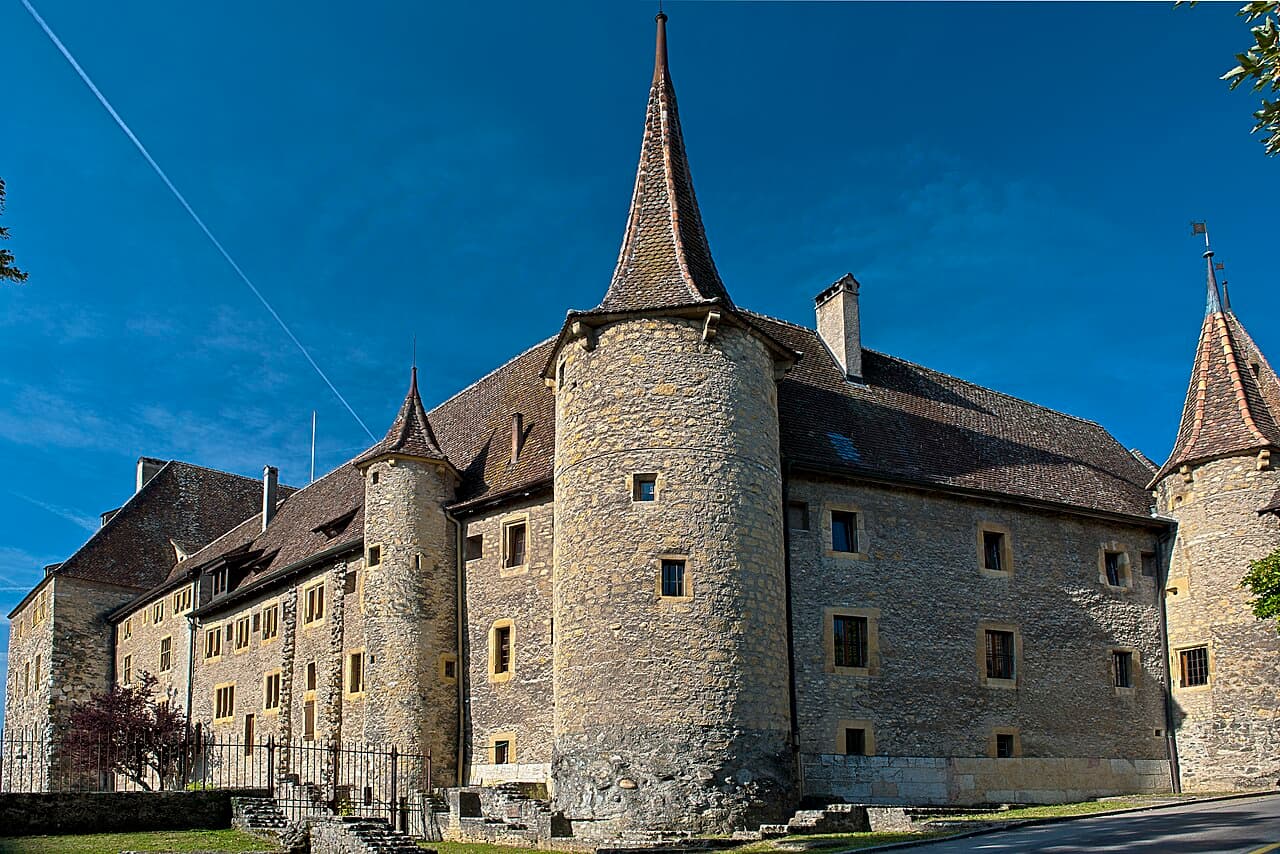
Between the 11th and 15th centuries, the site evolved into a fortified castle serving as the seat of the regional lords of Colombier. The original Roman courtyard was enclosed by a crenellated curtain wall with round towers, rebuilt in the 14th century to enhance defense capabilities. A prominent donjon was constructed in the southwest corner of the courtyard, serving as the main fortified tower and residence.
15th-century renovations
In the 15th century, Antoine de Colombier undertook significant renovations, replacing the old tower with a large rectangular donjon. This structure incorporated a cellar, kitchen, great hall, residential chambers, a polygonal stair turret, and a chapel, reflecting the castle’s transformation into a noble residence with both defensive and domestic functions. The castle’s layout and architecture from this period illustrate the late medieval emphasis on fortified yet comfortable living spaces.
16th to 18th-century adaptations
During the 16th to 18th centuries, Colombier Castle shifted away from a military role towards agricultural and administrative functions. Under owners such as Jean-Jacques de Watteville and the Count of Neuchâtel, the castle became the center of a prosperous vineyard estate. Additions from this period include a stair turret, a large roof dated 1541, granaries, a gate tower from 1543, and a vast barn arranged around the courtyard. The castle also served as the residence and storage site for the local tax collector, underscoring its administrative importance.
19th and 20th-century military use and restoration
The 19th century marked a return to military functions for Colombier Castle. In 1806, it was converted into a military hospital. From 1824, the castle grounds were used by Federal militias as a parade ground and subsequently transformed into barracks with an expanded arsenal. By 1877, it became the official barracks of the 2nd Division of the Swiss Army.
Throughout the late 19th and 20th centuries, the site saw the construction of numerous military buildings, including barracks (built in 1842-43 and 1890), an arsenal (1869-71), riding halls (1851 and 1873), officers’ quarters and stables (1912-14), and a modern barracks completed in 1982. These additions display a mix of architectural styles such as neoclassical and Heimatstil, reflecting evolving military needs and architectural trends.
Preservation and cultural significance
Archaeological interest in Colombier Castle began in earnest in the 19th century, with early excavations led by Frédéric Dubois de Montperreux. The oldest parts of the castle were protected as historic monuments starting in 1905, and restoration efforts led by architect Charles-Henri Matthey between 1905 and 1934 helped preserve the site’s medieval and Roman heritage.
The castle also became a cultural venue, housing large murals by Charles L’Eplattenier painted between 1915 and 1946. These murals depict the Swiss military mobilization during World War I and the origins of the Swiss Confederation, adding artistic and historical value to the site. Commemorative monuments include a World War I memorial (1921), a statue of athlete Jean Linder (1928), and a bas-relief of Henri I d’Orléans-Longueville (1953).
Current use and visitor experience
Today, Colombier Castle remains an active military site, serving as an infantry training center for the Swiss Army. The historic “Old Castle” houses a military museum since 1954, which was expanded in 1955 to include exhibits on locally produced painted cotton fabrics known as “indiennes.” Visitors can explore the layered history of the site, from its Roman origins to its medieval fortifications and modern military adaptations.
The castle’s architecture offers a fascinating study in historical continuity and change, with visible traces of Roman masonry integrated into medieval walls and later military structures. The combination of archaeological remains, restored medieval buildings, and 19th- and 20th-century military installations provides a comprehensive narrative of the region’s past.
Colombier Castle’s location on a hill overlooking Lake Neuchâtel offers picturesque views and a tangible connection to the landscape that shaped its history. The site’s preservation and continued use underscore its importance as both a cultural heritage landmark and a functional military facility.
Frequently asked questions (FAQ)
- What is the historical significance of Colombier Castle?
- Colombier Castle, dating back to the 13th century, played a crucial role in the defense of the region during the medieval period. Its strategic location provided a vantage point for monitoring surrounding territories, making it a key fortification in the area.
- When was Colombier Castle built?
- Construction of Colombier Castle began in the early 1200s, with various modifications and expansions occurring over the centuries. The castle reflects the architectural evolution typical of medieval fortifications in Switzerland.
- Can I visit Colombier Castle?
- Yes, visitors are welcome to explore Colombier Castle, which offers guided tours that provide insights into its rich history and architecture. Be sure to check the specific visiting hours and any seasonal changes in accessibility.
- What are the opening hours for Colombier Castle?
- Colombier Castle is typically open to visitors from April to October, with specific hours varying by month. It is advisable to confirm the current schedule on the castle's official website before planning your visit.
- Is it possible to access Colombier Castle by public transport?
- Yes, Colombier Castle is accessible by public transport, with nearby bus and train stations facilitating easy travel. Local transport services link the castle to larger cities, making it a convenient destination for visitors.
- What is the best time to visit Colombier Castle?
- The best time to visit Colombier Castle is during the spring and early autumn months when the weather is mild and suitable for outdoor exploration. Visiting during these times also allows you to enjoy the beautiful surrounding landscapes.
- Are there any nearby attractions to Colombier Castle?
- Yes, visitors can explore several nearby attractions, including the picturesque Lake Neuchâtel and the charming village of Colombier. These sites offer additional opportunities for sightseeing and enjoying the natural beauty of the region.
- What are the ticket prices for visiting Colombier Castle?
- Ticket prices for Colombier Castle are generally affordable, with discounts available for children, seniors, and groups. For the most accurate pricing, it's recommended to check the castle's official website prior to your visit.
Photo gallery

Information
Website
Visit websiteSources & official resources
Verify the information above using these authoritative references.
Loading map...
Visitor reviews
No reviews yet. Been here? Write the first review and help other travelers!
Write the first reviewVisited this castle? Share your experience
Your review helps other travelers and adds first-hand knowledge to our encyclopedia.