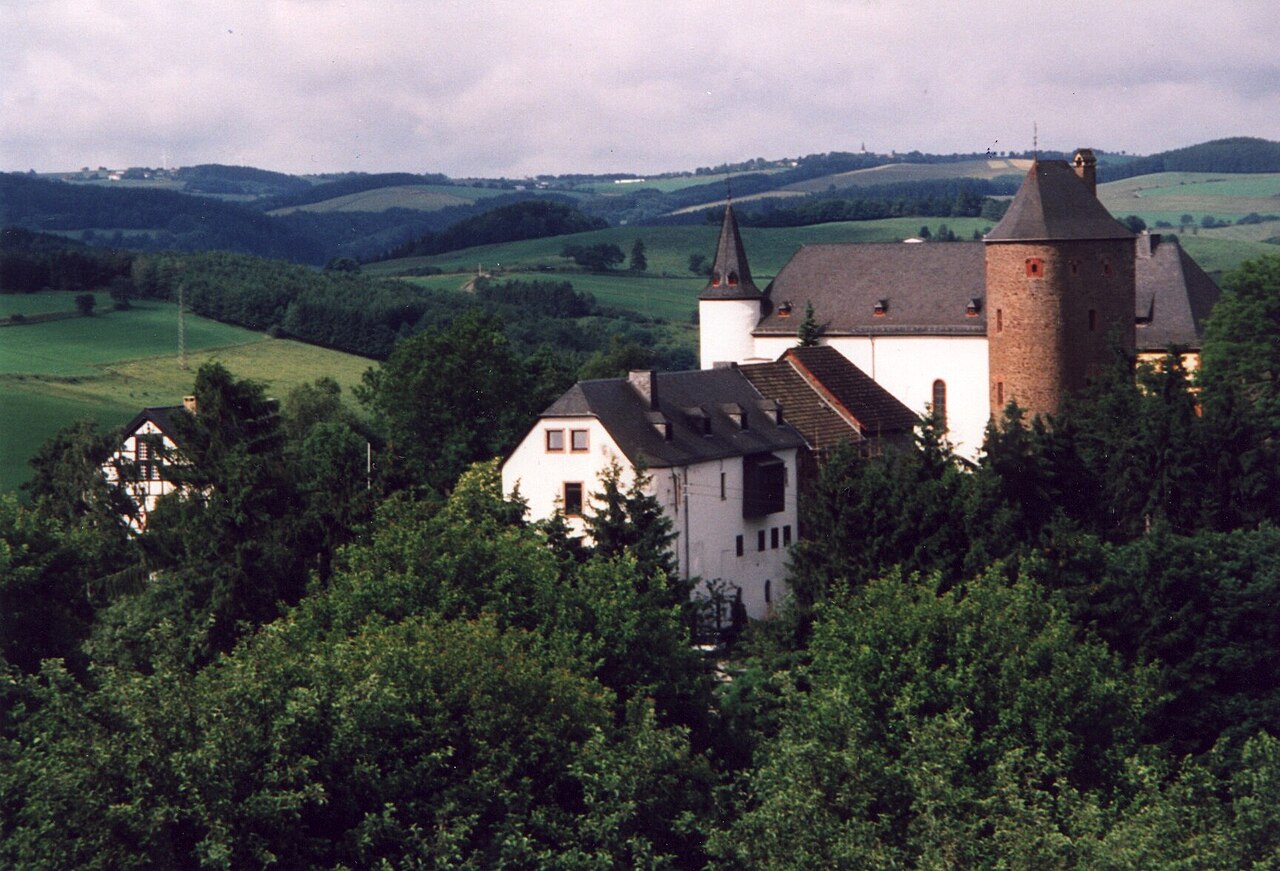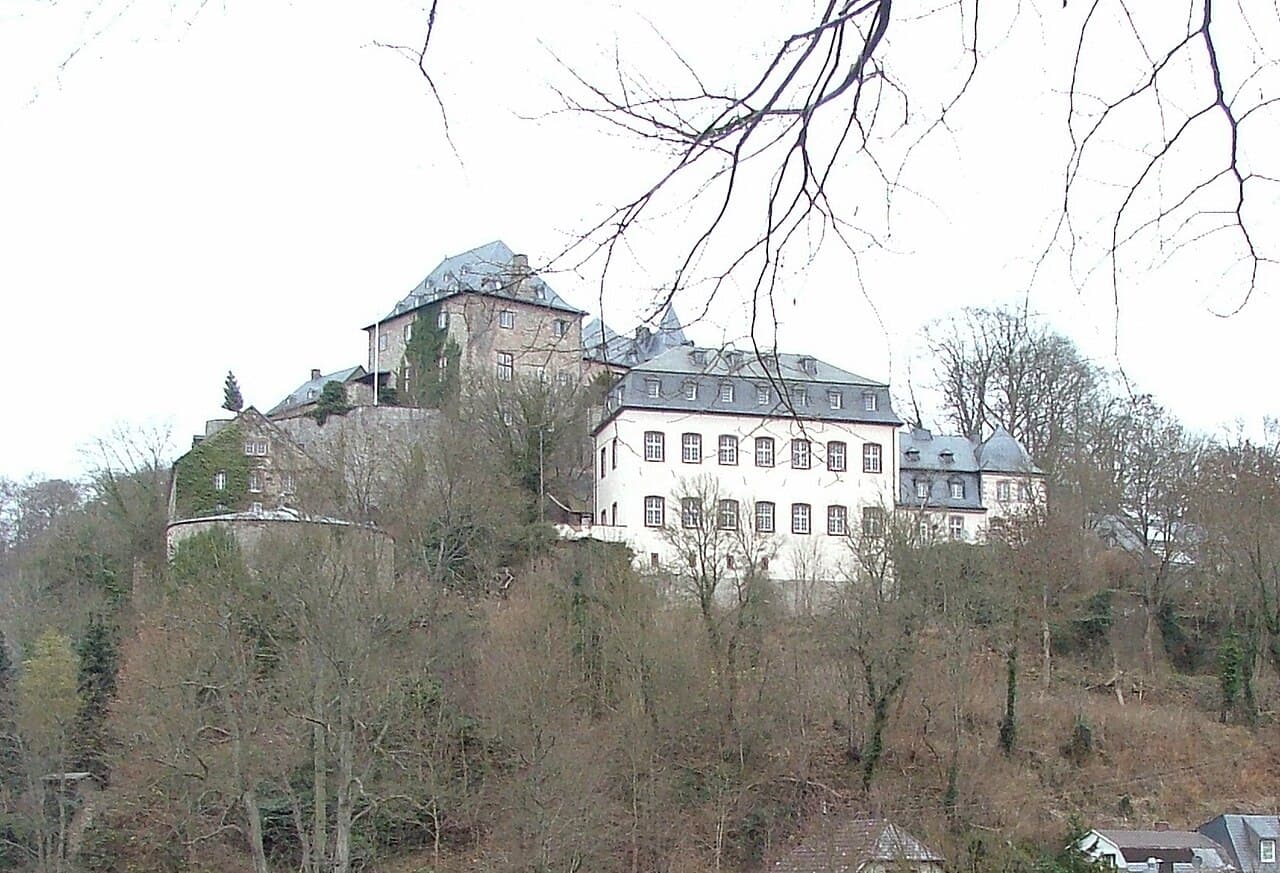
Blankenheim Castle
Blankenheim Castle (German: Burg Blankenheim) is a prominent hill castle situated above the village of Blankenheim in the picturesque Eifel mountains of North Rhine-Westphalia, Germany. Constructed around 1115 by Gerhard I von Blankenheim, the castle served as the ancestral seat of the noble House of Blankenheim. Its strategic location on a hill provided both defensive advantages and commanding views over the surrounding landscape, typical of medieval fortifications of the High Medieval period.
Early history and medieval origins
The castle was initially built as a fortified residence to assert control over the region and protect the interests of the Blankenheim family. The lords of Blankenheim rose in prominence and were elevated to the rank of counts in 1380. This elevation marked a significant increase in their political and social status within the Holy Roman Empire. The family lineage was closely connected to the Counts of Manderscheid, and upon the extinction of the Blankenheim male line, the castle passed by inheritance to the Manderscheid family in 1468.
Architectural evolution and baroque transformation
Over the centuries, Blankenheim Castle underwent numerous reconstructions and renovations that transformed it from a medieval fortress into a more comfortable and representative Baroque residence. These modifications reflected changing tastes and the reduced military importance of castles by the early modern period. The castle complex was enhanced with a Baroque garden and an orangery, typical of aristocratic residences seeking to display wealth and sophistication.
Water supply tunnel
One of the castle’s notable engineering features is a water supply tunnel excavated in 1469 under the direction of Count Dietrich III of Manderscheid-Blankenheim. Despite the nearby River Ahr, the castle relied on rainwater, necessitating the diversion of water from a spring called In der Rhenn, located about a kilometer away. This tunnel is an impressive example of medieval hydraulic engineering and was rediscovered in 1996.
Decline and modern use
The castle’s fortunes declined sharply in 1794 when French troops invaded the region during the Revolutionary Wars. Countess Augusta of Manderscheid-Blankenheim fled with her family to Bohemia, and the castle was left unoccupied for about a century. This abandonment led to significant dilapidation of the structure.
In 1894, the Prussian State financed consolidation and safety measures to preserve the castle. Later, in 1926, the site was acquired by the German Gymnastics Association, and then in 1936 by the German Youth Hostel Association, which transformed the castle into a youth hostel. This adaptive reuse has allowed the castle to remain in use and maintained, though it is generally accessible only to guests of the hostel.
Architectural features and layout
Blankenheim Castle exemplifies a hill castle with a complex layout shaped by its long history. The original medieval fortress included defensive walls, towers, a gatehouse, and a courtyard. The later Baroque renovations introduced more residential features, such as elegant living quarters, formal gardens, and ornamental structures like the orangery.
The castle’s fortifications were typical of the High Medieval period, designed to withstand sieges and control the surrounding territory. The transition to a Baroque residence reflects the broader European trend of converting military castles into stately homes as the nature of warfare and aristocratic life evolved.
Historical significance and heritage
Blankenheim Castle holds significant historical importance as the seat of the House of Blankenheim and later the Manderscheid-Blankenheim line, which became one of the largest territorial lordships in the Eifel region after the extinction of related Manderscheid lines in 1742. The castle’s history mirrors the political and social changes in the region from the medieval through early modern periods.
Today, the castle is valued both as a heritage site and a functional youth hostel, offering visitors a unique opportunity to experience a historic castle setting. While public access is limited, the castle's preservation and continued use contribute to the cultural landscape of North Rhine-Westphalia.
Nearby sites and visitor information
Near Blankenheim Castle lies Neublankenheim Castle, another historic structure that adds to the area's rich medieval heritage. Visitors interested in castle architecture and history can explore the surrounding Eifel region, known for its scenic landscapes and numerous historic sites.
Access to Blankenheim Castle is primarily through the youth hostel, which provides accommodation and a chance to stay within a castle environment. This unique experience combines historical ambiance with modern hospitality.
Frequently asked questions (FAQ)
- How do I visit Blankenheim Castle?
- Blankenheim Castle is accessible primarily to guests staying at the youth hostel located within the castle. Visitors can book accommodation to experience the historic setting firsthand.
- What is the historical significance of Blankenheim Castle?
- Blankenheim Castle was the ancestral seat of the House of Blankenheim and later the Manderscheid-Blankenheim counts, playing a key role in regional noble history from the 12th to 18th centuries.
- When was the water supply tunnel built and why is it important?
- The water supply tunnel was excavated in 1469 to divert spring water from about a kilometer away, ensuring a reliable water source for the castle, which otherwise depended on rainwater.
- Is Blankenheim Castle open to the public?
- The castle is generally not open to the public except as part of the youth hostel. Visitors interested in touring the castle should consider booking a stay or checking for special events.
- What architectural styles are present at Blankenheim Castle?
- Blankenheim Castle features architectural elements from the High Medieval period with later Baroque modifications, reflecting its evolution from fortress to noble residence.
Photo gallery

Photo by Borsi112•Public domain
Information
Current owner
German Youth Hostel Association
Loading map...
Visitor reviews
No reviews yet. Been here? Write the first review and help other travelers!
Write the first reviewVisited this castle? Share your experience
Your review helps other travelers and adds first-hand knowledge to our encyclopedia.