Neratzia Fortress
Neratzia Fortress is a prominent medieval hill castle situated on the Greek island of Kos, within the municipality of Kos. Constructed primarily by the Knights Hospitaller, also known as the Order of St. John of Jerusalem, this fortress played a crucial role in controlling maritime routes between Constantinople and Alexandria. Its strategic position guarding the harbor of Kos made it a vital military stronghold from the early 14th century through the Ottoman period and beyond.
Historical background and strategic importance
The construction of Neratzia Fortress began shortly after the Knights Hospitaller acquired Kos in 1314. Initial building efforts are attributed to the leadership of Grand Master Helion de Villeneuve, with substantial fortification work continuing under Jean Fernandez de Heredia from around 1377 and extending into the early 1500s. This timeline reflects the fortress's development in response to evolving military threats, especially from the expanding Ottoman Empire and the Mamluk Sultanate.
The fortress's location on a narrow peninsula east of Mandraki Harbor allowed it to oversee crucial sea lanes. It worked in tandem with the fortress at St. Peter in Bodrum, across the sea, to secure control over the Aegean maritime routes. This cooperation enhanced the defensive network of the Knights Hospitaller in the region.
The earliest written record of the fortress dates to 1395, when traveler Nicolo de Martoni described it as nearly impregnable due to its natural and man-made defenses, including its position surrounded by sea and a nearby lake connected by a drawbridge. Despite its formidable design, Neratzia faced several sieges, notably in 1457 when an Ottoman force attacked. The defenders temporarily abandoned the fortress to regroup but ultimately held out until the wider defeat of the Knights at Rhodes.
In 1523, Neratzia fell to the Ottomans following their victory over the Knights Hospitaller. Under Ottoman rule, the fortress remained a military garrison and the residence of the local governor. Though the Ottomans made limited structural changes, a significant explosion in 1816 damaged parts of the interior. The 20th century brought restoration efforts under Italian administration, which sought to emphasize the fortress's medieval character by removing many Ottoman modifications. During World War II, the fortress was used by German troops as a prison. It suffered earthquake damage in 2017 but partially reopened in 2021.
Architectural features and layout
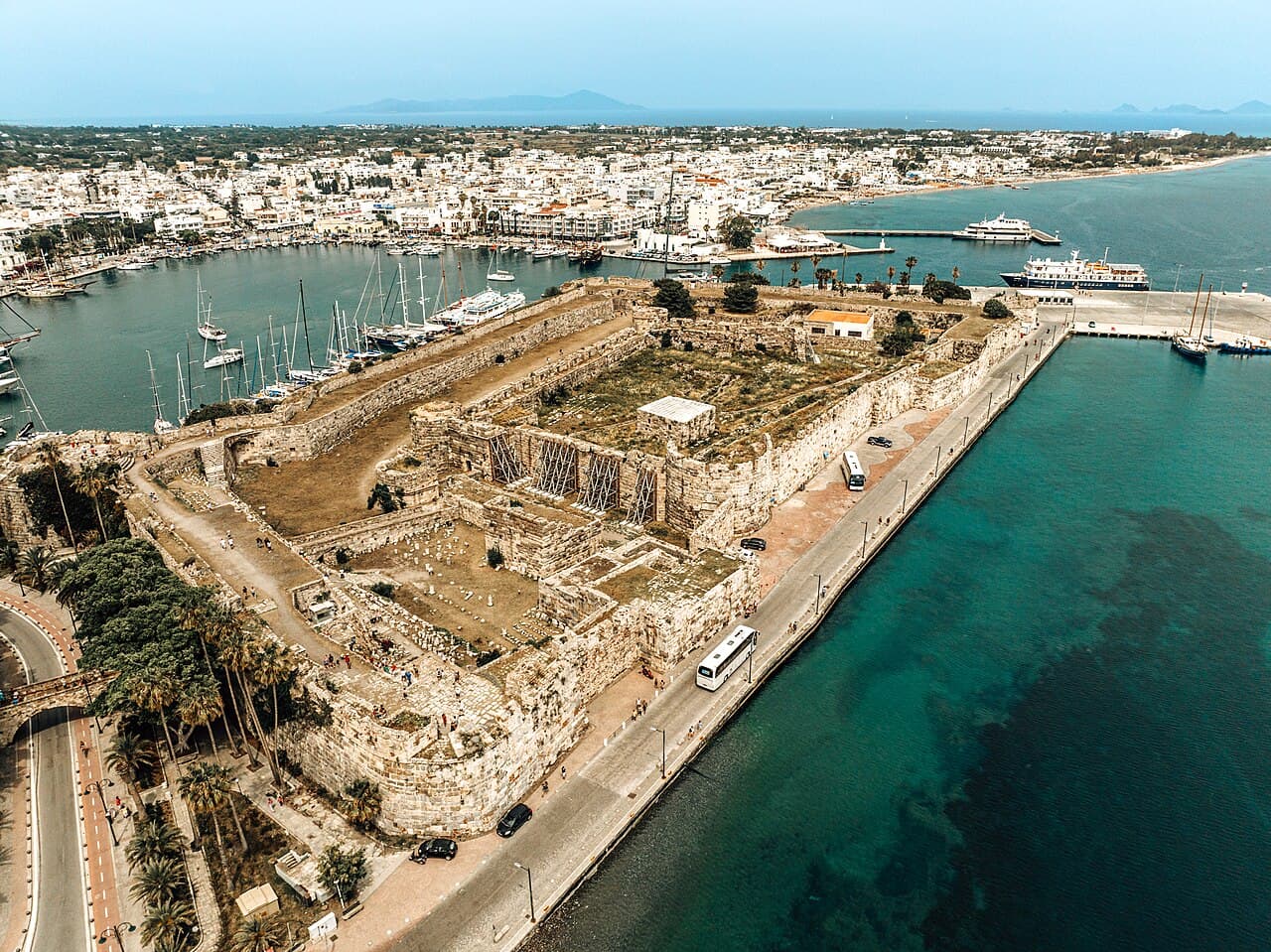
Neratzia Fortress occupies what was once an island connected to the mainland by a stone bridge over a wide moat. This moat has since been filled and replaced by a street. The fortress consists of an inner castle dating from the 13th century, surrounded by outer defensive walls constructed between the late 15th century and 1514. Together, these elements form an almost rectangular plan.
The inner castle is defined by four tall, round towers at its corners, which provided strong defensive positions. The outer walls were enhanced with large bastions, angular projections designed to withstand cannon fire, reflecting the fortress's adaptation to gunpowder artillery. Cannon openings are visible in these bastions, underscoring the fortress's military evolution. A broad moat, originally about six meters deep and nearly 38 meters wide, separated the inner and outer fortifications, adding another defensive layer.
Materials and reused elements
The builders made extensive use of local stones, including porous greenish varieties and softer types, alongside travertine limestone common in the Mediterranean. Notably, many architectural elements were repurposed from ancient structures on Kos and the nearby Asklepieion sanctuary. These include marble blocks, columns, altars, and carved stone fragments. Such reuse not only provided quality materials but also linked the fortress to the island's classical heritage.
Decorative features survive, such as a marble frieze with garlands and theatrical masks above the main entrance, believed to originate from a temple dedicated to Dionysus, the god of wine and festivity. The fortress walls and towers bear carved coats of arms of various Grand Masters of the Knights Hospitaller, including Emery d’Amboise, highlighting the castle's historical connections and prestige.
Interior and defensive structures
The main gate was once flanked by two small towers, removed in the early 20th century. Access was via a stone bridge linking the fortress to the mainland. Inside, the fortress resembles an open-air museum, scattered with ruins of ancient columns, graves, altars, and stone carvings. No roofs or intermediate floors survive, and much of the interior is overgrown with native thorny plants.
An arched structure near the gate is a remnant of the Ottoman period, likely part of a water storage system. A single sloping road connects the inner and outer sections along the eastern side, facilitating movement within the fortress. The layered design of Neratzia reflects centuries of adaptation to changing military technologies and strategic needs.
Military significance and sieges
Neratzia Fortress was a key defensive position in the eastern Aegean Sea, guarding the harbor of Kos and controlling maritime routes. Its fortifications evolved to meet the challenges posed by the introduction of gunpowder and cannon warfare. The addition of bastions and thick walls allowed the fortress to withstand artillery bombardments better than earlier medieval castles.
The fortress endured multiple sieges, including the notable Ottoman attack in 1457. Although the defenders temporarily withdrew, the fortress was retaken and held until the eventual Ottoman conquest in 1523. This conquest marked a significant shift in regional power, ending the Knights Hospitaller's control over Kos.
During Ottoman rule, the fortress's military role continued, though it gradually lost some of its strategic importance with changing political circumstances. The explosion in 1816 caused by a powder magazine accident significantly damaged the fortress's interior, but the structure remained in use as a garrison and administrative center.
Modern restoration and current status
In the 20th century, Italian authorities undertook restoration efforts to highlight the fortress's medieval origins by removing many Ottoman-era modifications. These restorations aimed to preserve the historical character and architectural integrity of the fortress. During World War II, the fortress served as a prison under German occupation.
Recent decades have seen the fortress become a cultural and historical site open to visitors. However, an earthquake in 2017 caused damage, leading to a temporary closure. Partial reopening occurred in 2021, allowing tourists to explore much of the fortress and its surrounding ruins.
Today, Neratzia Fortress stands as a significant monument reflecting the complex military history of the Aegean region, combining medieval fortification techniques with adaptations to early modern artillery. Its preservation offers insights into the Knights Hospitaller's architectural and military legacy on Kos.
Frequently asked questions (FAQ)
- How do I get to Neratzia Fortress?
- Neratzia Fortress is located in the charming town of Kos on the island of Kos, Greece. You can reach it by walking from the town center, as it is within easy walking distance from most hotels and attractions. Public transportation options, including buses and taxis, are also available for those traveling from other areas of the island.
- What is the historical significance of Neratzia Fortress?
- Neratzia Fortress, built by the Knights of St. John in the 15th century, served as a strategic defense point against invasions. Its location allowed for control over the sea routes and trade in the region. Today, it stands as a testament to medieval architecture and the history of the Knights in the area.
- When was Neratzia Fortress built?
- Construction of Neratzia Fortress began in 1450 and was completed in 1460. The fortress was designed to enhance the defensive capabilities of the Knights of St. John during their rule over the island of Kos. Its impressive structure has remained a notable landmark for centuries.
- Can I enter Neratzia Fortress?
- Yes, visitors can enter Neratzia Fortress to explore its fascinating architecture and historical significance. There are designated pathways and areas where you can roam freely and enjoy stunning views of the surrounding harbor. Make sure to check for any guided tours that may provide additional insights into the fortress's history.
- Why is Neratzia Fortress a popular tourist attraction?
- Neratzia Fortress is popular due to its rich history, stunning architecture, and picturesque views of the Aegean Sea. Visitors are drawn to its unique blend of cultural heritage and the opportunity to step back in time to experience the life of the Knights of St. John. The fortress also offers a scenic backdrop for photography and leisurely strolls.
- Is it possible to visit Neratzia Fortress year-round?
- Yes, Neratzia Fortress is open to visitors year-round, but opening hours may vary by season. It is advisable to check the official website or local tourism information for the most current visiting hours before planning your trip. Visiting in the shoulder seasons of spring and fall can provide a more pleasant experience with fewer crowds.
- What are the ticket prices for Neratzia Fortress?
- Entrance to Neratzia Fortress typically has a nominal fee, making it accessible for most visitors. Ticket prices may vary for adults, students, and children, so checking the latest information before your visit is recommended. Special discounts may be available for groups or during certain times of the year.
- What is the best time to visit Neratzia Fortress?
- The best time to visit Neratzia Fortress is during the spring (April to June) and fall (September to October) when the weather is mild and crowds are smaller. Summer months can be quite hot and busy, which might affect your experience. Early morning or late afternoon visits also offer beautiful lighting for photography and a more tranquil atmosphere.
- Are there any nearby attractions to visit after Neratzia Fortress?
- Yes, after visiting Neratzia Fortress, you can explore other nearby attractions such as the Ancient Agora, the Tree of Hippocrates, and the Archaeological Museum of Kos. These sites are within walking distance and offer additional insights into the rich history and culture of Kos. Enjoy a leisurely walk through the town to discover charming shops and local eateries along the way.
Photo gallery

Information
Loading map...
Visitor reviews
No reviews yet. Been here? Write the first review and help other travelers!
Write the first reviewVisited this castle? Share your experience
Your review helps other travelers and adds first-hand knowledge to our encyclopedia.