National Palace (Haiti)
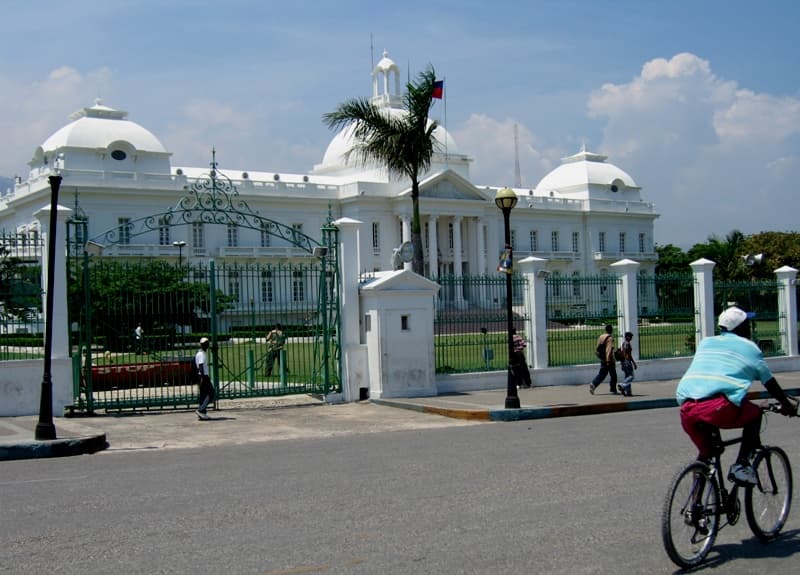
The National Palace (Palais national in French; Palè nasyonal in Haitian Creole) served as the official residence of the president of Haiti. Situated prominently in Port-au-Prince, the capital city, it faced the historic Place L'Ouverture near the Champs de Mars square, anchoring the seat of executive power in the country. The palace was an iconic symbol of Haitian sovereignty and governance for much of the 20th century and into the early 21st century.
Architectural significance and design
The National Palace was constructed in the early to mid-20th century, embodying elements of neoclassical architecture that were common in official government buildings of that era. Its design featured a grand façade with imposing columns and expansive entrance porticos, reflecting the influence of European classical styles adapted to the Caribbean context. The palace included multiple wings, formal reception halls, and administrative offices, arranged around a central courtyard that provided both security and ceremonial space.
The building's structural system employed reinforced concrete and masonry, materials chosen for their durability and prestige. Despite these modern construction techniques, the palace was vulnerable to seismic activity, a risk inherent to the region.
Historical context and role
The National Palace was more than a residence; it was the political heart of Haiti, witnessing numerous significant events in the nation's turbulent history. It housed the offices of successive Haitian presidents and was the site of official state ceremonies, diplomatic receptions, and national celebrations. The palace symbolized the authority of the Haitian state and was deeply intertwined with the country's political narrative.
Throughout the 20th century, the palace saw periods of renovation and restoration, reflecting changing political regimes and architectural trends. Its presence in the capital was a constant reminder of Haiti's sovereignty and the challenges faced by its leadership.
The 2010 earthquake and aftermath
On January 12, 2010, a devastating earthquake struck Haiti, with its epicenter near Léogâne, approximately 25 kilometers west of Port-au-Prince. The 7.0 magnitude earthquake caused catastrophic damage across the capital, including the National Palace. The building suffered severe structural failure, with large sections collapsing and leaving the palace in ruins.
The destruction of the palace was emblematic of the widespread devastation that affected government infrastructure, complicating relief and recovery efforts. The ruins remained a poignant symbol of the disaster's impact on the nation's political and cultural institutions.
Demolition and plans for reconstruction
In 2012, under the administration of President Michel Martelly, the decision was made to demolish the remaining ruins of the National Palace for safety reasons and to clear the site. The demolition marked the end of the palace's physical presence but not its symbolic importance.
Subsequently, in 2017, then-President Jovenel Moïse announced plans to rebuild the National Palace, aiming to restore the historic seat of executive power with modernized facilities. However, as of the latest updates, construction has not commenced, and the site remains vacant or used for governmental administrative functions in nearby ancillary buildings.
Current status and cultural importance
Today, the site of the National Palace stands as an archaeological ruin and a reminder of Haiti's resilience and ongoing challenges. While the main building no longer exists, the palace grounds and surrounding administrative structures continue to serve governmental purposes.
The National Palace remains a potent symbol in Haitian collective memory, representing both the nation's historical governance and the profound impact of natural disasters on its built environment. Efforts to rebuild or memorialize the palace continue to be part of broader discussions on Haiti's recovery and cultural heritage preservation.
Frequently asked questions (FAQ)
- When was the National Palace in Haiti originally built?
- The National Palace was constructed in the 20th century, reflecting neoclassical architectural influences common in government buildings of that period.
- What happened to the National Palace during the 2010 earthquake?
- The palace was severely damaged by the 7.0 magnitude earthquake on January 12, 2010, resulting in the collapse of large sections and leaving it in ruins.
- Are there plans to rebuild the National Palace?
- Plans to rebuild the palace were announced in 2017 by President Jovenel Moïse, but as of now, construction has not begun.
- Can visitors access the National Palace site today?
- The site is primarily an archaeological ruin and is not generally open for tourism, but the surrounding grounds and ancillary buildings remain in governmental use.
- Why was the National Palace demolished?
- The ruins were demolished in 2012 under President Michel Martelly's administration due to safety concerns following the earthquake damage.
Photo gallery

Information
Loading map...
Visitor reviews
No reviews yet. Been here? Write the first review and help other travelers!
Write the first reviewVisited this castle? Share your experience
Your review helps other travelers and adds first-hand knowledge to our encyclopedia.