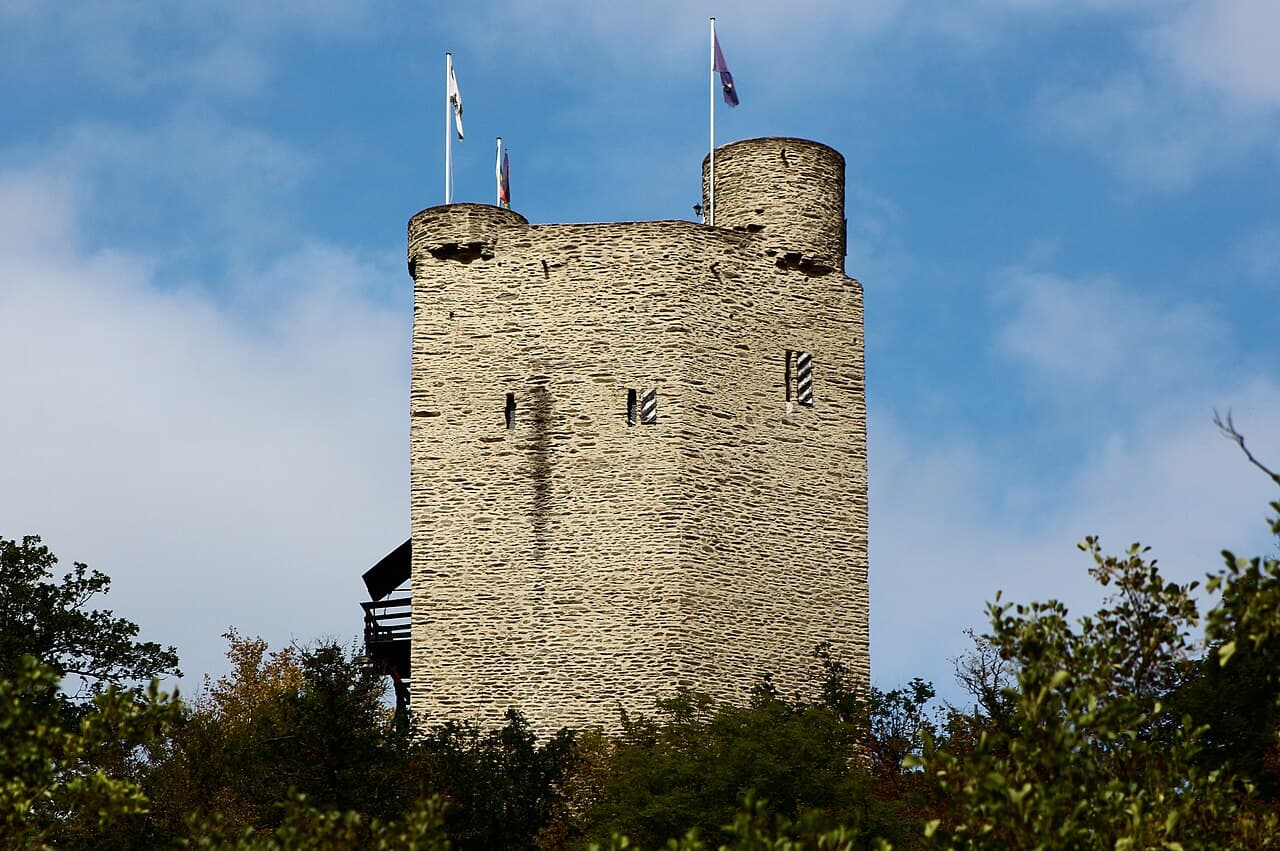
Laurenburg Castle Tower
Laurenburg Castle tower stands as a significant medieval fortress located in the municipality of Laurenburg, Germany. First mentioned in 1093, this castle is renowned as the ancestral seat of the House of Nassau, a noble family whose origins are deeply tied to this stronghold. Although the original castle structures have not survived, the 22-meter-high bergfried tower, dating from the 12th or 13th century, remains a prominent feature. This tower is accessible to visitors and offers a glimpse into the castle's rich history and architectural heritage.
Early history and foundation
The origins of Laurenburg Castle trace back to the late 11th century, around 1090, when Count Dudo of Laurenburg established the stone hill castle. Count Dudo is recognized as the earliest known member of the House of Nassau. His father, Ruprecht, is believed to have resided earlier in nearby Lipporn. Laurenburg Castle served as the initial power base for the Nassau family, who derived their name and status from this stronghold. The castle's strategic location atop a hill provided commanding views over the Lahn River valley and the Waselbach stream valley, emphasizing its defensive and surveillance roles in the medieval landscape.
Medieval ownership and significance
During the 12th and 13th centuries, Laurenburg Castle was a center of noble activity and territorial control. By the 14th century, ownership of the castle became more complex, reflecting the feudal fragmentation typical of the period. In 1343, Adolf of Nassau and his brother Johann reached an agreement to maintain peace at the castle. A few years later, in 1347, knights Dietrich von Staffel and Friedrich Brenner purchased a half-share of the castle from Count Johann of Nassau-Hadamar and his relatives. This division of property illustrates the common practice of shared lordship in medieval Europe.
By 1354, Count Adolf of Nassau-Idstein granted his half of Laurenburg Castle to Archbishop Balduin of Trier as part of his wife's dower. This transfer linked the castle to ecclesiastical authority and demonstrated the political alliances forged through marriage. Over time, the castle's strategic importance diminished, and by the mid-17th century, it had fallen into ruin.
Restoration and later developments
In 1643, the castle was acquired by Peter Melander von Holzappel, a notable military leader from Niederhadamar. He undertook partial restoration efforts, focusing primarily on the bergfried or main tower, reviving this key defensive and residential element. The rest of the castle structures, however, remained in decay.
Around 1800, a new palace complex called Schloss Laurenburg was constructed at the base of the hill, marking a shift from medieval fortress to more modern residential architecture. Since 1985, the castle has been privately owned, with the bergfried fully restored and maintained as a residence. The tower also serves cultural functions, including housing a small military museum within the knight's hall and hosting ceremonial events such as weddings.
Architectural features of the bergfried tower
The surviving structure of Laurenburg Castle is dominated by the bergfried, a tall, five-sided tower typical of medieval fortifications. The tower rises approximately 22 meters and is situated on a hill at an elevation of 178.9 meters above sea level. Its position allowed for extensive surveillance over the surrounding valleys, a critical advantage in medieval defense.
Access to the bergfried is gained via an external wooden staircase on the west side, leading to a high entrance above ground level. Inside, visitors enter the knight's hall, originally used for gatherings and important functions. A wooden staircase connects this hall to the living quarters on the upper floor. From there, a spiral staircase embedded in the tower's eastern corner ascends to a flat roof platform, which offers panoramic views of the surrounding landscape.
Historically, the bergfried was enclosed within a fortified perimeter marked by a stone ring wall and a dry moat or neck ditch, enhancing the castle's defenses. While no other original buildings remain, the tower itself has been carefully restored to preserve its medieval character and structural integrity.
Cultural significance and visitor experience
Today, Laurenburg Castle tower stands as a symbol of the House of Nassau's origins and medieval heritage. The tower's adaptation for modern use includes a small military museum within the knight's hall, providing educational insights into the castle's history and the broader medieval military context.
The castle's location and preserved bergfried offer visitors a unique opportunity to explore a well-maintained medieval tower with authentic architectural features. The panoramic views from the roof platform highlight the strategic importance of the site and its enduring presence in the regional landscape.
Laurenburg Castle tower is open to the public, allowing visitors to experience firsthand the architectural and historical legacy of this high medieval hill castle. Its combination of historical significance, architectural preservation, and cultural use makes it a noteworthy destination for those interested in medieval castles and German history.
Frequently asked questions (FAQ)
- How do I visit Laurenburg Castle tower?
- Laurenburg Castle tower is open to visitors, with access to the bergfried tower and its panoramic views. Check local tourism websites for current opening hours and any guided tours available.
- What is the historical significance of Laurenburg Castle?
- Laurenburg Castle is the ancestral home of the House of Nassau, a noble family that played a significant role in German and European history. The castle's origins date back to the 11th century, marking it as an important medieval fortress.
- Can I see original medieval architecture at Laurenburg Castle?
- Yes, the bergfried tower, dating from the 12th or 13th century, is the main surviving medieval structure. It has been restored and retains authentic architectural features such as the knight's hall and defensive elements.
- Is Laurenburg Castle accessible for families and groups?
- Laurenburg Castle tower is suitable for families and groups interested in medieval history. The site offers educational exhibits and scenic views, making it a rewarding visit for all ages.
- When is the best time to visit Laurenburg Castle?
- The best time to visit Laurenburg Castle is during the spring and summer months when the weather is favorable for exploring the tower and enjoying the panoramic views from the roof platform.
Photo gallery

Information
Sources & official resources
Verify the information above using these authoritative references.
Loading map...
Visitor reviews
No reviews yet. Been here? Write the first review and help other travelers!
Write the first reviewVisited this castle? Share your experience
Your review helps other travelers and adds first-hand knowledge to our encyclopedia.



