Namedy Castle
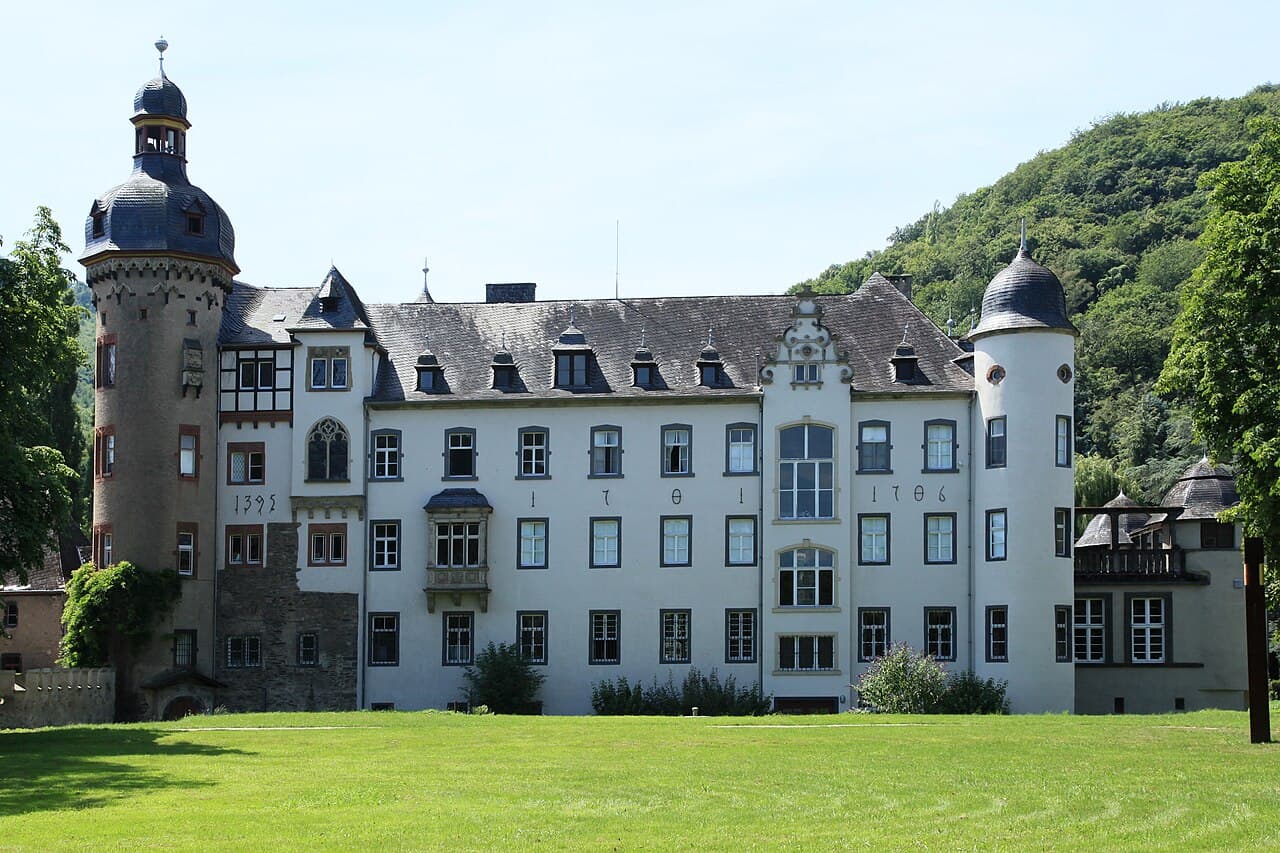
Namedy Castle stands prominently in the Rhine valley, nestled on the left bank of the river north of the village of Namedy, near Andernach, Germany. This castle's origins trace back to the 14th century, when it was initially constructed as a late Gothic moated fortress by the patrician Hausmann family from Andernach. The castle's location is notable for its proximity to the first wooded hills of the Eifel highlands, providing a strategic and scenic setting that blends natural beauty with medieval fortification.
The earliest recorded lord of the estate was Gerhardus dictus Husmann, who died in 1211, marking the long-standing historical lineage associated with the site. Originally, the castle functioned as a small moated stronghold integrated with the noble court of Niederhof, featuring a residential tower and two stair towers at the west and east corners, constructed using traditional stone masonry typical of the late medieval period.
Architectural evolution from gothic fortress to baroque palace
Late medieval origins and 16th-century expansions
During the 16th century, under the stewardship of Dr. Antonius von Hausmann, a knight and mayor of Koblenz, and his wife Margeretha zu Eltz, the castle underwent significant expansion between 1550 and 1560. The main residential wing was extended by nearly 27 meters towards the northwest, and an elegant round tower was added at the northern corner. These changes gave the castle a balanced and symmetrical facade facing the Rhine River. A notable architectural detail from this period is a tuff stone oriel window near the stair tower, adorned with a heraldic plaque displaying the coats of arms of Antonius von Hausmann and Margeretha zu Eltz, accompanied by Latin inscriptions commemorating the family lineage.
Baroque transformation under johann arnold von solemacher
In 1700, the castle was purchased by Johann Arnold von Solemacher, chancellor of the Electorate of Trier, who initiated a comprehensive transformation of the medieval fortress into a Baroque pleasure palace. After being ennobled in 1718 by Emperor Charles VI, Johann Arnold adopted the combined family name Husmann von Namedy and incorporated the family's coat of arms into the castle's decor. The renovation included adding stories to the existing structure and constructing two side wings, significantly enlarging the castle's footprint. The Solemacher family maintained residence here until the late 18th century.
Historical challenges and military impacts
The castle's history is marked by episodes of conflict and military use. In 1633, during the Thirty Years' War, Swedish troops plundered Namedy Castle, causing damage to its structures. Later, during the French Revolutionary Wars around 1794, the castle fell under French control and was repurposed as a military hospital and powder magazine. This military occupation severely damaged the interiors; wooden elements such as windows, stairs, floors, and doors were removed and used as fuel for heating, leading to significant interior ruin. Despite this, the roof structure survived, preserving the castle's basic form.
Restoration efforts began in 1856, after which the castle changed hands multiple times, including ownership by wealthy industrialists. In 1896, Johann Arnold Freiherr von Solemacher undertook historicist renovations, adding a third floor, extending the towers, and constructing new side wings. These renovations featured mullioned windows with blind tracery inspired by 16th-century designs, reflecting the Solemacher family's heraldic heritage.
20th-century enhancements and cultural revival
Between 1907 and 1909, the castle was acquired by Prince Karl Anton of Hohenzollern-Sigmaringen, a lieutenant general in the Prussian army, married to Princess Joséphine Caroline of Belgium. They added a distinctive hall of mirrors flanked by two corner towers, designed by architect Clemens Kroth. This addition blended early modern design elements with the castle's historic character.
During World War I, Princess Joséphine operated a military hospital within the hall of mirrors, while Prince Karl Anton served on multiple fronts. After the war, American forces occupied the castle, leading to further interior damage. Prince Karl Anton died in 1919, and his son, Albrecht, Prince of Hohenzollern, assumed responsibility for restoring the estate, including renewing the Baroque-style roofs on the towers by 1933.
The castle's management during World War II was complicated by political affiliations and wartime arrests within the family. Post-war, the castle passed to Godehard Prince of Hohenzollern in 1988, who spearheaded a comprehensive restoration and conversion of Namedy Castle into a vibrant cultural center. The hall of mirrors was restored in 2003 with support from the German Foundation for Monument Protection.
Architectural features and castle grounds
Namedy Castle's complex includes the original medieval residential tower, stair towers, and the extended 16th-century wing with the round tower, all constructed in stone. The Baroque renovations introduced elegant side wings and a grand entrance portal with a bridge over the moat on the hillside side. The historicist additions in the late 19th century enhanced the castle's verticality and decorative elements, including heraldic plaques and intricate stone tracery.
The early 20th-century hall of mirrors stands as a unique architectural element, serving historically as a hospital and now as a venue for cultural events. The castle park adjacent to the Rhine valley offers scenic views and is accessible via prominent recreational routes such as the EuroVelo 15 cycling path and the Eifel-Camino hiking trail, integrating the castle into the natural and cultural landscape of the region.
Cultural significance and present-day use
Today, Namedy Castle functions as a cultural hub, hosting concerts, theatrical performances, and art exhibitions, notably the Kultursommer Rheinland-Pfalz (Summer of Culture) event. The castle and its park are also available for private celebrations and professional events, blending historical ambiance with contemporary cultural life.
The castle's preservation and adaptive reuse exemplify the careful balance between maintaining historical integrity and providing modern cultural amenities. Its rich architectural layers—from medieval fortification to Baroque palace and historicist revival—offer a tangible narrative of regional history and aristocratic heritage along the Rhine.
Visitors can explore the castle's architectural evolution, enjoy its cultural programming, and appreciate its picturesque setting within the Rhine valley and near the Eifel highlands, making Namedy Castle a significant landmark in German heritage.
Frequently asked questions (FAQ)
- What is the historical significance of Namedy Castle?
- Namedy Castle dates back to the 14th century and showcases architectural evolution from a late Gothic moated fortress to a Baroque palace, reflecting regional history and aristocratic heritage.
- Can visitors attend cultural events at Namedy Castle?
- Yes, Namedy Castle hosts concerts, theatrical performances, and art exhibitions, including the Kultursommer Rheinland-Pfalz event, making it a vibrant cultural center.
- How did World War I affect Namedy Castle?
- During World War I, the hall of mirrors was used as a military hospital by Princess Joséphine, and the castle suffered occupation and interior damage but was restored afterward.
- What architectural styles are represented at Namedy Castle?
- Namedy Castle features a mix of late Gothic, Baroque, and historicist architectural styles, with notable additions like the hall of mirrors from the early 20th century.
- Where is Namedy Castle located?
- Namedy Castle is located near Andernach, Germany, in the Rhine valley on the left bank of the river, close to the Eifel highlands.
Photo gallery

Information
Sources & official resources
Verify the information above using these authoritative references.
Loading map...
Visitor reviews
No reviews yet. Been here? Write the first review and help other travelers!
Write the first reviewVisited this castle? Share your experience
Your review helps other travelers and adds first-hand knowledge to our encyclopedia.