Burg Hammerstein
Burg Hammerstein stands as a remarkable testament to medieval fortification and imperial power in the Middle Rhine Valley. Constructed in the 10th century by the Conradine dynasty, it holds the distinction of being the oldest known castle in this historically significant region of Germany. Originally built as a Reichsburg or imperial castle, Burg Hammerstein played a pivotal role in the political and military landscape of the Holy Roman Empire for several centuries.
Early history and imperial significance
The castle's origins trace back to around the year 1000, when it was first mentioned in historical records. It served as the seat of the burgraves of Hammerstein until their lineage ended circa 1417. One of the most notable early events was the conflict involving Otto von Hammerstein, Count of Engersgau, whose controversial marriage to his relative Ermengarde de Verdun led to a fierce dispute with the Church and imperial authorities. This culminated in Otto imprisoning the entourage of Archbishop Erkanbald of Mainz within the castle walls in 1018, provoking a siege by Emperor Henry II in 1020. The castle withstood the siege until late December, surrendering only due to starvation.
Restoration and imperial regalia
Following the siege, Burg Hammerstein experienced a period of decline until restoration efforts were undertaken by Emperor Henry IV in 1071. The castle then gained renewed prominence as a secure repository for the Imperial regalia, the symbols of the emperor's authority. Henry IV's son, Henry V, also entrusted the regalia to the castle after his ascension in 1125, highlighting its continued imperial importance.
Medieval governance and architectural development
Throughout the 13th and 14th centuries, Burg Hammerstein remained under imperial control until 1374, when Emperor Charles IV transferred feudal rights to the Electorate of Trier. By 1431, the castle and surrounding valley were granted to Count Ruprecht of Virneburg. He was authorized in 1434 to invest significantly in the construction of additional buildings, reflecting ongoing development and adaptation of the castle's facilities.
Military role during the thirty years' war
The castle's strategic location made it a valuable military asset during the Thirty Years' War. It was occupied by Spanish forces from 1632 to 1646 and later used by troops loyal to Charles IV, Duke of Lorraine until 1654. The castle changed hands multiple times, with allied forces of Trier and Wied eventually recapturing it. To prevent further military use, the castle was deliberately slighted—partially dismantled—after Trier's forces withdrew.
Architectural features and surviving remains
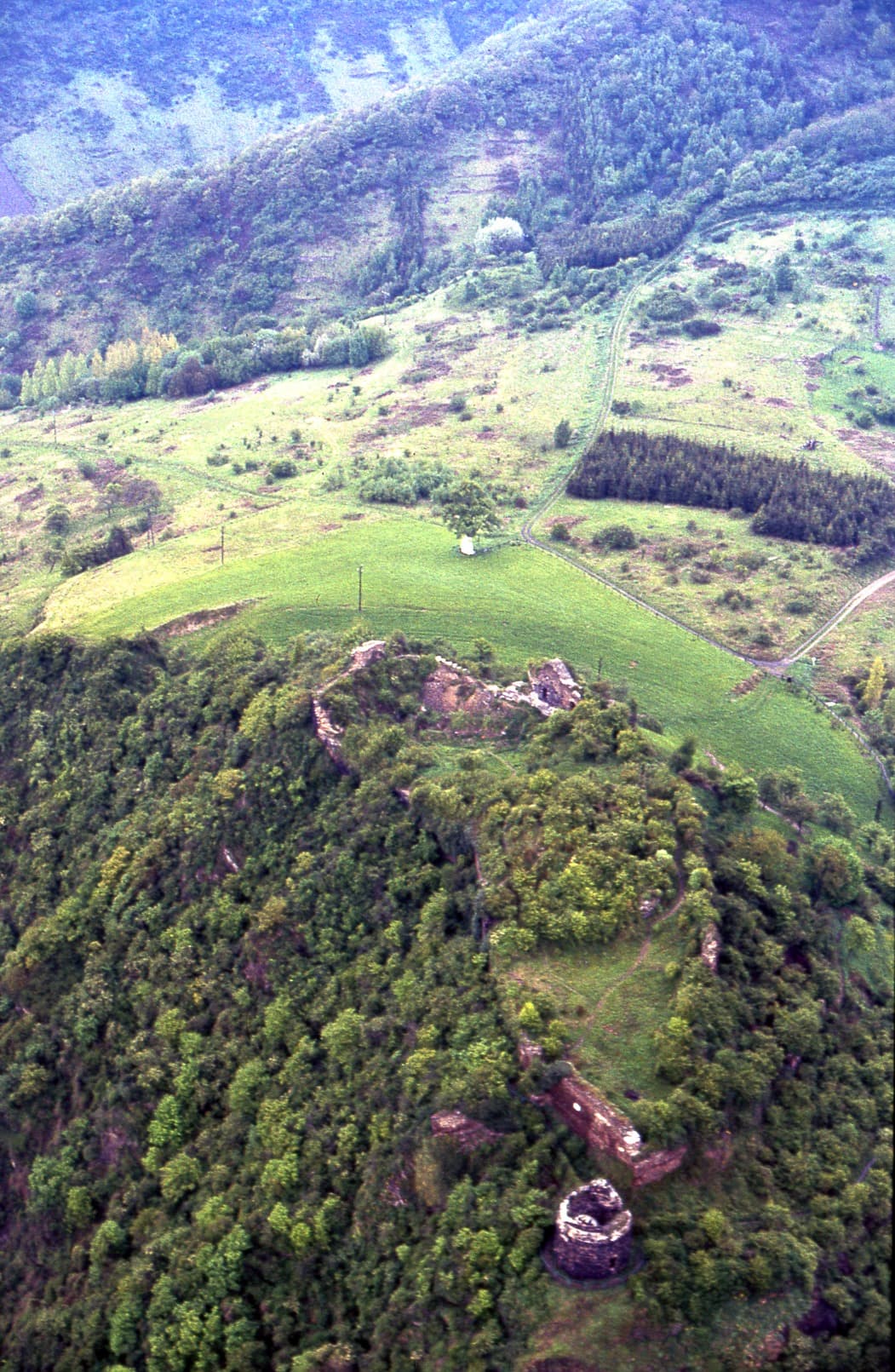
Situated on a hill 195 meters above sea level on the east bank of the Rhine River, Burg Hammerstein's ruins vividly illustrate its historic defensive function. The surviving masonry, characterized by rubble and small stones bound with mortar, was once mistakenly thought to be of Roman origin but is now recognized as medieval construction.
Defensive structures and walls
Key remnants include the ruins of a prominent watchtower overlooking the Rhine, which served as a vantage point for surveillance and defense. Portions of the ring wall that enclosed the inner castle remain visible, alongside fragments of the eastern defensive wall walk, a raised patrol path used by guards. A partially preserved postern gate (Ausfallpforte) reveals the castle's design for controlled sorties and emergency escapes.
Unique features and memorials
The so-called Barbarossa Wall, featuring a narrow loophole for archers, highlights the castle's military architecture. A modern reconstruction of one of the castle gates offers visitors a glimpse of the original entrance's appearance. At the base of the rock, a memorial commemorates the significant 1020 siege by Emperor Henry II, marking a key historical moment in the castle's story.
Economic and strategic importance
Burg Hammerstein's location was not only militarily strategic but also economically vital. By 1071, it operated a toll station controlling river traffic on the Rhine, a crucial commercial artery. Later, in 1215, the castle housed a mint, underscoring its role in regional economic affairs alongside its defensive and administrative functions.
Modern history and preservation
After the Napoleonic Wars, the castle ruins came under Prussian control in 1815. Since 1893, the site has been owned by the Barons of Hammerstein, who maintain stewardship of this historic landmark. Today, the castle ruins are accessible via hiking trails, inviting visitors to explore a site rich with centuries of layered history and architectural evolution.
Burg Hammerstein remains a significant cultural heritage site, embodying the complex history of medieval Germany, imperial politics, and military architecture. Its ruins offer a tangible connection to the past, reflecting the enduring legacy of one of the Middle Rhine Valley's oldest and most historically important castles.
Frequently asked questions (FAQ)
- How do I get to Burg Hammerstein?
- Burg Hammerstein is located in the municipality of Hammerstein in Rhineland-Palatinate, Germany. It is accessible by local roads and hiking trails leading up to the castle ruins on a hill above the Rhine River.
- What is the historical significance of Burg Hammerstein?
- Burg Hammerstein is the oldest known castle in the Middle Rhine Valley, dating back to the 10th century. It served as an imperial castle and played important roles in medieval politics, military conflicts, and regional economic control.
- Can I visit the castle ruins?
- Yes, the ruins of Burg Hammerstein are open to the public and can be explored via marked trails. Visitors can see remains of the watchtower, ring walls, and other medieval structures.
- When was Burg Hammerstein built?
- Burg Hammerstein was constructed in the 10th century by the Conradine dynasty, making it one of the oldest castles in the region.
- Is there an entrance fee to visit Burg Hammerstein?
- There is no entrance fee to visit the ruins of Burg Hammerstein, making it an accessible historical site for all visitors.
Photo gallery

Information
Current owner
Barons of Hammerstein
Loading map...
Visitor reviews
No reviews yet. Been here? Write the first review and help other travelers!
Write the first reviewVisited this castle? Share your experience
Your review helps other travelers and adds first-hand knowledge to our encyclopedia.