
Najac Castle
Najac Castle, perched dramatically on a rocky spur overlooking the Aveyron River in southern France, stands as a remarkable example of medieval military architecture. Constructed in 1253 under the direction of Alphonse de Poitiers, brother of King Louis IX, the castle was built atop the remains of an earlier 12th-century fortification. Its strategic location, about 200 meters above the river, afforded commanding views and control over the surrounding region, making it a vital stronghold in the turbulent history of the Midi-Pyrénées region, now part of Occitanie.
The castle’s design reflects the height of 13th-century Gothic military engineering, combining robust defensive features with architectural innovation. Najac’s imposing curtain walls rise approximately 25 meters, making them nearly impregnable to scaling attempts. The fortress is renowned worldwide for its 6.80-meter-high archères, the tallest arrow slits known, which could accommodate three archers firing simultaneously. This feature exemplifies the castle’s emphasis on defense and strategic combat capabilities.
Historical context and significance
The origins of Najac Castle trace back to around 1100 when Bertrand de Saint-Gilles, son of Raymond IV, Count of Toulouse, established a Romanesque square tower on the site. This early fortification laid the groundwork for the later expansive Gothic fortress. The castle’s pivotal transformation occurred in the mid-13th century when Alphonse de Poitiers undertook a major reconstruction between 1253 and 1266, expanding the castle into a formidable royal fortress. Alphonse’s marriage to Jeanne de Toulouse linked the castle to the legacy of the last Count of Toulouse, Raymond VII, cementing royal authority in the region.
Najac served as the seat of a royal viguerie, an administrative and judicial district, marking the western edge of Rouergue and acting as a bulwark against the influence of powerful neighboring lords such as the Trencavel family and the Counts of Barcelona. The castle’s military importance was repeatedly demonstrated during key historical conflicts including the Albigensian Crusade, the Hundred Years’ War, and the French Wars of Religion. It endured English occupation in the late 14th century and was a focal point during peasant revolts such as the 1643 uprising led by Bernard Calmels.
Architectural features and defensive innovations
Layout and fortifications
The castle’s inner bailey forms a roughly rectangular enclosure approximately 40 meters in length. The perimeter is fortified with curtain walls and multiple towers projecting from the north and south walls, including the original Romanesque square tower and a massive round donjon nearly 40 meters high. This donjon served as the command center for the castle’s defenses and symbolized the power of Alphonse de Poitiers over the County of Toulouse.
The entrance is heavily fortified with a barbican and a single narrow approach protected by a drawbridge, limiting access and creating a formidable obstacle for attackers. The castle’s walls are founded directly on the bedrock, a design choice that discouraged undermining attempts, a common siege tactic of the era.
Unique defensive elements
Najac Castle is famous for its extraordinarily tall archères, measuring 6.80 meters high, believed to be the tallest in the world. These narrow vertical slits allowed multiple archers to fire simultaneously from staggered platforms within, covering all directions of attack. This innovation greatly enhanced the castle’s defensive capabilities.
A secret corridor hidden within the walls connects the Romanesque tower to the chapel located inside the donjon. This passage was likely used for discreet movement during sieges or emergencies. The castle also features a dungeon within one of its towers, underscoring its role in regional justice and imprisonment.
Rainwater management was ingeniously handled by channeling runoff from the roofs into a cistern via a stone conduit, ensuring a reliable water supply during prolonged sieges. The castle’s masonry is of exceptional quality, with subtle architectural details and carvings that reveal the skill of medieval craftsmen.
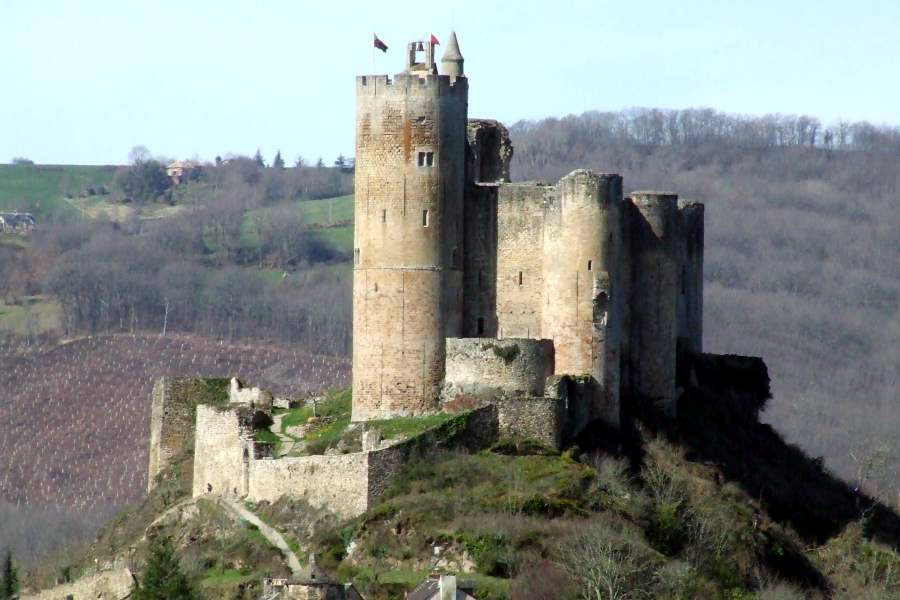
Photo by Alecs.y • CC BY 2.5
Later history and preservation
Following its active military use, Najac Castle experienced decline, particularly after the French Revolution, when it was sold as national property and partially dismantled for building materials. In the 19th century, it was used as a stone quarry, accelerating its deterioration.
Fortunately, the castle was purchased in 1906 by the Cibiel family, who have since preserved and restored the fortress, opening it to the public. Najac Castle is now a protected monument historique, recognized for its outstanding architectural and historical value. It forms part of the Route des Seigneurs du Rouergue, a tourist itinerary linking 23 castles in the Aveyron département, promoting the region’s rich medieval heritage.
Cultural and touristic importance
Today, Najac Castle is a major attraction in Occitanie, drawing visitors interested in medieval history, architecture, and panoramic views of the Aveyron valley. Its well-preserved structures, including the donjon, curtain walls, towers, and chapel, offer a vivid glimpse into the military and feudal life of the Middle Ages.
The castle’s combination of Romanesque and Gothic elements exemplifies the evolution of fortification techniques and aristocratic power in southern France. Visitors can explore the secret passageways, admire the frescoes in the chapel, and appreciate the castle’s strategic design that made it "the impregnable fortress" of its time.
Najac’s enduring presence and historical significance make it an essential site for understanding the complex history of the Rouergue region and the broader narrative of medieval France.
Frequently asked questions (FAQ)
- What is the historical significance of Najac Castle?
- Najac Castle, built in the 13th century, is a remarkable example of medieval military architecture. Its strategic position overlooking the Aveyron River made it a vital stronghold during the Albigensian Crusade, playing a pivotal role in the defense of the region.
- When was Najac Castle built?
- Construction of Najac Castle began in 1253 and continued over several decades. The castle was completed in the late 13th century, showcasing the architectural styles and defensive strategies of the medieval period.
- Can I visit Najac Castle?
- Yes, Najac Castle is open to visitors throughout the year, providing a unique opportunity to explore its historical grounds. Guided tours are available, offering insights into its rich history and architectural features.
- What are the opening hours for Najac Castle?
- Najac Castle typically opens at 10 AM and closes at 6 PM during the peak season from April to October. In the off-season, hours may vary, so it's advisable to check the official website for the most current information.
- Is it possible to access Najac Castle with limited mobility?
- Access to Najac Castle can be challenging due to its elevated position and uneven terrain. However, the site is working towards improving accessibility, and visitors with mobility concerns are encouraged to contact the castle administration for assistance.
- What is the best time to visit Najac Castle?
- The best time to visit Najac Castle is during the spring and early autumn months when the weather is pleasant and the crowds are smaller. Additionally, visiting during the summer allows you to enjoy various cultural events and activities hosted in the area.
- Are there any nearby attractions to visit?
- Yes, the village of Najac itself is charming, with its picturesque streets and local shops. Nearby attractions include the beautiful Aveyron Valley and other historical sites such as the Château de Belcastel and the Roquefort Caves.
- How much are the ticket prices for Najac Castle?
- Ticket prices for Najac Castle are quite reasonable, typically ranging from €5 to €10 for adults, with discounts available for children and families. It's advisable to check the official website for any special promotions or group rates.
Photo gallery

Information
Website
Visit websiteSources & official resources
Verify the information above using these authoritative references.
Loading map...
Visitor reviews
No reviews yet. Been here? Write the first review and help other travelers!
Write the first reviewVisited this castle? Share your experience
Your review helps other travelers and adds first-hand knowledge to our encyclopedia.