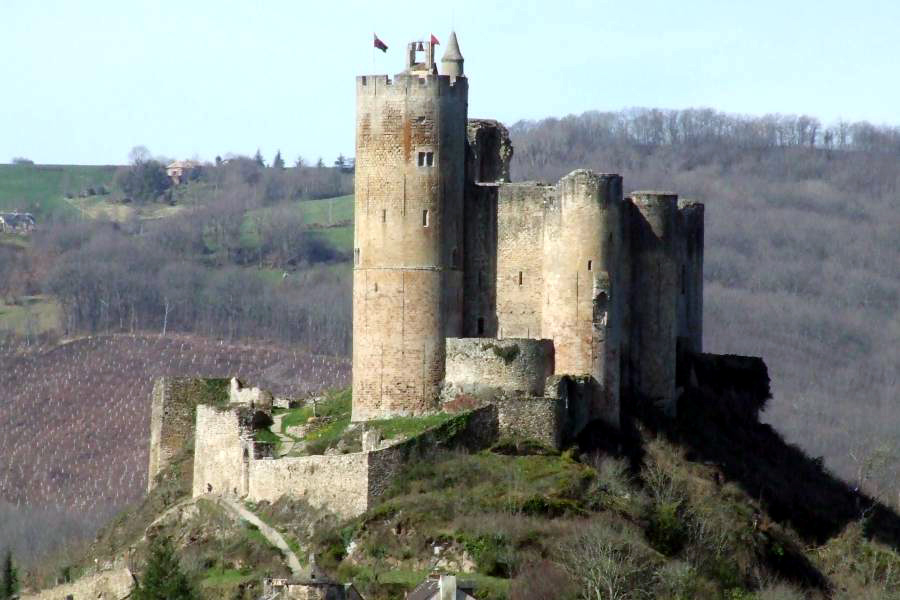
Château de Cornusson

Château de Cornusson in Parisot, France
Parisot, Occitanie, France
High Medieval (11th–13th c.)
Partially Preserved

Château de Cornusson is a historic castle located in the commune of Parisot in southern France. Originally constructed in the 12th century, it was first documented in 1157, marking it as a significant high medieval fortress with origins deeply rooted in medieval feudal society. The castle's strategic position and defensive architecture reflected the turbulent times of the Middle Ages, designed to withstand sieges and protect its noble inhabitants.

Medieval origins and architectural evolution

The initial construction of Château de Cornusson was typical of high medieval castles with robust stone walls, a fortified keep, and defensive towers. These elements were intended to provide security against both military assaults and local unrest. Over time, the castle underwent significant architectural transformations, particularly during the 16th and 17th centuries when it was extensively rebuilt by the La Valette-Parisot family. This renovation introduced elements of the Renaissance architectural style, blending fortified medieval features with more refined residential comforts and aesthetic details.

Renaissance rebuilding and stylistic features

The Renaissance period brought a shift from purely defensive architecture to a more palatial style. Château de Cornusson's reconstruction included enlarged windows, decorative stonework, and more spacious living quarters. While the castle retained its formidable walls and defensive towers, these were complemented by elegant facades and interior enhancements that reflected the changing tastes and social status of its owners. This blend of medieval fortification and Renaissance elegance makes the château architecturally significant.

Historical significance and wartime role

During the Wars of Religion in France (1562–1598), Château de Cornusson played a notable role as a stronghold. The castle successfully resisted several attacks by Protestant forces, demonstrating its strategic importance and the strength of its fortifications. The owners at the time, the La Valette-Parisot family, were staunch defenders of the Catholic cause, which positioned the château as a key site in the religious conflicts that shaped France's history.

Ownership transitions and revolutionary impact

In the late 17th century, ownership of Château de Cornusson passed to the Vignes family from Puylaroque through marriage. The castle remained a noble residence until the upheavals of the French Revolution, when it was reportedly pillaged and left in a state of disrepair. The revolution's impact on the château reflects the widespread destruction and redistribution of aristocratic properties during this period.

Post-revolutionary decline and current status

Following the revolution, Château de Cornusson changed hands multiple times and gradually sank into obscurity, typical of many rural French castles that lost their strategic and residential importance. Today, the château stands as a testament to its layered history, although it has suffered from neglect and deterioration. Despite this, it remains a site of cultural heritage, illustrating the evolution of French castle architecture from the medieval to the Renaissance period and the social upheavals that influenced its fate.

Architectural elements and preservation challenges

The castle's surviving structures include portions of its medieval stone walls, Renaissance-era residential wings, and defensive towers. Preservation efforts face challenges due to the château's rural location and the extent of damage sustained over centuries. However, its historical and architectural value continues to attract interest from historians, conservationists, and visitors intrigued by France's feudal and early modern past.

Visiting château de cornusson

While not as widely known as some of France's grander castles, Château de Cornusson offers a unique glimpse into the region's medieval and Renaissance history. Visitors interested in castle architecture and French history may find the site rewarding, though access and visitor facilities may be limited due to its private ownership and preservation status. Exploring the château and its surroundings provides insight into the lifestyle and defensive needs of French nobility across centuries.

Frequently asked questions (FAQ)

How do I get to Château de Cornusson?
Château de Cornusson is located in Parisot, France, easily accessible by car or public transport. If you are driving, follow the signs to Parisot, and there is ample parking available near the castle.
What is the historical significance of Château de Cornusson?
Château de Cornusson is a remarkable example of medieval architecture and has a rich history dating back to the 12th century. It served as a strategic fortress during various conflicts and has been meticulously preserved, showcasing the architectural styles of its time.
When was Château de Cornusson built?
Construction of Château de Cornusson began in the late 12th century, with significant modifications made over the centuries. The castle reflects various architectural influences from the medieval period, making it a fascinating site for history enthusiasts.
Can I take guided tours of Château de Cornusson?
Yes, guided tours are available at Château de Cornusson, offering visitors in-depth insights into its history and architecture. Tours are conducted by knowledgeable guides and are available in multiple languages to cater to international visitors.
Why is Château de Cornusson popular among tourists?
Château de Cornusson is popular due to its stunning architecture, rich history, and picturesque surroundings. The castle also hosts various cultural events and exhibitions throughout the year, attracting visitors interested in art and history.
Is it possible to visit Château de Cornusson year-round?
Yes, Château de Cornusson is open to visitors year-round, with varying hours depending on the season. It is advisable to check the official website for specific opening hours and any seasonal events that may enhance your visit.
What are the ticket prices for Château de Cornusson?
Ticket prices for Château de Cornusson vary based on age and tour options. Discounts are often available for students, seniors, and families, making it accessible for all visitors.
What is the best time to visit Château de Cornusson?
The best time to visit Château de Cornusson is during the spring and early fall, when the weather is mild and the gardens are in full bloom. Additionally, visiting during weekdays can help you avoid larger crowds.
Are there any nearby attractions to visit along with Château de Cornusson?
Yes, the area surrounding Château de Cornusson is rich in cultural and historical attractions. Nearby, you can explore charming villages, local markets, and other historical sites, making it a perfect day trip destination.

Information

Hill Castle

Loading map...

Visitor reviews

No reviews yet. Been here? Write the first review and help other travelers!

Write the first review

Visited this castle? Share your experience

Your review helps other travelers and adds first-hand knowledge to our encyclopedia.

Write a review

(5/5)

0/2000 characters

Your review will be visible after admin approval

Nearby castles

6.8 km

Château de Cas

, France

The Château de Cas, located in the Hauts-de-France region of France, is a remarkable example of a hill castle with a history spanning over a millennium. Originally established in the 9th century on the remains of a Gallo-Roman site, the castle embodies the strategic importance of this location through successive historical periods. Its enduring presence offers a unique window into the evolution of medieval fortifications and noble residences in northern France. The early origins and medieval significance The castle's foundation on a Gallo-Roman site signifies its long-standing military and administrative role in the region. During the medieval period, Château de Cas became part of the holdings of the commandery of La Capelle-Livron, linked to the Hospitaller order, a prominent religious and military organization in medieval Europe. This connection underscores the castle's strategic and religious importance during the Middle Ages. Throughout the 14th and 17th centuries, the castle underwent significant modifications to adapt to changing defensive needs and residential comforts. These alterations reflect broader trends in castle architecture, transitioning from purely military fortresses to more complex estates combining defense with noble habitation. Architectural features and estate elements The chapel and burial vault One of the most ancient and significant structures within the château complex is the chapel dating from 960. This chapel not only serves religious functions but also houses the family burial vault, emphasizing the château's role as a hereditary seat for the noble family. Its preservation offers valuable insight into early medieval religious architecture and the continuity of family traditions over centuries. Gardens and dovecote The surrounding garden and dovecote, developed in the 18th century, were inspired by an earlier garden that had been lost. The dovecote, historically used for housing pigeons or doves, reflects the agricultural practices and domestic economy associated with the estate during this period. These features contribute to the château's historic landscape, blending natural and architectural heritage. Historical events and ownership The château has been owned continuously by the same family lineage since 1437, a rare example of unbroken hereditary possession in France. In the late 18th century, it became the residence of Claude-Marie, Count de Lastic Saint-Jal, a cavalry brigadier and governor of Carcassonne, following his marriage to Henriette de Lacapelle, the widowed owner of the property. The French Revolution was a tumultuous period for Château de Cas. The castle suffered significant damage, including the looting of furnishings and the destruction of several coats of arms by fire. Structural changes during this time included the lowering of the keep and a tower, reflecting the widespread impact of revolutionary violence on noble estates. Restoration efforts began in the late 19th century, focusing on rebuilding the roof and repairing windows, which helped revive the castle's historic appearance and structural integrity. Role during World War II and modern preservation During World War II, the château played a covert role in the French Resistance. Its owners concealed munitions for the Free French Forces in a basement room, which was later sealed after a denunciation forced the transfer of the weapons to nearby caves. The castle subsequently suffered retaliatory damage by German occupying forces, underscoring its involvement in modern historical events. Restoration resumed in the 1980s under Lyonnel and Jeanne de Lastic, who continued to preserve the château's heritage. Since 1984, Château de Cas has been officially recognized as a historic monument in France. Its extensive archives, containing documents dating back to 1310, highlight the château's importance as a continuous site of habitation and noble lineage. Notable historical associations and cultural significance The château is reputed to have hosted King Philip IV (Philip the Fair) in the so-called "Louis XIV" room, linking the site to significant royal history. Additionally, Jean-Albert de Lastic, related to the Countess of Ségur, is traditionally believed to have inspired a character in the novel Un bon petit diable, intertwining the château's history with French literary heritage. Architectural evolution and surviving elements The Château de Cas presents a complex architectural layering reflecting centuries of adaptation. Its core defensive structures date from the 9th century, built upon earlier Gallo-Roman foundations. Although detailed records of construction materials and methods are limited, the castle's layout includes typical medieval fortifications such as towers, keeps, and curtain walls. The chapel from 960 remains intact, serving as a rare example of early medieval religious architecture preserved within a fortified estate. The estate's 18th-century garden and dovecote add to the historical landscape, illustrating the château's evolution from a purely defensive structure to a noble residence with agricultural functions. Structural changes during the French Revolution, including the lowering of the keep and a tower, demonstrate the impact of political upheaval on the castle's form. Later restorations in the 19th and 20th centuries focused on preserving key architectural features such as roofs and windows, maintaining the château's historic character. The basement room used to conceal weapons during World War II reflects the château's adaptation to modern historical circumstances. Despite damage from German reprisals, the castle retains original heraldic materials and archives, preserving the noble family's identity and history. Visiting Château de Cas Today, Château de Cas stands as a testament to the enduring legacy of medieval fortifications and noble lineage in France. Its well-preserved structures, historic chapel, and surrounding gardens offer visitors an immersive experience into centuries of French history. The château's archives and heraldic materials provide valuable resources for historians and genealogists interested in noble heritage and medieval architecture. Visitors can appreciate the castle's architectural evolution, from its early medieval origins through Renaissance and post-medieval modifications, culminating in its modern preservation as a protected historic monument. The château's story of resilience, adaptation, and continuous family ownership makes it a unique cultural landmark in the Hauts-de-France region.

Early Medieval (5th–10th c.)
Details
9.2 km

Château de Saint-Projet

Saint-Projet, France

Château de Saint-Projet is a historic castle located in Saint-Projet, France, notable for its origins dating back to around 1300. Constructed by Jehan de Jehan, the castle was strategically built upon an ancient Gallo-Roman tumulus, linking its foundation to a site with deep historical significance. This positioning reflects a common medieval practice of repurposing earlier fortifications or sacred sites to establish new centers of power and defense. Architectural features and medieval origins The castle's initial construction in the late medieval period embodies the typical characteristics of fortifications from that era. While specific architectural details of the original structure are limited, it is understood that the castle would have featured defensive elements common to the time, such as thick stone walls, battlements, and possibly a keep or donjon to serve as a last refuge during sieges. The choice of location on a tumulus would have provided a natural elevation advantage, enhancing visibility and defense. Structural layout and defensive elements Though detailed plans of the castle's medieval layout are scarce, castles built around 1300 often included a curtain wall enclosing a courtyard, towers placed at strategic points for surveillance and defense, and a gatehouse controlling access. The use of local stone materials would have contributed to the castle's imposing presence and durability. The castle's design likely balanced residential and military functions, providing living quarters alongside defensive capabilities. 18th-century restoration and transformation In the 18th century, Château de Saint-Projet underwent significant restoration. This period often saw medieval castles adapted for more comfortable residential use rather than solely for defense. The restoration may have included modifications to the interiors, such as the addition of larger windows, refined living spaces, and decorative elements reflecting the architectural tastes of the time. These changes would have softened the castle's medieval austerity while preserving its historical character. Adaptation to modern use The castle's transformation continued into the modern era, with its current function as a hotel. This adaptive reuse allows visitors to experience the historic ambiance of a medieval fortress while enjoying contemporary amenities. The hotel setting helps preserve the castle by maintaining its structure and making it accessible to the public, contributing to cultural tourism in the region. Historical context and significance Located in a region with a rich history, the castle's establishment around 1300 places it in a period marked by feudal conflicts and territorial consolidation in France. Castles like Saint-Projet served as local power centers, controlling surrounding lands and serving as residences for nobility. The connection to a Gallo-Roman tumulus also highlights the layered history of the site, reflecting centuries of human occupation and strategic importance. Legacy and cultural heritage Today, Château de Saint-Projet stands as a testament to the architectural evolution from medieval fortification to 18th-century residence and finally to a modern hospitality venue. Its preservation and continued use contribute to the cultural heritage of Saint-Projet and the broader region, offering insights into historical construction techniques, social history, and adaptive reuse of historic buildings. Visiting Château de Saint-Projet As a hotel, the castle welcomes guests who wish to immerse themselves in a historic atmosphere. Visitors can appreciate the castle's medieval origins alongside its later architectural modifications. The setting offers a unique opportunity to experience history firsthand, with the comfort of modern accommodations. The castle's location in Saint-Projet provides access to the scenic landscapes of the French countryside, enhancing its appeal as a destination for cultural and historical tourism.

Late Medieval (14th–15th c.)
Details
10.4 km
Najac Castle — France castle

Najac Castle

Najac, France

Najac Castle, perched dramatically on a rocky spur overlooking the Aveyron River in southern France, stands as a remarkable example of medieval military architecture. Constructed in 1253 under the direction of Alphonse de Poitiers, brother of King Louis IX, the castle was built atop the remains of an earlier 12th-century fortification. Its strategic location, about 200 meters above the river, afforded commanding views and control over the surrounding region, making it a vital stronghold in the turbulent history of the Midi-Pyrénées region, now part of Occitanie. The castle’s design reflects the height of 13th-century Gothic military engineering, combining robust defensive features with architectural innovation. Najac’s imposing curtain walls rise approximately 25 meters, making them nearly impregnable to scaling attempts. The fortress is renowned worldwide for its 6.80-meter-high archères, the tallest arrow slits known, which could accommodate three archers firing simultaneously. This feature exemplifies the castle’s emphasis on defense and strategic combat capabilities. Historical context and significance The origins of Najac Castle trace back to around 1100 when Bertrand de Saint-Gilles, son of Raymond IV, Count of Toulouse, established a Romanesque square tower on the site. This early fortification laid the groundwork for the later expansive Gothic fortress. The castle’s pivotal transformation occurred in the mid-13th century when Alphonse de Poitiers undertook a major reconstruction between 1253 and 1266, expanding the castle into a formidable royal fortress. Alphonse’s marriage to Jeanne de Toulouse linked the castle to the legacy of the last Count of Toulouse, Raymond VII, cementing royal authority in the region. Najac served as the seat of a royal viguerie, an administrative and judicial district, marking the western edge of Rouergue and acting as a bulwark against the influence of powerful neighboring lords such as the Trencavel family and the Counts of Barcelona. The castle’s military importance was repeatedly demonstrated during key historical conflicts including the Albigensian Crusade, the Hundred Years’ War, and the French Wars of Religion. It endured English occupation in the late 14th century and was a focal point during peasant revolts such as the 1643 uprising led by Bernard Calmels. Architectural features and defensive innovations Layout and fortifications The castle’s inner bailey forms a roughly rectangular enclosure approximately 40 meters in length. The perimeter is fortified with curtain walls and multiple towers projecting from the north and south walls, including the original Romanesque square tower and a massive round donjon nearly 40 meters high. This donjon served as the command center for the castle’s defenses and symbolized the power of Alphonse de Poitiers over the County of Toulouse. The entrance is heavily fortified with a barbican and a single narrow approach protected by a drawbridge, limiting access and creating a formidable obstacle for attackers. The castle’s walls are founded directly on the bedrock, a design choice that discouraged undermining attempts, a common siege tactic of the era. Unique defensive elements Najac Castle is famous for its extraordinarily tall archères, measuring 6.80 meters high, believed to be the tallest in the world. These narrow vertical slits allowed multiple archers to fire simultaneously from staggered platforms within, covering all directions of attack. This innovation greatly enhanced the castle’s defensive capabilities. A secret corridor hidden within the walls connects the Romanesque tower to the chapel located inside the donjon. This passage was likely used for discreet movement during sieges or emergencies. The castle also features a dungeon within one of its towers, underscoring its role in regional justice and imprisonment. Rainwater management was ingeniously handled by channeling runoff from the roofs into a cistern via a stone conduit, ensuring a reliable water supply during prolonged sieges. The castle’s masonry is of exceptional quality, with subtle architectural details and carvings that reveal the skill of medieval craftsmen. Later history and preservation Following its active military use, Najac Castle experienced decline, particularly after the French Revolution, when it was sold as national property and partially dismantled for building materials. In the 19th century, it was used as a stone quarry, accelerating its deterioration. Fortunately, the castle was purchased in 1906 by the Cibiel family, who have since preserved and restored the fortress, opening it to the public. Najac Castle is now a protected monument historique, recognized for its outstanding architectural and historical value. It forms part of the Route des Seigneurs du Rouergue, a tourist itinerary linking 23 castles in the Aveyron département, promoting the region’s rich medieval heritage. Cultural and touristic importance Today, Najac Castle is a major attraction in Occitanie, drawing visitors interested in medieval history, architecture, and panoramic views of the Aveyron valley. Its well-preserved structures, including the donjon, curtain walls, towers, and chapel, offer a vivid glimpse into the military and feudal life of the Middle Ages. The castle’s combination of Romanesque and Gothic elements exemplifies the evolution of fortification techniques and aristocratic power in southern France. Visitors can explore the secret passageways, admire the frescoes in the chapel, and appreciate the castle’s strategic design that made it "the impregnable fortress" of its time. Najac’s enduring presence and historical significance make it an essential site for understanding the complex history of the Rouergue region and the broader narrative of medieval France.

High Medieval (11th–13th c.)
Details