Myślenice — Poland castle

Myślenice

Myślenice castle ruins and historical fortifications
Myślenice, Poland
Renaissance (15th–17th c.)
Ruins

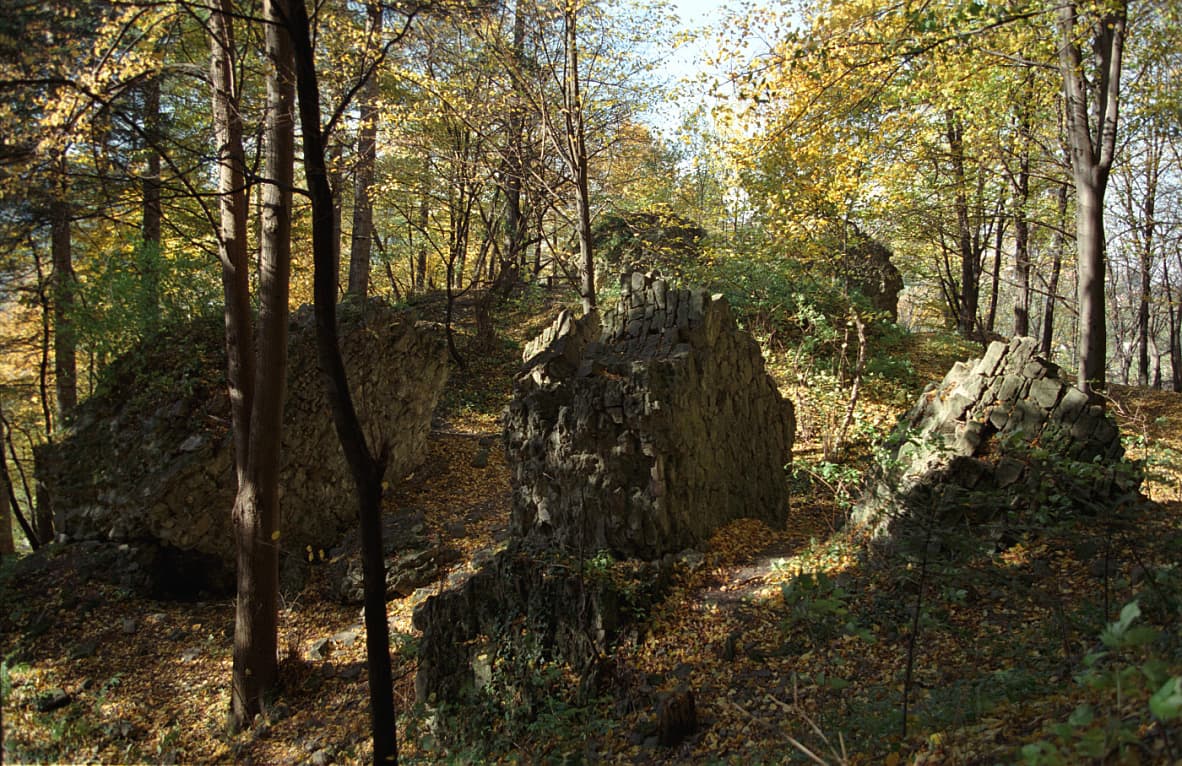
Situated on the right bank of the Raba River, on the slope of Ukleiny Hill known locally as Zamczysko, the ruins of Myślenice Castle stand as a testament to a mysterious medieval stronghold whose origins are shrouded in some uncertainty. Archaeological research has established that the fortress was initially constructed at the turn of the 13th and 14th centuries, although documentary evidence first mentions the castle in 1342. This earliest record refers to a customs chamber on the trade route connecting Kraków with Hungary, suggesting the castle's strategic importance and possible royal ownership, potentially commissioned by King Casimir the Great. Another theory proposes that the castle was built by Hanko, the first wójt (local mayor) of Myślenice.

Architectural features and layout of the original castle

The castle's most prominent feature was a cylindrical stone tower constructed from local sandstone. This tower had an external diameter of 10.2 meters, an internal diameter of 2.5 meters, and walls over 4 meters thick. It likely featured battlements and a conical roof covered with wooden shingles, typical of medieval defensive architecture. The tower was positioned at the edge of a promontory measuring approximately 50 by 60 meters, which was protected by two deep ditches with an earthen rampart between them. Adjacent to the tower, on the river side, lay an irregularly shaped bailey or courtyard about 11 by 17 meters in size.

So far, archaeological investigations have not uncovered other stone structures within the castle complex. It is presumed that any additional buildings, probably serving economic or domestic purposes, were made of wood and that the entire site was enclosed by a wooden palisade. This type of construction was common in medieval fortifications, where stone was reserved for the most critical defensive elements like towers and gatehouses.

Historical significance and decline

The castle likely remained in use until the mid-15th century. Historical chronicles, notably those by Jan Długosz, recount events from 1457 when Myślenice was seized by mercenary troops led by Kawka and the Świeborowski brothers. These forces demanded overdue pay for their campaigns in Prussia. King Casimir IV Jagiellon responded by sending royal troops, resulting in a skirmish during which the town of Myślenice was set ablaze. The absence of any mention of the castle in Długosz’s account suggests that by this time, the fortress had lost its military significance and may have already been in ruins.

The exact circumstances and timing of the destruction of the stone tower remain unclear. Some sources speculate that it was deliberately demolished around the turn of the 15th and 16th centuries on royal orders, as the castle had become a refuge for bandits who attacked merchants traveling the nearby trade route. However, this narrative is difficult to verify and may be part of local folklore that often associates abandoned castles with outlaw activity. Another hypothesis suggests that the tower was damaged in the 19th century by treasure hunters. Today, only substantial fragments of the stone walls remain, scattered across the hillside and overgrown with dense vegetation.

The new defensive manor and later developments

In 1513, Mikołaj Jordan reestablished the town of Myślenice, and his son Wawrzyniec Spytek Jordan, after assuming the office of wójt, constructed a large defensive manor known as the "New Castle". This manor was surrounded by a water-filled moat and a fence, located east of the town amidst marshlands near today's Żeromskiego Street. The manor served as a fortified residence rather than a traditional medieval castle.

By 1773, the manor had been abandoned and subsequently dismantled, with the site leveled. In the late 18th century, a new administrative building was erected on the former manor grounds using materials salvaged from the demolished manor. This building, constructed in the late Baroque style, featured a rectangular plan supported by massive buttresses at the corners. It underwent partial façade modifications around the turn of the 19th and 20th centuries and significant interior renovations in the 1970s. Today, this building at 13 Mikołaja Reja Street houses the offices of the Myślenice County authorities.

Archaeological and cultural importance

The site of the original Myślenice Castle is valuable for understanding the defensive strategies and settlement patterns in southern Poland during the High and Late Middle Ages. Its location on a natural promontory overlooking the Raba River exemplifies the medieval preference for elevated, easily defensible positions controlling important trade routes. Although only ruins remain, the castle's remnants provide insights into the use of local materials like sandstone and the architectural techniques employed in tower construction.

The later manor and administrative buildings reflect the evolution of fortification and domestic architecture from medieval to early modern periods, illustrating changes in military technology, social organization, and land management. The site's layered history from a medieval fortress to a Renaissance manor and finally to an administrative center mirrors broader regional historical trends.

Visiting Myślenice castle ruins today

Today, visitors to Myślenice can explore the ruins scattered on Ukleiny Hill, surrounded by woodland that adds to the site's atmospheric charm. While the castle no longer stands in its original form, the remains of the tower and defensive earthworks invite reflection on the area's turbulent past and its strategic role in Polish history. The nearby town of Myślenice offers additional cultural and historical attractions, making the castle ruins a worthwhile stop for those interested in medieval architecture and Polish heritage.

Frequently asked questions (FAQ)

What is the historical significance of Myślenice Castle?
Myślenice Castle, situated in the picturesque town of Myślenice, Poland, has a rich history that dates back to the Middle Ages. It served as a defensive structure and a royal residence, reflecting the architectural styles and social dynamics of its time.
When was Myślenice Castle built?
The exact date of construction is not definitively known, but Myślenice Castle is believed to have been established in the 14th century. It has undergone several renovations and restorations throughout the centuries, preserving its historical essence.
Can I visit Myślenice Castle?
Yes, visitors are welcome to explore Myślenice Castle and its surroundings. The castle offers guided tours that provide insights into its history and architecture, making it an enriching experience for all ages.
What are the opening hours of Myślenice Castle?
Myślenice Castle is typically open to visitors from 10 AM to 6 PM during the summer months, and from 10 AM to 4 PM in the winter. It is advisable to check the official website for any seasonal changes or special events.
Is it possible to access Myślenice Castle by public transport?
Yes, Myślenice Castle is accessible by public transport, including buses and trains that connect to the town of Myślenice. Once in the town, it is a short walk to the castle, making it convenient for visitors.
What is the best time to visit Myślenice Castle?
The best time to visit Myślenice Castle is during the spring and summer months when the weather is pleasant, and the surrounding gardens are in full bloom. Additionally, various cultural events and festivals often take place during this time, enhancing the visitor experience.
Are there any nearby attractions to Myślenice Castle?
Yes, several attractions are located near Myślenice Castle, including the beautiful landscapes of the Beskids Mountains and the scenic Myślenice Lake. Visitors can also explore local eateries and shops that reflect the culture of the region.
What are the ticket prices for Myślenice Castle?
Ticket prices for Myślenice Castle are generally affordable, with discounts available for students and seniors. It is recommended to check the official website for the most current pricing and any special offers.

Photo gallery

Myślenice
Click to view

Photo by Jerzy Strzelecki•CC BY-SA 3.0

1 photo • Click any image to view in full screen

Information

Bastioned Fortress

Loading map...

Visitor reviews

No reviews yet. Been here? Write the first review and help other travelers!

Write the first review

Visited this castle? Share your experience

Your review helps other travelers and adds first-hand knowledge to our encyclopedia.
Write a review

(5/5)

0/2000 characters

Your review will be visible after admin approval

Nearby castles

11.9 km
Dobczyce — Poland castle

Dobczyce

Dobczyce, Poland

Dobczyce Castle stands prominently on a rocky promontory overlooking the valley of the Raba River and the artificial Dobczyce Lake in southern Poland. This site has been a strategic defensive position since prehistoric times, with archaeological evidence revealing traces of Neolithic and Bronze Age settlements. The location’s natural fortifications were first harnessed during the reign of the early Piast dynasty, when a wooden fortification with palisades was constructed to guard the area. The castle’s upper fortress likely dates back to the early 13th century, with the first written mention appearing in 1225. Built on a triangular plan at the edge of a cliff, its buildings clustered tightly around a small inner courtyard. The key defensive feature was a square tower positioned at the southeast corner, which protected the original southern entrance. During the reign of Bolesław V the Chaste, the castle guarded an important trade route to Hungary and withstood two separate Tatar invasions, underscoring its military significance. Medieval origins and royal significance Dobczyce Castle played a notable role in medieval Polish history. In 1311, during the uprising led by the Kraków mayor Albert, the castle served as a refuge for the court of Władysław I Łokietek. King Casimir III the Great rewarded the town of Dobczyce with privileges for assisting his father, and in 1362 he granted Dobczyce Magdeburg rights, elevating its status and marking the castle as the seat of a non-fortified starostwo (administrative district) until 1768. Under Casimir the Great, the castle’s defenses were significantly enhanced, with walls ranging from five to nine meters thick, making it one of the most formidable fortresses in Poland. The castle became a royal residence, hosting King Władysław II Jagiełło and Queen Jadwiga in 1398. It also served as a place of education for the sons of King Casimir IV Jagiellon, where the historian and diplomat Jan Długosz tutored future monarchs. Renaissance transformation under the lubomirski family The castle’s most significant architectural transformation occurred between 1585 and 1649 under the stewardship of the noble Lubomirski family. They remodeled the medieval fortress into a splendid Renaissance residence. The original southern gate was sealed and converted into a chapel, and a new eastern entrance was created featuring a drawbridge, a fortified gatehouse with a bastion, and a clock tower. The lower castle was developed on the site of the former bailey, expanding the complex considerably. By 1620, the castle boasted around 70 rooms and three defensive towers, including the clock tower added by the Lubomirskis. The addition of a decorative fountain and the chapel reflected the shift from a purely military stronghold to a noble residence with representational functions. Destruction and decline in the 17th and 18th centuries In 1649, the starostwo passed to Michał Jordan, who undertook repairs on the castle walls. However, the mid-17th century brought devastation during the Swedish Deluge (1655), when both the town and castle were ravaged by Swedish forces. Further destruction followed in 1657 at the hands of Transylvanian troops under Rakoczy, and again in 1702 during another Swedish invasion led by King Charles XII. These successive assaults led to the castle’s rapid decline. Despite continued occupation by starosts, the fortress fell into ruin. The discovery of a hidden cache of coins and jewels in the late 18th century sparked treasure hunts that accelerated the dismantling of the structure. Stones from the castle were repurposed for local buildings, including a church, leaving the castle as a mound overgrown with grass and used as pasture for over a century. 20th-century restoration and archaeological work Restoration efforts began in earnest in 1960 as part of the "Milenium" campaign led by local enthusiasts from the Polish Tourist and Sightseeing Society (PTTK). Excavations uncovered the remains of both the upper and lower castles, though the western part of the hill had collapsed in the 19th century due to quarrying activities. The site was stabilized and partially reconstructed, with the ruins opened to visitors. Today, Dobczyce Castle is a protected historical monument featuring well-preserved sections of its massive defensive walls, the remains of the upper castle with its square and cylindrical towers, and parts of the lower castle. The restored towers serve as viewing platforms offering panoramic views of the surrounding Pogórze and Beskid mountain ranges and the adjacent Dobczyce Lake. Architectural features and layout The castle’s original medieval layout was defined by its triangular plan on a cliff edge, with buildings tightly grouped around a central courtyard. The impressive square tower at the southeast corner was the main defensive bastion, guarding the southern entrance. The castle’s walls, especially those from King Casimir III’s time, were extraordinary for their thickness, reaching up to nine meters, providing formidable protection against invaders. The Renaissance modifications introduced by the Lubomirski family added a new layer of fortifications typical of the period’s military architecture, including a bastioned gatehouse and a drawbridge. The addition of a clock tower and chapel reflected the castle’s evolution into a noble residence, balancing defense with comfort and prestige. Defensive structures Thick stone curtain walls up to nine meters thick, built in the 14th century. Square and cylindrical towers providing vantage points and flanking fire. Bastioned gatehouse with a drawbridge added in the Renaissance period. Deep moat separating the castle from the fortified town below. Residential and ceremonial spaces Chapel created by converting the original gatehouse in the late 16th century. Clock tower serving both practical and decorative functions. Fountain symbolizing the Renaissance emphasis on aesthetics and comfort. Approximately 70 rooms by the early 17th century, including chambers for royal and noble residents. Cultural and historical significance Dobczyce Castle is an important monument reflecting the evolution of Polish castle architecture from medieval fortifications to Renaissance residences. Its history is intertwined with key figures such as Władysław I Łokietek, Casimir III the Great, Władysław II Jagiełło, and the Lubomirski family. The castle’s resilience during invasions and its role as a royal residence and administrative center underscore its strategic and political importance. Today, the castle ruins serve as a cultural landmark and tourist attraction, offering insights into Polish history, architecture, and the region’s heritage. The site’s museum and viewing platforms provide visitors with educational and scenic experiences, preserving the legacy of this remarkable bastioned fortress. Visitor information and accessibility Dobczyce Castle is accessible to the public, with parts of the ruins stabilized and safe for exploration. The castle grounds include walking paths, informational signage, and panoramic viewpoints. The on-site Regional Museum operated by the PTTK offers exhibitions on the castle’s history and archaeological findings. Visitors can enjoy spectacular views of the Dobczyce Lake and surrounding mountain landscapes. The castle’s location near Kraków makes it a convenient day trip for those interested in medieval and Renaissance architecture, Polish history, and natural beauty.

Renaissance (15th–17th c.)
Details
17.2 km

Lanckorona

Lanckorona, Poland

Lanckorona Castle stands prominently on a conical hill north of the town of Lanckorona in southern Poland. This late medieval bastioned fortress was originally constructed in the mid-14th century under the reign of King Casimir III the Great (Kazimierz Wielki), a monarch renowned for his extensive fortification projects across the Kingdom of Poland. The castle's strategic location atop the hill allowed it to guard the border with the Duchy of Oświęcim, then a vassal to the Bohemian crown, and it served as a counterpart to the castle in Barwałd on the opposite side of the valley.The castle was founded on a leveled southwestern part of the summit, separated from the rest of the hill by a defensive ditch. Its original layout was a regular rectangular plan featuring two corner towers on the southern side. Early construction likely included wooden structures alongside a single stone residential building, reflecting typical medieval fortification practices where stone was reserved for the most critical defensive and residential elements.Early history and royal significanceBy 1410, under the rule of Władysław Jagiełło, Lanckorona was established as the seat of a non-fortified starosty (administrative district). The castle and its lands were granted as royal property to Zbigniew of Brzezie, the Grand Marshal of the Crown, in recognition of his contributions during the Battle of Grunwald, a pivotal conflict in Polish-Lithuanian history. Over the following centuries, the castle and starosty passed through the hands of several noble families, including the Lankoroński, Bekies, Zebrzydowski, Czartoryski, Myszkowski, and Wielopolski clans, reflecting its continued importance in regional governance and defense.Internal conflicts and siegesThe castle witnessed internal strife, notably after the death of starost Mikołaj Wolski. His widow engaged in a dispute with Olbracht Łaski, the voivode of Sieradz, who forcefully seized the castle in 1574. Although King Stefan Batory ruled in favor of the widow, it required military intervention to restore her control, underscoring the castle's strategic and symbolic value.Architectural evolution and military roleThrough successive reconstructions, Lanckorona Castle expanded into a complex featuring three residential wings enclosing an inner courtyard. The southern side was fortified with a shield wall reinforced by two corner towers, enhancing its defensive capabilities. Despite these fortifications, the castle fell victim to the Swedish invasion during the "Deluge" in 1655, suffering significant damage alongside the town below.Confederate strengthening and final siegeThe most dramatic phase in the castle's military history occurred during the Bar Confederation (1768-1772), when it was seized by confederate forces led by Maurycy Beniowski. With assistance from French military engineers, the castle was transformed into a modern bastioned fortress, featuring earthworks and a northern outwork with a pincers-shaped ("kleszczowy") fortification layout. This made it one of the two most important strongholds of the confederates, alongside the fortress in Tyniec.Following the confederates' defeat near Lanckorona in 1771, the castle endured a prolonged siege until June 8, 1772, when the Polish garrison surrendered. The victorious Austrian forces, who annexed the region during the partitions of Poland, occupied and severely damaged the fortress.Decline and present conditionAfter the partitions, the Lanckorona starosty became part of the Austrian partition. In 1777, the property was sold at a public auction to Franciszka Krasińska. Neglected and abandoned, the castle gradually fell into ruin. Today, only remnants of the towers, fragments of walls, and sections of the shield wall remain, offering a glimpse into its former military grandeur.Cultural and historical significanceLanckorona Castle's ruins stand as a testament to the complex political and military history of southern Poland. Its evolution from a royal medieval fortress to a bastioned stronghold during the 18th century reflects broader European military architectural trends and the turbulent history of the Polish-Lithuanian Commonwealth. The site continues to attract historians, archaeologists, and visitors interested in medieval fortifications and Polish heritage.Visitors today can explore the evocative ruins set against the picturesque landscape of the Lanckorona hill, gaining insight into the castle's layered history and architectural transformations over more than four centuries. The castle's remains, though fragmented, highlight the resilience and strategic importance of this hilltop bastion through Poland's medieval and early modern eras.

Late Medieval (14th–15th c.)
Details
19.6 km

Skawina

Skawina, Poland

Skawina castle is a historically significant fortress located in Skawina, Poland. Although now existing only as ruins, the site offers valuable insights into medieval fortifications and the region's history. According to the chronicles of Jan Długosz and Janko z Czarnkowa, the castle was originally constructed under the reign of King Casimir III the Great in the 14th century, near the town of Skawina. This strategic location was likely chosen due to its proximity to a customs chamber on the Skawinka River, which played a role in controlling trade and collecting tolls during the medieval period. Historical context and ownership The castle served as a seat for local administrators, known as the wójtów of Skawina, after the town passed into the ownership of the Tyniec Abbey following the death of King Casimir III. This transition reflects the common medieval practice of ecclesiastical institutions acquiring territorial control and administrative responsibilities. Over time, the castle's military and administrative importance diminished, leading to its decline. Architectural features and layout Archaeological excavations conducted in 1958 near a local school uncovered fragments of walls dating back to the 14th century. These findings, though limited, suggest that the castle was designed as a quadrilateral fortress with a prominent polygonal tower positioned at the southwest corner. Along the western curtain wall, there was likely a residential building serving the castle's inhabitants. The castle's defensive structures would have included thick stone walls and possibly bastions, typical of medieval fortifications designed to withstand sieges and control the surrounding territory. Bastioned fortress characteristics While the existing records and archaeological evidence are sparse, the classification of Skawina castle as a bastioned fortress aligns with the defensive architectural trends of the period. Bastions allowed for improved angles of fire and better protection against artillery, which became increasingly important in the late medieval and Renaissance eras. However, given the castle's probable construction in the 14th century and its decline by the late 17th century, it may have undergone modifications to adapt to evolving military technologies. Decline and current condition By the late 17th century, historical sources indicate that the castle was already in a state of ruin. Its strategic and administrative functions had ceased, and it eventually fell into disuse. In the early 18th century, the remaining structures were dismantled, leaving only archaeological traces. Today, the site is recognized as an important archaeological ruin, providing scholars and visitors a glimpse into the medieval fortifications of the region. Archaeological significance and preservation The discovery of the castle's foundations and wall fragments has been crucial in piecing together the history of Skawina and its fortifications. Although the castle no longer stands above ground, the site continues to be a focus for archaeological study, helping to illuminate the architectural and historical development of medieval Poland. Preservation efforts emphasize protecting the ruins and making the site accessible for educational purposes. Visiting Skawina castle ruins Visitors to Skawina can explore the area where the castle once stood, appreciating its historical significance despite the absence of standing structures. The site is accessible and offers a unique opportunity to connect with Poland's medieval past. Nearby attractions include the town of Skawina itself, with its rich cultural heritage and historical landmarks. Frequently asked questions about Skawina castle When was Skawina castle built? The castle was likely constructed in the 14th century during the reign of King Casimir III the Great. What remains of Skawina castle today? Today, only archaeological ruins and fragments of the original walls remain at the site. Can visitors access the castle ruins? Yes, the ruins are accessible to the public, though no standing structures remain. Why was the castle built near the Skawinka River? Its location was strategic for controlling trade and customs duties on the river. What type of castle was Skawina? It was a bastioned fortress, typical of medieval defensive architecture.

Renaissance (15th–17th c.)
Details

