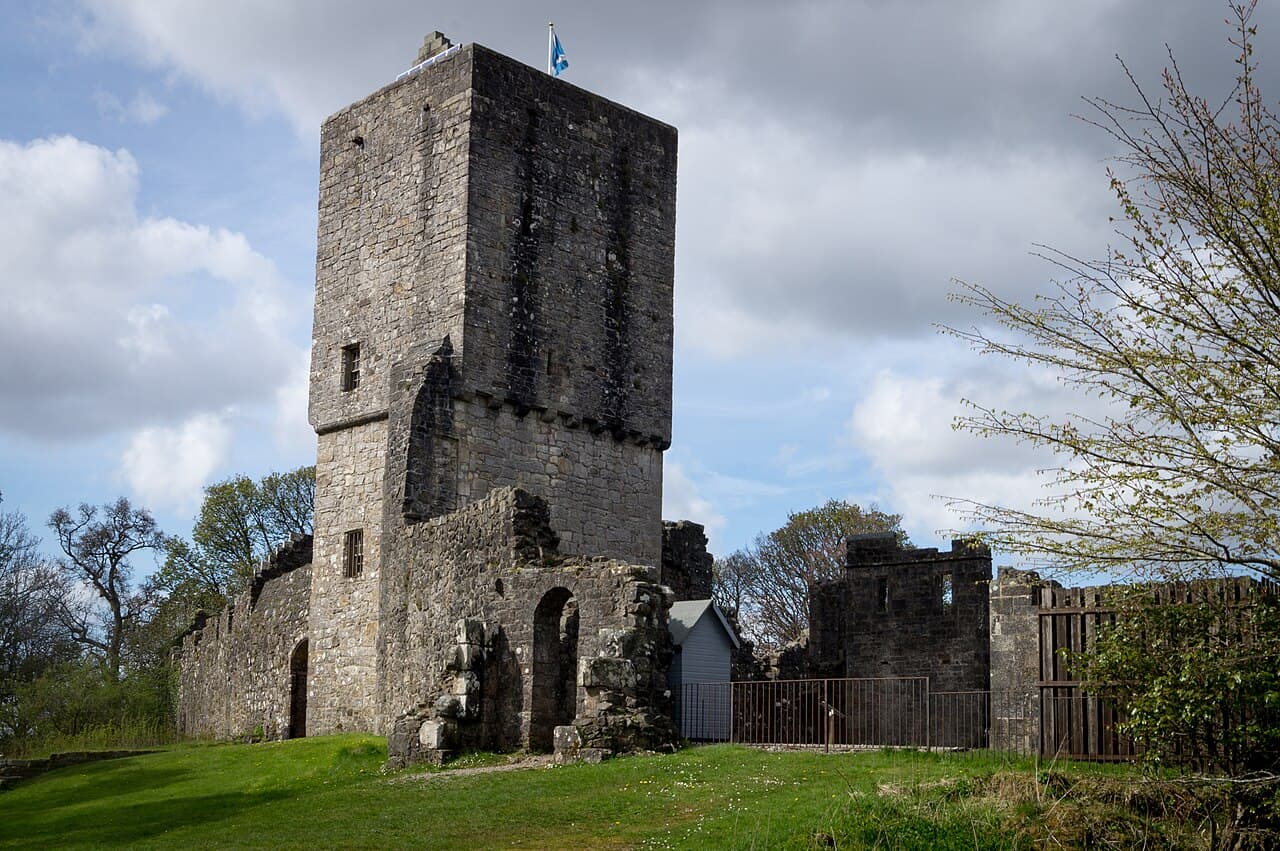
Mugdock Castle
Mugdock Castle stands as a remarkable example of a late medieval hill castle perched atop a natural mound of volcanic rock near Strathblane, Scotland. It was the ancestral seat of the Clan Graham, whose influence in Scottish history is reflected in the castle's architectural evolution and turbulent past. The castle's origins trace back to the mid-13th century when the lands were acquired by David de Graham of Dundaff from the Earl of Lennox, marking the beginning of the Grahams' long association with Mugdock.
The castle itself was likely constructed around 1372 by Sir David de Graham or his son, serving as a fortified residence and stronghold. Its strategic location on a steep-sided mound provided natural defenses, augmented by constructed curtain walls and towers arranged in a distinctive shield-shaped plan. The most intact surviving structure is the four-storey south-west tower, notable for its vaulted basement and corbelled upper stories that project outward, giving it a unique "top-heavy" silhouette. This tower, with its elevated first-floor entrance accessed by external steps, exemplifies medieval defensive architecture combined with residential functionality.
Historical significance and clan graham legacy
The elevation of the lands to the Barony of Mugdock in 1458 marked the growing prominence of the Grahams in Scottish nobility. By 1505, the family had been ennobled as the Earls of Montrose, further cementing their status. Mugdock Castle became intertwined with significant political and military events, especially during the 17th century. James Graham, the 1st Marquess of Montrose, possibly born at Mugdock around 1612, played a pivotal role in the Wars of the Three Kingdoms. Initially a Covenanter opposing royal interference in the Church of Scotland, Montrose later led a Royalist uprising, reflecting the complex allegiances of the period.
The castle endured two major attacks during these conflicts: first in 1641 when Lord Sinclair seized it during Montrose's imprisonment, and again in 1644 amid Montrose's Royalist resurgence. After Montrose's execution in 1650, the estate was confiscated and transferred to the rival Marquess of Argyll, who was executed in 1661. Subsequently, the castle returned to the Grahams, who undertook significant repairs and added a mansion within the defensive walls.
Architectural evolution and castle layout
Original medieval structures
The initial castle likely featured a courtyard enclosed by curtain walls with several towers positioned around it, including the prominent south-west tower. The castle's plan was shield-shaped, optimizing defense and residential space. The basement of the north-west tower and parts of the gatehouse also survive, providing insight into the castle's original fortified design.
15th and 16th-century expansions
In the mid-15th century, an outer defensive wall was constructed to enclose most of the mound, creating an outer courtyard with its main entrance to the south near the south-west tower. Within this courtyard are the ruins of various stone buildings dating mainly from the 16th century, including a chapel at the northern end and a domestic range to the south-west. The southern section of the outer curtain wall remains partially intact, although much has been lost over time.
19th-century developments and later history
During the 1820s, the estate was enhanced with a terraced walled garden and a summer house to the east of the castle, reflecting changing tastes and domestic needs. In the late 19th century, John Guthrie Smith, a local historian and relative of the Smith family of nearby Craigend Castle, leased the property. He demolished the 17th-century mansion and commissioned a new house in the Scottish Baronial style, designed by architects Campbell Douglas & Sellars. This new L-shaped mansion was integrated with the medieval ruins, connected to the south-west tower by a covered passage spanning a deep-arched bridge.
James Sellars later extended the house in the 1880s, blending Victorian architectural elements with the medieval remains. However, a devastating fire in 1966 destroyed much of the Victorian house and remaining 16th-century outbuildings, leaving the site largely in ruins.
Modern preservation and public access
Following the fire, the estate was purchased by Hugh Fraser in 1945, and in 1981 it was donated to Central Regional Council by Sir Hugh Fraser. The site was transformed into Mugdock Country Park, a public amenity that preserves the castle ruins and surrounding landscape. The south-west tower was restored and repurposed as a museum, offering visitors a direct connection to the castle's medieval heritage.
Mugdock Castle is now a legally protected scheduled monument, recognized for its architectural and historical significance. The castle's layered history from medieval fortress to Victorian mansion ruins provides a rich narrative of Scotland's feudal past, clan dynamics, and evolving architectural styles.
Architectural features and defensive elements
The castle's strategic position on a volcanic mound provided natural defenses, enhanced by the construction of curtain walls, towers, and a gatehouse. The south-west tower's vaulted basement and corbelled upper floors exemplify medieval military architecture designed to maximize defense while accommodating residential needs. The external steps leading to the first-floor entrance were typical of the period, improving security by limiting direct ground-level access.
The 15th-century outer courtyard and additional defensive walls reflect the castle's adaptation to changing military technology and social requirements. The inclusion of a chapel and domestic ranges within the outer courtyard illustrates the castle's role as both a fortress and a noble residence.
Visitor information and cultural significance
Today, visitors to Mugdock Castle can explore the ruins within Mugdock Country Park, enjoying the blend of natural beauty and historical architecture. The restored south-west tower museum provides interpretive displays about the castle's history and the Graham family. The park also offers walking trails, gardens, and scenic views of the surrounding landscape.
Mugdock Castle remains a poignant symbol of Scotland's feudal heritage and the enduring legacy of Clan Graham. Its architectural remnants and landscape setting continue to attract historians, architects, and tourists interested in medieval fortifications and Scottish history.
Frequently asked questions (FAQ)
- What is the historical significance of Mugdock Castle?
- Mugdock Castle is a 15th-century castle that showcases the rich history of Scotland. It served as a stronghold for the Mugdock family and has connections to various Scottish historical events, making it an important site for understanding the region's past.
- When was Mugdock Castle built?
- Mugdock Castle was constructed in the late 15th century, with its foundations believed to have been laid around 1450. Over the centuries, it has undergone various renovations, reflecting the architectural styles of the different eras it has witnessed.
- Can I visit Mugdock Castle?
- Yes, Mugdock Castle is open to visitors, allowing you to explore its historic grounds. Visitors can enjoy guided tours that provide insights into the castle's history and architecture, making it a delightful experience for history enthusiasts.
- What are the opening hours for Mugdock Castle?
- Mugdock Castle typically opens to visitors from 10 AM to 5 PM, but hours may vary depending on the season or special events. It is advisable to check the official website or contact the castle directly for the most accurate information before planning your visit.
- Is it possible to access Mugdock Castle for individuals with disabilities?
- Mugdock Castle is committed to making its grounds accessible to all visitors. While some areas may be challenging due to the castle's historical structure, there are paths and facilities designed to assist individuals with disabilities.
- What is the best time to visit Mugdock Castle?
- The best time to visit Mugdock Castle is during the spring and summer months when the weather is milder, and the gardens are in full bloom. Additionally, many special events and activities take place during this time, enhancing your experience.
- Are there any nearby attractions to visit along with Mugdock Castle?
- Yes, Mugdock Country Park is located nearby, offering beautiful walking trails, picnic areas, and stunning natural scenery. The park provides an excellent opportunity for outdoor activities and complements your visit to the castle.
- What are the ticket prices for Mugdock Castle?
- Ticket prices for Mugdock Castle are generally very affordable, with discounts available for children, seniors, and families. It's best to check the castle's official website for the most up-to-date pricing information and any special offers.
Photo gallery

Information
Loading map...
Visitor reviews
No reviews yet. Been here? Write the first review and help other travelers!
Write the first reviewVisited this castle? Share your experience
Your review helps other travelers and adds first-hand knowledge to our encyclopedia.



