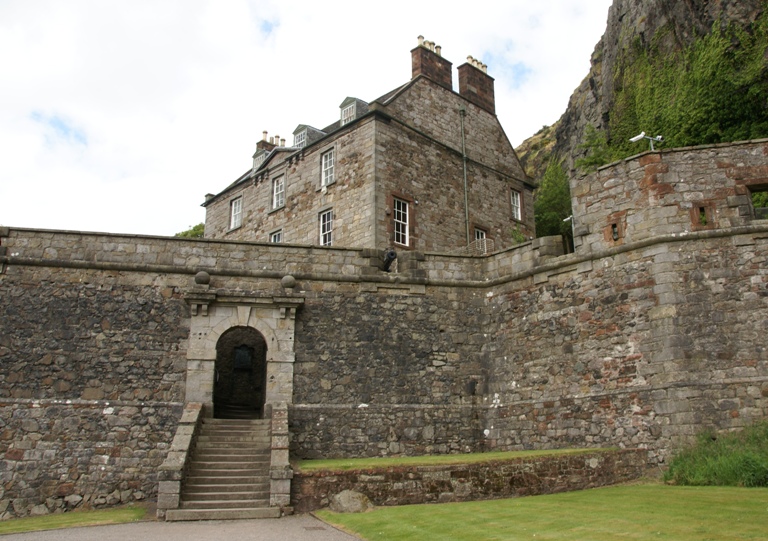
Dunglass Castle

Dunglass Castle in West Dunbartonshire, Scotland
Late Medieval (14th–15th c.)

Dunglass Castle is a late medieval fortress located in West Dunbartonshire, Scotland. Constructed around 1400, the castle stands today in a ruinous state, offering a glimpse into Scotland's turbulent medieval past. The remains include a large section of high wall, rising to approximately 7–8 metres in height, which showcases a blend of original masonry and later repairs.

Architectural features and layout

The castle's walls form a defensive enclosure typical of the period, with thick stone construction designed to withstand sieges. Notably, a small conical dovecot once stood on the south wall, a feature common in Scottish castles for housing pigeons, though it is now completely ruined. Near the west end of the wall, outside the south perimeter, there is a small landing place that appears to have been protected by a hoarding—a wooden defensive structure projecting from the walls. Some of the corbels that supported this hoarding remain visible, providing insight into the castle's defensive arrangements.

Later additions and structures

At the north-west corner of the castle's enclosure lies a dwelling house that incorporates older elements, possibly dating back to around 1590. However, much of this structure is modernized internally. Additionally, a round tower on the site, likely from the 17th century, served as a pigeon house or dovecot, reflecting the castle's adaptation to changing needs over time.

Historical context and changes

The castle was originally built during the early 15th century and underwent various modifications through to the mid-16th century. In 1735, much of the castle and courtyard stone was removed by order of the Commissioners of Supply to repair the nearby quay, significantly contributing to its current ruinous state. This removal of stone was a common practice in Scotland where disused castles provided convenient building materials for local infrastructure projects.

Significance and preservation

While Dunglass Castle no longer functions as a fortress or residence, its remains are valuable for understanding the architectural and defensive strategies of late medieval Scottish castles. The surviving walls and structural remnants allow historians and visitors to appreciate the scale and complexity of such fortifications. The castle's location in West Dunbartonshire situates it within a region rich in medieval history, contributing to Scotland's cultural heritage.

Frequently asked questions (FAQ)

How do I get to Dunglass Castle?
Dunglass Castle is located in Bowling, United Kingdom. It is easily accessible by car, with parking available nearby, and is also reachable via public transportation, with local bus services connecting to the area. For those traveling from Glasgow, the journey takes approximately 30 minutes by car.
What is the historical significance of Dunglass Castle?
Dunglass Castle dates back to the 16th century and is a prime example of Scottish baronial architecture. It has a rich history that includes serving as a residence for the influential Argyll family. The castle has witnessed significant events in Scottish history, making it an important cultural landmark.
When was Dunglass Castle built?
Dunglass Castle was constructed in the late 1500s, with significant renovations occurring over the centuries. Its architectural style reflects the changing tastes of the times, showcasing features typical of the Renaissance period. The castle remains a testament to the historical evolution of Scottish architecture.
Can I visit Dunglass Castle?
Currently, Dunglass Castle is not open to the public for tours due to its private ownership and ongoing preservation efforts. However, visitors can admire the exterior from designated viewpoints and enjoy the surrounding scenic landscape. It's advisable to check local resources for any upcoming public events or open days.
Why is Dunglass Castle a popular attraction?
Dunglass Castle is popular for its stunning architectural features and dramatic location overlooking the River Clyde. Visitors are drawn to its historical significance and picturesque scenery, making it a favored spot for photographers and history enthusiasts. The castle's romantic ruins add to its allure, creating a captivating experience for all who visit.
Is it possible to hold events at Dunglass Castle?
While Dunglass Castle is primarily a private residence, certain events may be held on the grounds with appropriate permissions. It is recommended to contact the current owners or management for specific inquiries regarding private hire and events. The beautiful setting makes it an unforgettable venue for special occasions.
What are the best times to visit Dunglass Castle?
The best times to visit Dunglass Castle are during the spring and summer months when the weather is milder and the surrounding gardens are in full bloom. This period typically offers the most picturesque views and pleasant conditions for outdoor photography. Autumn can also be beautiful with the changing leaf colors, but always check local weather forecasts.
What are the opening hours for Dunglass Castle?
Dunglass Castle is not open for regular public tours, so it does not have specific opening hours. Visitors interested in viewing the castle should look for special events or public access days that may be announced. It’s best to stay updated through local tourism websites for any changes or opportunities to visit.
Are there any nearby attractions to Dunglass Castle?
Yes, there are several attractions near Dunglass Castle, including the scenic Clyde Muirshiel Regional Park, which offers hiking and outdoor activities. The nearby village of Bowling is also charming, featuring waterfront views and local dining options. Additionally, the bustling city of Glasgow is just a short drive away, offering a wealth of cultural experiences.
What are the ticket prices for Dunglass Castle?
As Dunglass Castle is not regularly open to the public, there are no standard ticket prices. Any events or special openings that allow public access will have their own pricing, which can be found on local event listings. It’s advisable to check ahead for any specific events that may offer a ticketed entry.

Loading map...

Visitor reviews

No reviews yet. Been here? Write the first review and help other travelers!

Write the first review

Visited this castle? Share your experience

Your review helps other travelers and adds first-hand knowledge to our encyclopedia.

Write a review

(5/5)

0/2000 characters

Your review will be visible after admin approval

Nearby castles

3.9 km

Dumbarton Rock

Dumbarton, United Kingdom

Dumbarton Rock is a striking geological and historical landmark located on the banks of the River Clyde in Scotland. This imposing 240-foot-tall volcanic basalt plug has served as a natural fortress for millennia, shaping the region's history from ancient times through the Georgian era. Its unique geological formation and strategic position have made it a coveted stronghold throughout Scottish history. Geological and strategic significance The rock itself is a rare example of a volcanic plug, formed from hardened magma that resisted erosion while the surrounding softer rock wore away. This geological feature provided a naturally defensible position, rising sharply above the surrounding landscape and the river. Its elevated vantage point allowed for extensive views over the Clyde estuary, making it an ideal location for defense and control of river traffic. Because of this natural advantage, Dumbarton Rock became a focal point for human settlement and military fortification from prehistoric times. Its position at the confluence of the River Clyde and the River Leven made it a strategic gateway to the interior of Scotland, controlling access to the western lowlands. Ancient stronghold and the kingdom of strathclyde The site was the center of the ancient kingdom of Strathclyde, known in early medieval sources as Alt Clut (meaning "rock of the Clyde"). This kingdom was one of the major Brittonic realms in post-Roman Britain, and Dumbarton Rock served as its royal fortress and capital. Archaeological evidence and historical records indicate that the fortress at Dumbarton was heavily fortified with strong stone walls and defensive structures by the early medieval period. The rock's natural defenses were augmented by man-made battlements and ramparts, creating a formidable bastioned fortress that could withstand sieges. The fortress was a cultural and political hub, hosting rulers and serving as a symbol of power for the kingdom. It was also a target for various invaders, including the Vikings, who famously raided the fortress in the 9th century. The Viking siege in 870 AD was a significant event, resulting in the capture and destruction of the fortress, which marked a turning point in the region's history. Medieval and renaissance history Following the Viking era, Dumbarton Rock continued to play an important role in Scottish history. It was used as a royal residence and military stronghold throughout the medieval period. Notably, Sir William Wallace, a key figure in the First War of Scottish Independence, was imprisoned here in the early 14th century, underscoring the fortress's continued strategic importance. In the 16th century, the rock's fortress was a royal refuge for Mary, Queen of Scots, who stayed there briefly as a child before her journey to France in 1548. This period saw the fortress adapting to changing military technologies and political circumstances. Georgian military architecture and later history By the 18th century, Dumbarton Rock underwent significant redevelopment to become a modern bastioned fortress reflecting contemporary military architectural principles. The Georgian era fortifications included extensive stone walls, bastions, and artillery placements designed to defend against artillery and naval threats. This transformation illustrates the rock's enduring military significance, adapting through centuries from a natural fortress to a sophisticated bastioned fortress. The site remained active in military use well into the 19th century. Cultural legacy and notable visitors The rock's rich history has attracted numerous notable figures and inspired legends. According to local legend, Saint Patrick was thwarted by the Devil throwing the rock at his boat as he left Scotland for Ireland, a tale that highlights the cultural significance of the rock in Celtic folklore. The legendary wizard Merlin is said to have stayed at the fortress when it was known as Alt Clut, adding a layer of mythic allure to its history. The poet William Wordsworth and his wife visited in 1803, drawn by the site's dramatic landscape and historical resonance. Today, Dumbarton Rock stands as a symbol of Scotland's layered history, from ancient kingdoms to Georgian military innovation. It is a protected heritage site, attracting visitors interested in geology, history, and military architecture. Visiting dumbarton rock Visitors to Dumbarton Rock can explore the extensive remains of the fortress, including the bastioned walls and remnants of earlier medieval structures. The site offers panoramic views of the River Clyde and surrounding countryside, making it a popular destination for history enthusiasts and hikers alike. Interpretive signage and guided tours provide insights into the site's complex history, from its volcanic origins to its role in Scottish national identity. The rock's accessibility and striking presence continue to captivate visitors, ensuring its place as a cherished landmark.

Details
4.5 km
Dumbarton Castle — United Kingdom castle

Dumbarton Castle

Dumbarton, United Kingdom

Dumbarton Castle stands as one of the most historically significant fortresses in Scotland, boasting the longest recorded history of any stronghold in the country. Perched atop Dumbarton Rock, a volcanic plug rising 240 feet (73 meters) above the surrounding landscape, the castle commands a strategic position overlooking the confluence of the River Clyde and River Leven. This natural elevation has made the site a crucial defensive and political center for over 1,500 years. The site was originally known as Alt Clut, meaning "Rock of the Clyde" in the Brythonic language, serving as the capital of the early medieval British kingdom of Strathclyde from the 5th century until 1018. The Gaelic name Dun Breatann, meaning "Fortress of the Britons," later evolved into the modern name Dumbarton. Throughout its history, Dumbarton Castle has witnessed numerous sieges, battles, and transformations, reflecting the shifting political and military landscape of Scotland and the British Isles. Early medieval significance and sieges The fortress's origins date back to at least the Iron Age, with archaeological evidence indicating early settlement and trade connections, including contact with the Romans. Its first recorded mention appears in a late 5th-century letter from Saint Patrick to King Ceretic of Alt Clut. During the early medieval period, Dumbarton Castle was the political and military heart of the Brythonic kingdom of Strathclyde. In 756, the castle endured an attack by a combined force of Picts and Northumbrians. The most devastating siege occurred in 870 when Viking leaders Amlaíb Conung and Ímar besieged the fortress for four months. The Vikings cut off the castle's water supply, forcing its surrender. The raid resulted in the capture of many inhabitants and the looting of treasure, marking a significant turning point in the site's history. Medieval royal fortress and strategic importance After the Viking siege, the site declined in prominence until the 13th century when it was redeveloped as a royal fortress by Alexander II of Scotland around 1220. This reconstruction aimed to defend against threats from the Norwegian kings who controlled the Hebrides and nearby islands. At the time, the Norwegian frontier was only 16 kilometers downriver, making Dumbarton a vital border stronghold. The castle played a role in the Wars of Scottish Independence. It is believed that William Wallace was briefly imprisoned here in 1305 before his transfer to London. The Wallace Tower within the castle is thought to commemorate his legacy. The fortress also served as a refuge for Scottish royalty, including David II in 1333–34 and Mary Queen of Scots in 1548, who both sought safety here before fleeing to France. Naval base and royal residence Under the reign of James IV (1488–1513), Dumbarton Castle became a significant naval base on Scotland's west coast. James IV used the castle as a staging ground for campaigns in the Western Isles and commissioned the construction of ships nearby, highlighting the site's maritime importance. The castle also housed a parish church and a college where royal religious services such as Evensong were held, blending military and ecclesiastical functions. In 1503, the castle was granted to Margaret Tudor, wife of James IV, further cementing its status as a royal residence. The castle safeguarded important artifacts, including the sword of William Wallace, which was repaired there in 1505, underscoring its symbolic significance in Scottish history. Architectural features and fortifications Dumbarton Castle's location atop a volcanic plug provided formidable natural defenses. The steep basalt cliffs made direct assault difficult, while the castle's fortifications evolved over centuries to withstand various military threats. Although little remains of the original Dark Age fortress, the medieval and later artillery fortifications are prominent today. The castle's layout adapted to the rock's contours, resulting in a compact fortress with multiple defensive layers. The surviving structures include thick curtain walls, bastions, and artillery platforms built primarily during the 17th and early 18th centuries. These adaptations reflect the transition from medieval to early modern military architecture, emphasizing cannon defense. Religious and cultural elements Within the castle grounds stood a parish kirk and a college, indicating the site's dual role as both a military stronghold and a center for religious observance. Royal services such as Evensong linked the fortress to the spiritual life of the kingdom. The presence of these buildings highlights the castle's importance beyond purely military functions. Later history and modern significance In later centuries, Dumbarton Castle continued as a key garrison fortress. It was involved in various military actions, including its last known military use during the Second World War. The castle's strategic location remained relevant well into the modern era. Today, Dumbarton Castle is a popular historic site open to the public. Visitors can explore the extensive fortifications, enjoy panoramic views of the town of Dumbarton and the Clyde estuary, and learn about the castle's rich history spanning from the Iron Age through medieval and modern times. The castle's enduring legacy as a symbol of Scottish resilience and heritage makes it a significant cultural landmark. Its combination of natural defenses, historic architecture, and storied past continues to attract historians, tourists, and castle enthusiasts alike.

High Medieval (11th–13th c.)
Details
10 km

Kilmahew Castle Ruins

Argyll and Bute, United Kingdom

Kilmahew Castle stands as a significant historical site in Argyll and Bute, Scotland, with origins tracing back to lands granted around 1290 by Malcolm, Earl of Lennox to the Napier family. The castle itself, a 16th-century four-storey tower house, was the ancestral home of the Napiers for eighteen generations. This family is notable for their extensive lineage, including many descendants who emigrated to North America and made substantial contributions to engineering and other fields.The Napier family and early historyThe Napier family's association with Kilmahew began in the late 13th century, when Malcolm, Earl of Lennox, granted the lands. The castle's construction in the 16th century marked the establishment of a fortified residence typical of Scottish tower houses of the period. These structures were designed both for defense and as symbols of noble status. The Napiers maintained ownership of the estate for nearly 400 years, during which time the castle evolved to meet changing needs.Legacy and lineageOne of the most prominent Napier descendants was John Napier, the mathematician credited with inventing logarithms, although direct familial ties to Kilmahew's Napiers are part of broader clan history. The Kilmahew branch of the family played a significant role locally, with their coat of arms preserved through heraldic quarterings by the Noble family of Ardmore, who represent the Napier legacy in heraldry today.Architectural features and modificationsThe original castle was a tower house built in the 16th century, featuring four storeys and typical defensive elements such as thick stone walls and narrow windows. The design reflects the High Medieval style transitioning into the Renaissance period, incorporating both military and residential functions.18th-century alterationsIn 1744, the castle underwent significant modifications attributed to the architect John Douglas. These alterations likely included updates to the castle's interiors and structural reinforcements, reflecting the evolving architectural tastes and the reduced need for military defense in that era.19th-century gothic revival influencesDuring the 19th century, under the ownership of Alexander Sharp, the castle saw the addition of Gothic-style modifications. These changes introduced characteristic features such as pointed arches, decorative battlements, and other romanticized medieval elements typical of the Gothic revival movement. This period's alterations contributed to the castle's picturesque ruinous appearance today.Ownership transitions and estate historyFollowing the Napier lineage, the estate passed to George Maxwell of Newark and Tealing in 1694, who adopted the Napier name but left no legitimate heirs. The estate was later claimed by an illegitimate daughter, Jean Smith, who married David Brydie. Financial difficulties led to the sale of the property to Alexander Sharp in 1820 to settle gambling debts.In 1839, James Burns of Bloomhill acquired the estate. He was the son of Rev. Dr. John Burns and died at the castle in 1871. The castle and surrounding lands were eventually acquired by the Archdiocese of Glasgow in 1948, marking a new chapter in the site's custodianship.Current condition and cultural significanceToday, Kilmahew Castle remains a ruined structure, with its imposing tower house silhouette still visible amid the landscape. The ruins provide valuable insight into Scottish tower house architecture and the history of the Napier family. The site attracts visitors interested in medieval architecture, Scottish history, and genealogy.Despite its ruinous state, the castle's remnants display elements from its original 16th-century construction, 18th-century modifications, and 19th-century Gothic revival enhancements. Preservation efforts focus on maintaining the structural integrity of the ruins and interpreting the site's layered history for educational and cultural purposes.

High Medieval (11th–13th c.)
Details