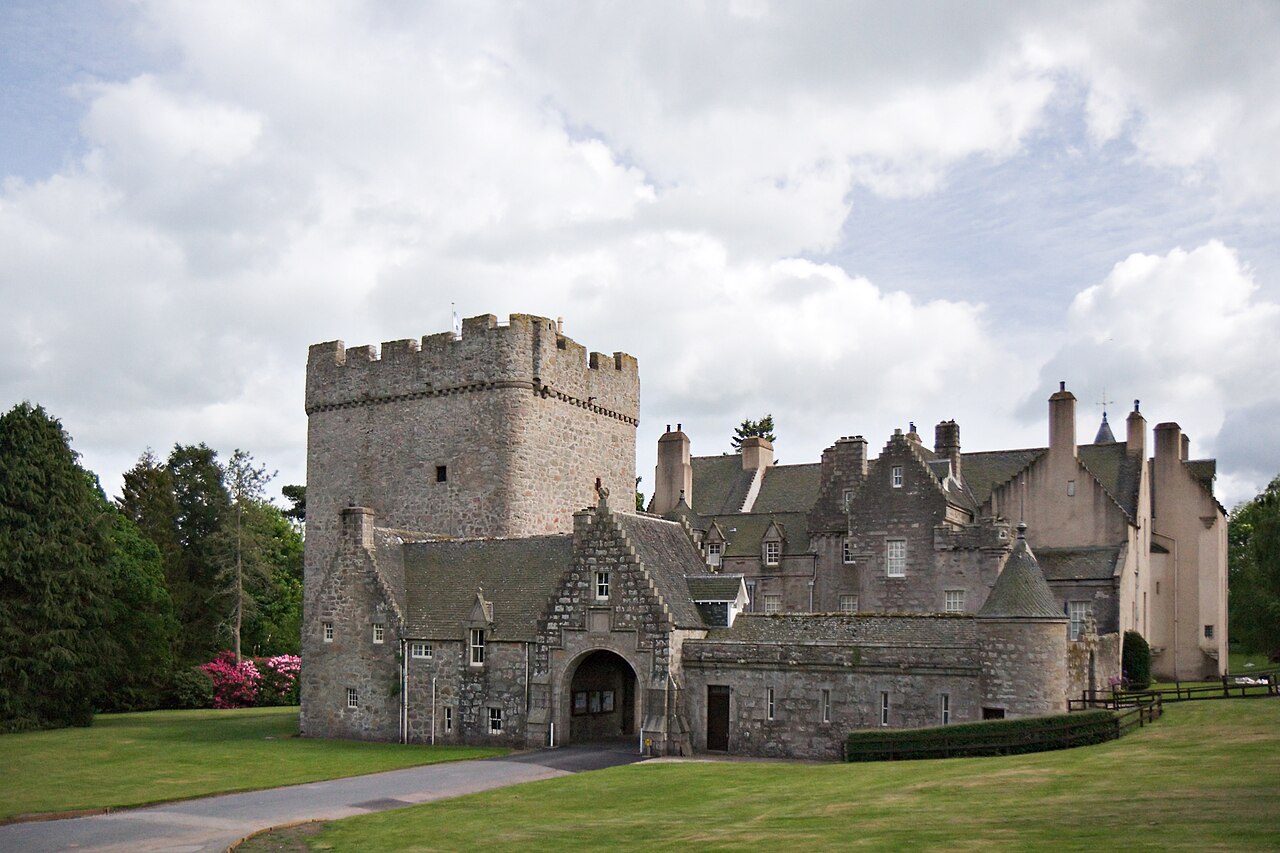
Muchalls Castle
Muchalls Castle is a remarkable historic site located in the countryside of Kincardine and Mearns, overlooking the North Sea in northeast Scotland. This castle uniquely combines architectural elements from the 13th century and the 17th century, reflecting centuries of Scottish history and noble lineage. The castle's origins lie in a well-preserved Romanesque double-groined towerhouse constructed in the 13th century by the Frasers of Muchalls, a prominent Scottish family of the High Medieval period. This original towerhouse forms the lower courses of the present-day structure, showcasing early medieval defensive architecture with its robust stone walls and characteristic groined vaulting.
Evolution from medieval towerhouse to 17th-century castle
In the early 17th century, the castle underwent significant expansion and transformation under the ownership of the Burnett family of Leys. Alexander Burnett initiated the construction of what would become the current four-storey castle, built atop the existing medieval towerhouse. His son, Sir Thomas Burnett, 1st Baronet, completed the work in 1627. The resulting structure is designed in the classic L-plan style, typical of Scottish castles of that era, with an additional extension wing at the west end. This architectural style combines both residential comfort and defensive features, including thick stone walls, narrow windows, and battlemented parapets.
Architectural highlights and interior features
Muchalls Castle is particularly renowned for its elaborate plasterwork ceilings in the principal drawing rooms, which date to 1624. These ceilings are considered among the finest examples of plasterwork in Scotland, preserved in virtually perfect condition. The intricate designs feature the heraldry of the Burnett of Leys family, intertwined with the coats of arms of allied families and biblical iconography. This decorative program reflects the social status and religious affiliations of the Burnett family during a period of significant political and religious upheaval in Scotland.
The Great Hall contains a notable overmantel above the fireplace, which displays the arms of King James VI flanked by striking Egyptianesque figures. This unique artistic element highlights the Renaissance influences permeating Scottish noble residences in the early 17th century, blending traditional heraldry with exotic motifs.
Historical significance and events
Muchalls Castle holds an important place in Scottish national history. In 1638, it was the site of a significant Covenanter gathering, a pivotal event in the religious and political conflicts that eventually led to the English Civil War. The Covenanters were Scottish Presbyterians who opposed attempts by the monarchy to impose Anglican practices, and their meetings at Muchalls Castle helped to galvanize resistance to royal authority.
The castle's strategic location near the North Sea and its robust construction made it a key site during turbulent times in Scotland's history. Over the centuries, it has remained a symbol of the region's noble heritage and religious struggles.
Preservation and current status
Today, Muchalls Castle is well preserved, with much of its original medieval and early modern fabric intact. Visitors can appreciate the blend of Romanesque defensive architecture and 17th-century Renaissance decorative arts. The castle's condition allows for detailed study of Scottish castle design evolution from the High Medieval period through the early modern era.
Its combination of historical, architectural, and artistic significance makes Muchalls Castle a valuable cultural landmark in northeast Scotland, attracting historians, architects, and tourists interested in Scotland's rich heritage.
Frequently asked questions (FAQ)
- When was Muchalls Castle originally built?
- Muchalls Castle was originally constructed in the 13th century as a Romanesque towerhouse by the Frasers of Muchalls.
- What architectural style characterizes Muchalls Castle?
- The castle features a Romanesque 13th-century towerhouse base with a 17th-century L-plan extension reflecting Renaissance influences.
- What is special about the plasterwork ceilings at Muchalls Castle?
- The plasterwork ceilings, dating to 1624, are among the finest in Scotland, featuring heraldry and biblical iconography in excellent condition.
- What historical event is associated with Muchalls Castle?
- In 1638, Muchalls Castle hosted a significant Covenanter gathering, an important precursor to the English Civil War.
- Is Muchalls Castle open to visitors?
- Visiting information is limited; potential visitors should check local resources or heritage organizations for access details.
Information
Loading map...
Visitor reviews
No reviews yet. Been here? Write the first review and help other travelers!
Write the first reviewVisited this castle? Share your experience
Your review helps other travelers and adds first-hand knowledge to our encyclopedia.