Moy Castle
Moy Castle stands as a remarkable example of a 15th-century Scottish tower house located on the Isle of Mull, Scotland. Perched on a rocky outcrop near Lochbuie, this hill castle was the hereditary stronghold of the Clan Maclean of Lochbuie. Its strategic position and robust construction highlight the defensive and residential needs of Scottish clans during the late medieval period.
The castle was initially built in the early 15th century by John Maclean, the third Laird of Lochbuie, and completed by his son, Hector Reaganach Maclean, the fourth Laird. The lands were granted to Hector Reaganach Maclean in 1360, marking the beginning of the Macleans' tenure in the area. Moy Castle's first documented mention appears in a royal charter from 1494, confirming ownership under the Lord of the Isles. Over the centuries, the castle witnessed significant historical events, including clan conflicts and political upheavals.
Architectural features and layout
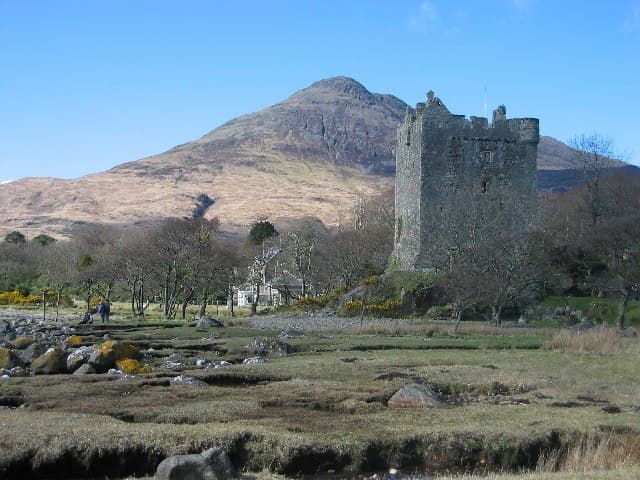
The castle is a classic Scottish tower house with a nearly square footprint measuring about 10.7 meters on each side and rising to approximately 17.5 meters high. It comprises three main floors plus a garret, which is a small attic space beneath the roof. The walls are constructed of local stone and stand largely intact to the gables, showcasing the durability of medieval masonry techniques.
One of the castle's most notable defensive features is its crenellated parapet, a battlemented wall at the top of the tower designed for protection during attacks. Two cap-houses sit atop the tower, providing access to the roof and serving as lookout points. Surrounding the castle on the northwest side are the remains of a rocky ditch, which functioned as a natural defensive barrier against invaders.
Internally, the castle's ground floor contains a freshwater well approximately 1.8 meters deep, an unusual and vital feature that ensured a reliable water supply during sieges. Adjacent to the southeast side of the tower was a barmkin, a small enclosed courtyard used for protecting livestock and storing supplies during times of conflict.
Historical context and clan significance
Moy Castle served as the principal seat of the Macleans of Lochbuie, a branch of the powerful Clan Maclean. The castle's history is deeply intertwined with the turbulent clan rivalries and political dynamics of the Scottish Highlands. In the late 17th century, the castle was briefly seized by the Clan Campbell during the Jacobite uprising of 1689, reflecting the shifting allegiances and power struggles of the period.
Despite these conflicts, control of the castle was eventually restored to the Macleans. However, by 1752, the family abandoned Moy Castle in favor of the more modern Lochbuie House, signaling the end of the castle's use as a residence.
Later history and cultural legacy
After its abandonment, Moy Castle gradually fell into ruin but retained cultural significance. It gained literary fame when the renowned writers Samuel Johnson and James Boswell visited in 1773 during their famous tour of the Hebrides. The castle also appeared in the 1945 British film I Know Where I’m Going!, further cementing its place in popular culture.
In the 21st century, Moy Castle has been the focus of extensive preservation efforts. Conservation work conducted between 2006 and 2015 stabilized the structure, preventing further decay and allowing visitors to appreciate this well-preserved example of late medieval Scottish fortification. Today, it stands as a testament to the architectural ingenuity and historical legacy of the Scottish clans.
Architectural details and defensive features
The castle’s stone walls are notable for their thickness and the skillful masonry typical of the period. The crenellated parapet provided defenders with cover while allowing them to repel attackers. The cap-houses not only facilitated access to the roof but also enhanced the castle’s defensive capabilities by serving as vantage points.
The location on a natural rocky platform adds to the castle’s defensibility, making direct assault difficult. The remnants of the rocky ditch on the northwest side further enhanced this natural defense by creating an obstacle for any approaching forces.
Interior features
The interior layout was practical for both defense and daily living. The ground floor well was an essential feature, ensuring a secure water supply during sieges. The upper floors would have contained living quarters, storage rooms, and possibly a great hall for gatherings and clan meetings. The garret offered additional space, likely used for storage or as a lookout post.
Visiting moy castle today
Visitors to Moy Castle can explore the ruins and appreciate the castle’s historical and architectural significance. The castle’s location near the village of Lochbuie on the Isle of Mull makes it accessible to tourists interested in Scottish history and clan heritage. While the castle is a ruin, its well-preserved walls and defensive features provide a vivid glimpse into Scotland’s medieval past.
Conservation efforts have ensured the site is safe for visitors, and interpretive signage helps explain the castle’s history and features. The surrounding landscape offers scenic views of Loch Buie and the rugged Mull coastline, enriching the visitor experience.
Frequently asked questions (FAQ)
- How do I get to Moy Castle on the Isle of Mull?
- Moy Castle is located near the village of Lochbuie on the Isle of Mull. Visitors can reach the Isle of Mull by ferry from the Scottish mainland, then drive or take local transport to Lochbuie. The castle is accessible via a short walk from the nearest road.
- What is the historical significance of Moy Castle?
- Moy Castle was the hereditary seat of the Clan Maclean of Lochbuie, playing a key role in the clan's history and Scottish clan conflicts, especially during the late medieval and early modern periods.
- Can I explore the interior of Moy Castle?
- As a partially restored ruin, Moy Castle’s interior is accessible to visitors, allowing them to see the stone walls, the ground floor well, and other architectural features, though some areas may be restricted for safety reasons.
- When is the best time to visit Moy Castle?
- The best time to visit Moy Castle is during the late spring to early autumn months when weather conditions on the Isle of Mull are most favorable for outdoor exploration.
- Are there any nearby attractions to visit along with Moy Castle?
- Nearby attractions include Lochbuie village, the nearby Lochbuie House, and the scenic landscapes of the Isle of Mull, which offer hiking, wildlife viewing, and cultural experiences.
- Is there an entrance fee to Moy Castle?
- Moy Castle is generally accessible to the public without an entrance fee, but visitors should check locally for any changes or guided tour options.
- What architectural style is Moy Castle built in?
- Moy Castle is built in the traditional Scottish tower house style typical of the late medieval period, featuring defensive elements like crenellated parapets and cap-houses.
Photo gallery

Information
Current owner
Private owner
Loading map...
Visitor reviews
No reviews yet. Been here? Write the first review and help other travelers!
Write the first reviewVisited this castle? Share your experience
Your review helps other travelers and adds first-hand knowledge to our encyclopedia.