Duart Castle
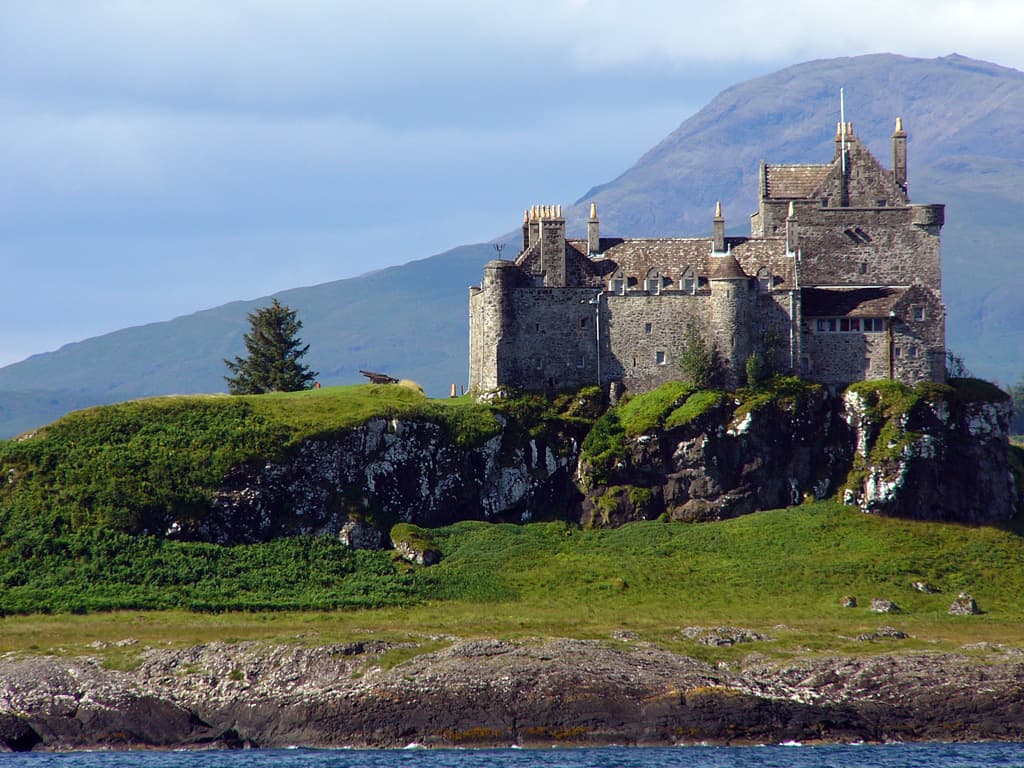
Duart Castle stands as a commanding hill castle on the rocky peninsula at the eastern corner of the Isle of Mull, Scotland. Dating back to the 13th century, it is renowned as the ancestral seat and stronghold of Clan MacLean. Its strategic location overlooks key maritime routes including the Sound of Mull, Firth of Lorne, and Loch Linnhe, making it a vital defensive and navigational landmark for centuries.
Early history and strategic significance
The site of Duart Castle likely held fortifications since ancient times, potentially serving as a defensive point during the Viking raids of the 9th century. The earliest stone structures were built in the mid-1200s when the land was controlled by the Clan Mackinnon. These initial fortifications included a curtain wall encircling the rocky outcrop, establishing the castle's defensive perimeter.
By the late 14th century, the castle became firmly associated with Clan MacLean. Around 1367, Lubanach Lachlan MacLean married Mary MacDonald, daughter of the Lord of the Isles, securing the castle and much of Mull as dowry. This union marked the beginning of the MacLeans' long stewardship of Duart.
Architectural evolution through the medieval period
Following the MacLean acquisition, significant expansions were undertaken. Around 1390, the imposing north-east keep was constructed, extending beyond the original curtain wall and enclosing a larger area within the castle walls. This keep served both defensive and residential purposes, symbolizing the clan's growing power.
Further additions in the 16th and 17th centuries shaped Duart into its recognizable form: a roughly square enclosure with ranges of buildings on three sides and a narrow main gate on the fourth. The landward side was heavily fortified with a rock-cut ditch and thick walls, while the other sides benefited from steep natural cliffs, enhancing the castle's impregnability.
Notable architectural features
- The massive at the northwest corner, housing the great hall, was central to the castle's domestic and defensive functions.
- The curtain walls, some of which bear a heavily eroded Sheela-na-Gig carving, reflect the medieval craftsmanship and cultural symbolism of the era.
- A two-storey L-shaped residential building added in the mid-17th century incorporated window openings into the older walls, enhancing habitability.
Turbulent clan history and conflicts
The MacLeans of Duart were deeply involved in the region's turbulent history. Noteworthy events include the death of Hector Odhar MacLean at the Battle of Flodden in 1513, a tragic loss for the clan. The 11th chief, Lachlan Cattanach, is infamous for his brutal treatment of his second wife, Catherine Campbell, highlighting the violent clan rivalries of the period.
In 1647, Duart withstood a siege by government troops allied with Clan Campbell, successfully repelling the attackers. However, by 1653, Cromwellian forces anchored nearby, and the MacLeans had fled. A severe storm shortly after sank three ships, including the HMS Swan, near the castle.
The late 17th century saw the decline of MacLean fortunes. In 1678, Archibald Campbell, 9th Earl of Argyll, invaded MacLean lands, forcing the last MacLean laird of Duart, Sir John Maclean, into exile. By 1691, the castle was surrendered to the Campbells, who partially demolished it and scattered its stones.
Period of ruin and 20th-century restoration
Following its demolition, Duart Castle fell into ruin and was largely abandoned by 1751. The stones were repurposed locally, including in a cottage built by Donald Maclean, 5th Laird of Torloisk. Ownership passed through several hands, including the MacQuarrie family and the Carter-Campbells of Possil, none of whom restored the fortress.
In 1911, Sir Fitzroy Donald Maclean, the 26th Chief of Clan MacLean, reacquired the castle. He commissioned architect John James Burnet to oversee a comprehensive restoration, reviving Duart Castle as a symbol of clan heritage and Scottish history. The restoration culminated in a large clan gathering in 1912, celebrating the castle's rebirth.
Despite ongoing maintenance, the castle suffered significant water damage in the winter of 2013–2014, causing ceiling collapses and necessitating further restoration efforts to preserve its historic fabric.
Cultural significance and visitor experience
Today, Duart Castle remains a potent emblem of Scottish clan heritage and medieval architecture. It serves as the home of the current clan chief and family, while also welcoming visitors to explore its courtyards, wall walks, and exhibition spaces dedicated to the history of Clan MacLean.
The castle's location offers spectacular views of the surrounding sea routes, and its grounds include a café housed in a converted barn, enhancing the visitor experience. Accessibility is convenient via car, bus from Craignure ferry terminal, or boat from Oban, making it a must-visit destination on Mull.
Duart Castle has also featured in films such as "Entrapment" (1999) and "When Eight Bells Toll" (1971), linking its historic presence to popular culture.
Nearby landmarks
Close to the castle stands the Duart Point lighthouse, built in 1900 to honor Scottish novelist William Black, adding to the area's historical landscape.
Frequently asked questions (FAQ)
- How do I get to Duart Castle on the Isle of Mull?
- Duart Castle is accessible by car, local bus services from Craignure ferry terminal, or by boat from Oban. The castle's website provides detailed transport options for visitors.
- What is the historical significance of Duart Castle?
- Duart Castle has been the ancestral seat of Clan MacLean since the 14th century and played a key role in regional conflicts, including resisting sieges and clan battles.
- Can visitors explore the interior and towers of Duart Castle?
- Much of Duart Castle is open to the public, including the courtyard, wall walks, and the great hall. Visitors can enjoy panoramic views from the towers and learn about the castle's history through exhibitions.
- When was Duart Castle restored and by whom?
- The castle was restored starting in 1911 by Sir Fitzroy Donald Maclean, 26th Chief of Clan MacLean, with architect John James Burnet leading the restoration work.
- Are there any notable films featuring Duart Castle?
- Yes, Duart Castle has appeared in films such as Entrapment (1999) starring Sean Connery and When Eight Bells Toll (1971) featuring Anthony Hopkins.
Photo gallery

Information
Sources & official resources
Verify the information above using these authoritative references.
Loading map...
Visitor reviews
No reviews yet. Been here? Write the first review and help other travelers!
Write the first reviewVisited this castle? Share your experience
Your review helps other travelers and adds first-hand knowledge to our encyclopedia.