Motta Sant'Anastasia Castle
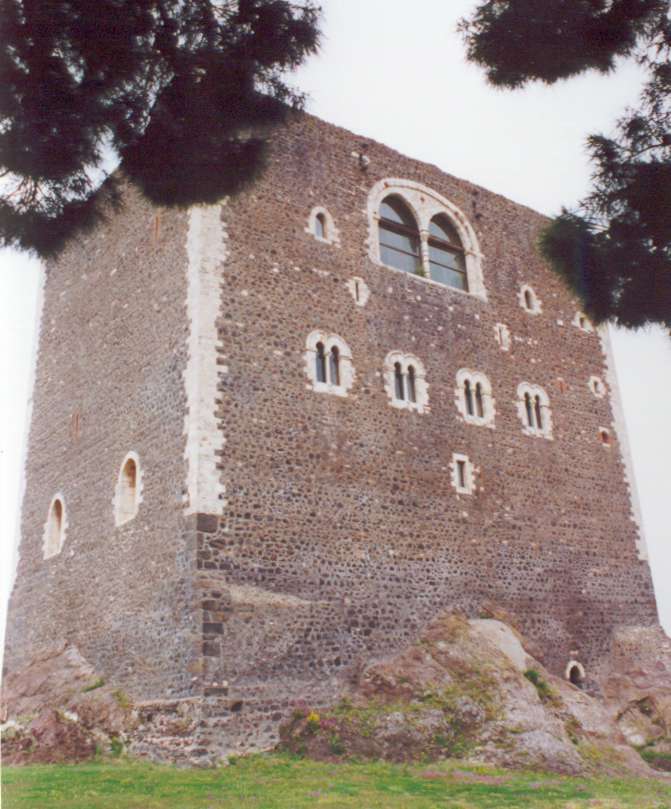
Motta Sant'Anastasia Castle, also known locally as Castello di Motta Sant'Anastasia, is a remarkable medieval fortress located in the town of Motta Sant'Anastasia in the province of Catania on the island of Sicily, Italy. Perched atop a prominent lava rock formation overlooking the fertile plain of Catania, this castle exemplifies the strategic importance of natural topography in medieval fortification design. The site itself bears evidence of ancient habitation, likely by the Siceliots, the Greek settlers of Sicily, underscoring its longstanding significance in regional history.
Origins and early fortifications
The earliest known fortification on the site was probably a watchtower constructed during the 9th century by the Muslim rulers of Sicily. This initial structure served as a military outpost to control the surrounding territory and monitor movements across the Catania plain. The tower's location on the volcanic rock provided a commanding view and natural defensive advantages, characteristics that would shape the castle's development in the centuries to come.
Norman construction and medieval history
In the late 11th century, the Normans, under the leadership of Roger I of Sicily, recognized the strategic value of the site and initiated the construction of the present castle around 1080. The castle was designed as a rectangular keep, a common Norman fortification style characterized by a massive, square or rectangular tower with thick walls and limited openings for defense. This design was intended to serve both as a military stronghold and a symbol of Norman authority in the newly conquered territories.
Shortly after its construction, in 1091, the castle was granted to the Bishop of Catania, reflecting the intertwined nature of secular and ecclesiastical power during the medieval period. The castle changed hands several times due to political shifts: in 1250, it was seized by Frederick II, Holy Roman Emperor, and later, in 1267, it passed to the Capetian House of Anjou. These transfers highlight the castle's importance in the broader context of Sicilian and Mediterranean politics.
Later medieval ownership and events
In 1408, the castle played a notable role in regional conflicts when Sancho Ruiz de Lihori, the Baron of Motta, imprisoned Bernardo Cabrera, the Count of Modica, within its walls. This incident illustrates the castle's continued function as a military and political stronghold during the turbulent late medieval period.
By 1455, the castle returned to royal control and was granted by Alfonso V of Aragon to Ludovico de Perellos. Subsequently, in 1526, it was purchased by Antonio Moncada, Count of Adrano, and remained in the Moncada family's possession as a feudal fiefdom until the abolition of feudalism in the 19th century. The Moncada family's long tenure reflects the castle's sustained role as a noble residence and administrative center.
Architectural features and design
The surviving structure of Motta Sant'Anastasia Castle is dominated by its imposing rectangular keep, which stands approximately 21 meters high. The keep measures about 21.5 meters by 9 meters at its base, with walls designed for both defense and habitation. The castle's architecture is typical of early Norman military construction, emphasizing solidity and functionality.
The keep consists of three main levels. The lowest level retains its original ogival arched windows on the exterior and corresponding interior arches, characteristic of Norman architectural style. The upper floors feature later modifications, including square windows and a front door dating from the 15th century, reflecting adaptations to changing defensive needs and residential use.
The roof terrace remains largely intact and is surrounded by battlements, providing a vantage point for observation and defense. The ground floor was designed to accommodate military personnel and includes strategically placed holes for defense, allowing defenders to repel attackers while remaining protected.
Comparison with nearby castles
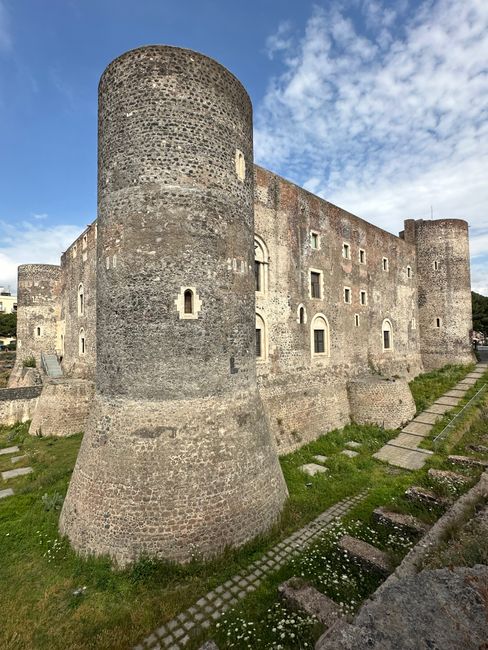
Motta Sant'Anastasia Castle shares architectural similarities with nearby Norman keeps such as Adrano Castle and Paternò Castle. All three feature rectangular plans and robust defensive elements typical of Norman fortifications built during the same period in Sicily. These castles collectively illustrate the Norman approach to military architecture and their efforts to consolidate control over the island.
Current status and visitor information
Today, the castle's well-preserved keep is open to visitors free of charge, often with guided tours available to provide historical context and architectural insights. The castle offers a unique opportunity to explore a Norman fortress in situ, with its commanding position on a volcanic outcrop providing spectacular views of the surrounding landscape. While access to the interior can sometimes be restricted due to maintenance or preservation efforts, the site remains a significant cultural and historical landmark in Sicily.
Visiting tips
Visitors are encouraged to check opening times in advance, as access to the keep may vary seasonally or due to restoration work. The castle's location in Piazza Castello makes it accessible from the town center, and its proximity to other historic sites in the Catania region makes it a worthwhile stop for those interested in medieval architecture and Sicilian history.
Frequently asked questions (FAQ)
- How do I get to Motta Sant'Anastasia Castle?
- Motta Sant'Anastasia Castle is located in Piazza Castello in the town of Motta Sant'Anastasia, Sicily. It is accessible by local roads and is a short walk from the town center.
- What is the historical significance of Motta Sant'Anastasia Castle?
- The castle is a prime example of Norman military architecture in Sicily, built in the 9th century with origins as a Muslim watchtower. It played a key role in regional power struggles involving the Normans, Holy Roman Emperors, and local nobility.
- Can I visit the interior of the castle?
- Yes, the castle's keep is open to visitors free of charge, often with guided tours available. However, access may be restricted at times due to maintenance or preservation efforts.
- What architectural style is Motta Sant'Anastasia Castle built in?
- The castle is built in the Romanesque style, typical of Norman fortifications, featuring a rectangular keep with ogival arched windows and battlements.
- When was the castle built?
- The original fortification dates back to the 9th century as a Muslim watchtower, with the current Norman keep constructed around 1080.
- Is the castle well preserved?
- Yes, the keep of Motta Sant'Anastasia Castle is well preserved and retains many original features, including battlements and defensive openings.
Information
Address
Piazza Castello, Motta Sant'Anastasia, Catania, Sicily, Italy
Loading map...
Visitor reviews
No reviews yet. Been here? Write the first review and help other travelers!
Write the first reviewVisited this castle? Share your experience
Your review helps other travelers and adds first-hand knowledge to our encyclopedia.